page
FSA 2026/27 Annual Plan and Budget
FSA BC 26/03/05 - Report by: Ian Gibson
1 Summary
1.1 The Business Committee is asked to:
-
Agree the Food Standards Agency’s (FSA) annual plan and budget allocations for 2026/27.
2 Executive Summary
2.1 This paper summarises the FSA’s annual plan and budget for the financial year 2026/27.
2.2 The FSA remains focused on our mission of ‘food you can trust’, to make sure that food is safe and what it says it is, in accordance with our five-year strategy and vision for the food system. In the coming year, we will also continue to play our part in helping to make food healthier and more sustainable for everyone – ensuring the public can trust food in the longer term.
2.3 The Board reviewed a first draft of the priorities in January 2026. Building on those discussions, this paper provides a summary of the key FSA priorities across England, Wales and Northern Ireland for 2026/27, together with the ongoing activity the FSA needs to carry out, and the budget required to deliver them.
3 Strategic Direction
3.1 The FSA’s mission is ‘food you can trust’. By food you can trust, we mean a food system in which:
-
Food is safe
-
Food is what it says it is
-
Food is healthier and more sustainable
3.2 Plans for 2026/27 build on the activity set out in our published three-year Corporate Plan (that covered the period to March 2026) and aligns to our five-year strategy, ending March 2027. For the purposes of the 2026/27 plan, we have completed a ‘light touch’ update of the activities previously set out in the Corporate Plan to reflect our changing circumstances.
3.3 Our planning approach is necessarily adaptive this year, to reflect the changing role for the FSA which could result from the Sanitary and Phytosanitary (SPS) agreement which is currently being negotiated and from our evolving role in delivering the Government’s priorities.
4 Annual Business Plan for 2026/27
4.1 We will remain focused on our regulator and policy-maker roles and continue to deliver our core statutory functions. These include:
-
Delivery of official controls in meat, wine and dairy
-
Delivery and oversight of statutory controls on feed, shellfish and egg hygiene
-
Food and feed incident response and prevention work, with local authorities and businesses
-
Preventing and responding to food crime
-
Overseeing and monitoring local authority delivery
-
Supporting inward audits by trading partners of these controls
-
Monitoring and managing foodborne disease risks, including those posed from imported food
-
Delivering a market authorisation service in line with delivery plans agreed by the FSA Board
-
Providing policy and risk management advice in line with our policy remit in England, Wales and Northern Ireland
-
Delivering a programme of scientific research to support our statutory objectives
-
Delivering a set of sampling and surveillance programmes
-
Continue delivering the Cell Cultivated Products (CCP) Sandbox programme to February 2027, and continue the Innovation Research Programme (IRP) on precision fermentation until end May 2026, unless further funding can be secured
-
Deliver our wider responsibilities in Northern Ireland with nutritional standards and nutrition food labelling policy and dietary health and surveillance as well as compositional standards and labelling in Wales and Northern Ireland.
4.2 In addition to continuing to deliver our statutory role and ‘core’ objectives described above, this year we will support wider government priorities and undertake the following specific ‘change’ actions:
-
Sanitary and Phytosanitary agreement (SPS): Support the conclusion of negotiations with EU, finalising policy positions and deliver implementation programme across FSA, engagement with Defra / Cabinet Office.
-
Future of Food Regulation: develop a package of reforms to deliver an effective, sustainable and trusted regulatory assurance system that continues to keep food standards high in the future. This will include developing a national approach to regulation for the largest businesses alongside improvements to locally delivered regulation.
-
Cost of official controls delivery: Implement a reformed discount scheme for the meat industry and develop a plan to improve the administration of the current official controls charging regime.
-
FSA Ready and technology transformation: reshape our organisation so we can continue delivering our role effectively and sustainably in a rapidly changing environment. We will deliver a baseline level of technology transformation, harness advanced digital tools, automation, and data-driven insight to deliver simpler, faster, and more secure services for both staff and Food Business Operators.
-
National Food Surveillance Programme: integrating sampling, surveillance and laboratory capacity activity.
-
Developing and publishing an overall enforcement strategy for the FSA to ensure a visible and consistent approach to enforcement.
4.3 We will also continue to play our part in helping to make food healthier and more sustainable for everyone, by providing support and input where we can to wider government initiatives in these areas as well as our nutritional dietary health work in Northern Ireland (as covered in paragraph 4.1 and 4.2).
4.4 Unlike the Future of Food Regulation, we have to date received no additional funding for SPS – HM Treasury have provided a letter of comfort which indicates they will look favourably on a request for additional resource; however the expectation is that we will absorb as much of this additional cost as we can. Our planning has taken this approach but consequently we have needed to take a series of difficult decisions, such as:
4.5 Reducing resourcing levels in other areas, such as our trade and international work, and refocusing people on the SPS activity from other priorities where we can safely do so (e.g. our risk management work on routine market authorisations). This has significantly limited our overall resilience across many parts of the organisation, meaning that issues like sickness absence or unforeseen new work pressures are more likely to impact on our ability to deliver the business plan.
4.6 Not funding new (or continuing) projects unless they are essential to the delivery of our statutory functions, including in areas which are priorities for us and for governments. This means, for example, that the Innovation Research Programme will end in May 2026, unless further funding can be secured. Funding in 2025/26 was provided by DSIT. It also means that we will not be able to undertake any substantial design or preparatory work on the commitments made in the NHS Ten Year Plan for mandatory reporting on healthy food sales, in anticipation of a decision by ministers on whether FSA should be the regulator that enforces these new requirements.
4.7 It is also important to note that our business planning is based on significant assumptions around the scope and timelines of a SPS Agreement, which are subject to negotiation with the EU. If these materially change through the year, we will need to revisit the business plan to create capacity.
4.8 We are preparing a Business Case to HM Treasury to explain the pressure SPS is putting on our delivery with the current Spending Review settlement and will seek additional funding to alleviate this.
4.9 The key deliverables we aim to achieve in 2026/27 for each corporate objective are detailed in Annex A.
5 Budget 2026/27
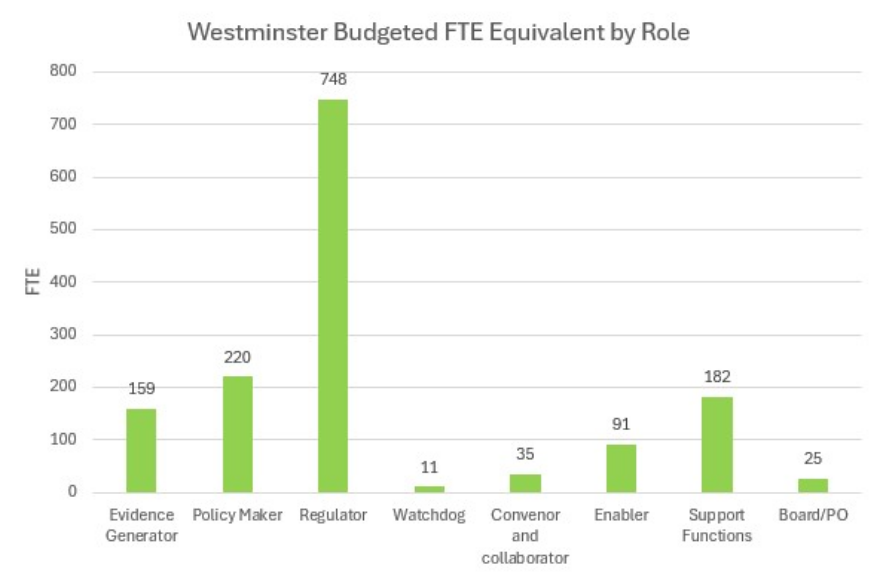
5.1 The proposed Westminster 2026/27 business plans are affordable within our available budget, which comprises £129.7m resource (including R&D) and £2.2m capital (see Annex B). A breakdown of resources by role is provided in Annex C.
5.2 In line with HM Treasury requirements, we plan to hold some contingency to deal with unforeseen in-year pressures. We are entering the year with a lower than desirable level of contingency, consequently our ability to manage financial risks is more constrained than in 2025/26. The most significant area of uncertainty in plans relates to SPS resources, which are based on significant assumptions and could change as negotiations progress. As flagged above, we remain in dialogue with HM Treasury regarding SPS resources.
5.3 The Wales indicative budget for 2026/27 of £5.6m resource was approved by vote in the Senedd on 27 January 2026. This will be formally confirmed shortly by the Welsh Government as the final budget agreed in the Senedd.
5.4 The FSA Northern Ireland 2026/27 draft budgets are £12.4m resource and £0.1m capital, and these are currently out for an 8-week consultation until 3 March.
5.5 FSA Wales and FSA Northern Ireland business plans will be updated to reflect the budget finally agreed.
5.6 In addition to the planning against 2026/27 budgets, work is ongoing to plan against allocations for the remainder of the SR period. In Westminster, we received a ‘flat cash’ settlement for 2026/27 through to 2027/28 and a 0.5% cash cut in 2028/29. This will require us to absorb the significant impact of inflation through efficiency savings and is likely to include headcount reductions in the later years.
6 Conclusions
6.1 The contents of this paper set out the annual plan for 2026/27 to achieve our strategy as detailed in Annex A and budget as detailed in Annex B-C.
6.2 We will monitor the delivery of our plan through existing process and performance measures as detailed in Annex D.
6.3 The Business Committee is asked to:
-
Agree the FSA’s annual plan and budget allocations for 2026/27.
Annex A
Annual Plan for 2026/27
The FSA has a range of statutory duties, we carry these out through undertaking different roles in the food system. The roles, as set out in our published strategy, are, ‘Regulator’, ‘Policy Maker’, ‘Watchdog’, ‘Convenor & Collaborator’ and ‘Evidence Generator’. To fulfil these roles, we also have ‘Enabler’ functions which support and improve delivery across all areas of our business.
Our priorities for the year ahead are laid out under these roles. The activities have been iterated with the Executive and Board members to identify our top priorities and represent the most important things to deliver in 2006/27.
| Corporate Plan Objective | Annual Plan for 2026/27 |
|---|---|
| Regulator | |
|
Deliver our regulatory responsibilities to enable food and feed businesses to comply with the rules so that food is safe and what it says it is. |
|
|
Reform the food safety regulatory framework to deliver proportionate and risk-based assurance. |
|
| Policy Maker | |
|
Make robust recommendations and support decision makers to take informed decisions on rules relating to food and feed. |
|
|
Create a proportionate, effective, efficient and future focused approach to regulation through the risk analysis process and regulated products service. |
|
| Evidence Generator | |
|
Ensure that our decisions are based on science and evidence, and share this evidence to inform and influence others. |
|
|
Build evidence, including through science and research, so we can anticipate opportunities and risks across the UK food system. |
|
| Watchdog | |
|
Speak out publicly about areas of consumer interest to encourage high food standards in the UK. |
|
| Convenor & Collaborator | |
|
Work in partnerships across the food system to address issues affecting consumers and businesses. |
|
| Enabler | |
|
Provide the people, resources and processes needed to deliver our corporate objectives and priorities. |
|
Annex B
2026/27 FSA Westminster Budgets
| 25/26 Budget | 26/27 Budget | |
|---|---|---|
| £m | £m | |
| FSA Westminster | ||
| Income | (52.5) | (61.5) |
| Staff Costs | 91.4 | 99.0 |
| Non-Pay Costs | 91.0 | 92.2 |
| Net Cost of Operations* | 129.9 | 129.7 |
| Capital Expenditure** | 5.8 | 2.2 |
2026/27 FSA Westminster Budgets by Role
| 26/27 Budget £m*** | ||||||||
|---|---|---|---|---|---|---|---|---|
| FSA Westminster | Evidence Generator | Policy Maker | Regulator | Watchdog | Convenor and collaborator | Enabler | Support Functions | Board/PO |
| Income | (0.3) | (1.4) | (59.7) | 0.0 | 0.0 |
0.0 |
(0.2) | 0.0 |
| Staff Costs | 10.9 | 15.9 | 46.1 | 0.8 | 2.7 | 6.7 | 13.4 | 1.4 |
| Non-Pay Costs | 10.0 | 2.2 | 64.3 | 0.0 | 0.1 | 8.4 | 3.8 | 0.2 |
| Net Cost of Operations* | 20.7 | 16.7 | 50.7 | 0.8 | 2.8 | 15.1 | 17.0 | 1.7 |
| Capital Expenditure | 0.0 | 0.2 | 0.3 | 0.0 | 0.0 | 1.4 | 0.0 | 0.0 |
*Net Cost of Operations is Resource (including Research and Development) excluding depreciation and excluding Annually Managed Expenditure (AME).
** 25/26 Capital includes £3.4m relating to IFRS 16 (£0.0m 26/27)
***The table excludes centrally managed (£4.2m Resource and £0.3m Capital) which are budgets outside of an area’s control and include contingency.
Annex C
2026/27 Westminster Resources
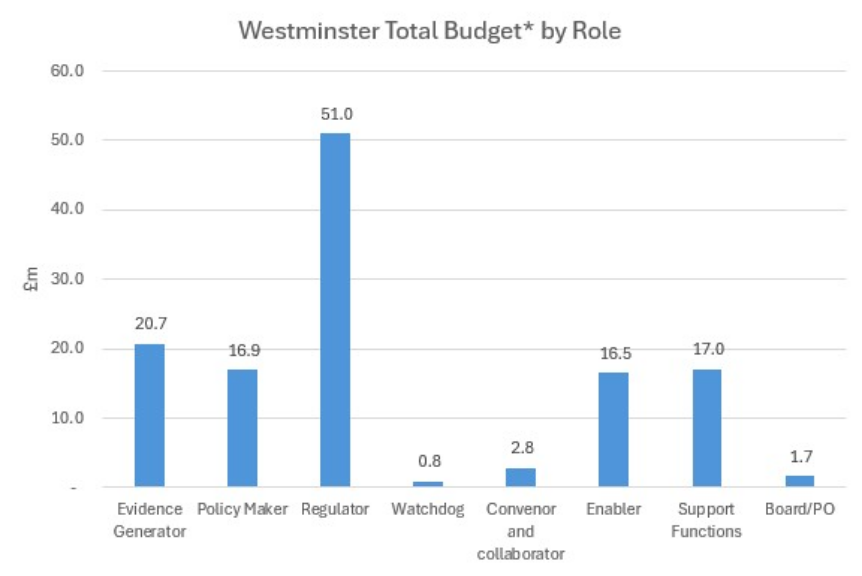
*Total Budget is Resource (exc. Depreciation) and Capital. The graphs exclude centrally managed (£4.5m) which are budgets outside of an area’s control and include contingency.
Annex D
Monitoring the delivery of our Annual Plan and Budget
1. To measure performance against our plans, we use an established performance assurance framework. The framework uses performance indicators to provide strategic oversight of our progress in delivering against our strategy and corporate business plan, helps identify cross-cutting risks and supports prioritisation decisions. This gives assurance to the FSA Board, Business Committee and Executive. The indicators continually evolve as our work and delivery changes but include regular measures from Operational delivery such as meat food business operator compliance, Local Authority and Port Health Authority delivery; the Risk Analysis Process and Market Authorisations of Regulated Products Service; imported foods and international trade; our key science outcomes and consumer trust and confidence in the FSA.
2. This is reported across four different levels of management which includes quarterly to the Executive and Business Committee via separate performance reports. These reporting levels culminate, annually, into the performance section of the Annual Report and Accounts for an aligned golden thread of performance from our strategic vision through to our day-to-day activities. To ensure we remain open and transparent the Business Committee performance report will accompany a written note from the Committee and will be provided to the following FSA Board meeting alongside the published papers.
3. Measures we use to monitor our performance and to provide assurance to the Board, via the Business Committee, that we are on track to meet our objectives include:
-
Reputation and communication – Covering trust and confidence in the FSA reported in our Food & You 2 consumer survey and press coverage and social media engagement.
-
Science – We track key indicators to ensure evidence underpins policy and decision-making. These include the quality and timeliness of risk assessments, scientific capacity and resource allocation, progress on research and evidence programmes, and the publication and external impact of scientific outputs. We also monitor engagement with trusted providers and expert committees to maintain credibility and transparency.
-
FSA sampling and laboratories – Covering expenditure across sampling categories and monitoring the status of sampling projects, including whether they are on track or off track.
-
Market Authorisations – Covering caseload management, service delivery, and resource allocation alongside monitoring user satisfaction through feedback and complaints.
-
Trade and imports / exports controls – To provide assurance for imported food and international trade obligations. This includes monitoring border notifications, import market access audits and equivalence assessments, alongside compliance with World Trade Organisation notifications and Section 42 advice submissions.
-
Direct delivery of Official Controls – including Official Controls staffing; service delivery contract arrangements in England, Wales and Northern Ireland; establishment approvals; Official Veterinarian enforcement and incident recommendations and meat, dairy and wine food business operator audits and inspections.
-
Food incidents - Notifications received (food, feed, and environmental contamination) and alerts issued (allergy, product recalls and food alerts for action). Our monitoring of international signals for potential incidents and our review and communication of root cause analysis of incidents that have materialised.
-
Understanding the food crime threat (NFCU) – Progress against the four key performance questions including alignment with the NFCU Control Strategy priorities and Intelligence and disruptions and national outcomes achieved, alongside the impact of those on the food system.
-
Local Authority performance – including business compliance, such as Food Hygiene Rating Scheme business ratings. Local authority resourcing and performance to ensure official controls are being delivered in England, Wales and Northern Ireland (to provide context to FSA performance).
-
People and resources - To deliver our objectives.
4. In addition to performance reporting, we also have a well-established quarterly finance and delivery review process. We use this to assess the FSA’s overall financial position throughout the year and re-allocate / re-balance budgets as appropriate.
5. The Executive will continue to periodically review how changes in the external environment and uncertainty are impacting our priority activity and may reassess allocation of resources.