page
Future of Food Regulation programme
FSA 26/03/05 - Report by Beth Chaudhary and Rachel Cooper
1. Summary
1.1 This paper sets out for the Board the work undertaken to establish the Future of Food Regulation programme, following the November 2025 budget announcement in which the government asked the FSA to develop a consistent, national approach in England for the regulation of large food businesses.
1.2 The paper outlines the changing context for food regulation and a proposed regulatory approach in response to this. This model has been developed using feedback from partners across the food system.
1.3 We recognise the scale and impact of the proposed reforms and that there are still risks, opportunities and questions to work through. We are committed to continued collaboration with stakeholders as we move into the next phase of design and development.
1.4 The Board is asked to:
-
Agree the high-level scope and focus of the Future of Food Regulation Programme, in particular the point that the programme should not be limited to developing proposals on national level regulation but should also develop proposals to better support delivery of regulation at local level too.
-
Commission officials to begin more detailed design and options appraisal, noting the initial feedback from stakeholders and that this is being used to inform the development of our work.
-
Agree the proposed approach to future engagement and confirm that this meets your expectations for designing and developing options.
-
Agree the outlined next steps, noting that timelines are indicative at this stage given the uncertainty on the opportunities for primary legislation and that, as the process of detailed design and options appraisal continues, adjustments may be required to the scope and sequencing of projects.
2. Introduction
2.1 The food system and the context for food regulation is rapidly evolving. Consumer habits are changing, with more online sales and emerging business models that are primarily technology-based. Businesses are also navigating a complex change environment. They are struggling with increasing costs and, at the same time, advancing the way that they operate, including innovating with data and technology. Over the past 15 years, while the number of businesses has risen, the local authorities that regulate these businesses have seen resourcing levels decrease significantly, as set out in recent Our Food publications.
2.2 It is critically important that the regulatory assurance system – the system of checks and controls to ensure that businesses are following the rules on food hygiene and food standards – can continue to protect consumers and work effectively for businesses in the future.
2.3 In recent years, the FSA has been working with local authorities and businesses to modernise the regulatory assurance system. We have rolled out the new food standards delivery model, which has introduced a more risk-based and proportionate approach to food standards regulation locally, and have now introduced flexibilities in the food hygiene delivery model.
2.4 We have worked with the Chartered Institutes for Environmental Health and Trading Standards to develop the pathways into these vital professions, developed a resource calculator to support local authorities to assess their resourcing needs and we have advocated publicly, including in our annual reports on food standards, for better resourcing for delivery of food controls. These changes have helped to address some challenges in the current system and to enable local authorities to make best use of the resources they have.
2.5 But these changes alone are not enough. We continue to see increasing pressure on local government resources, skills shortages, high volumes of businesses awaiting their first inspections and backlogs of inspections at lower risk-premises.
2.6 Over the past few years, we have gathered views from local authorities and businesses on potential for cost-recovery, explored challenges with the current registration system through our enhanced registration pilot in Wales and trialled a new approach to regulation through our National Level Regulation (NLR) pilots with large supermarkets in England. We have advised the Board that further reforms will be needed to create a sustainable regulatory assurance system which continues to ensure food is safe and authentic in the future.
2.7 We are working closely with colleagues in Food Standards Scotland, as they pursue their separate but parallel programme of reform to the food regulatory system in Scotland (SAFER), to understand synergies and explore areas for collaboration.
2.8 In parallel, the UK Government is committed to ensuring that regulation supports economic growth. The November 2025 budget included a statement that: “The government is asking the Food Standards Agency (FSA) to streamline food standards and hygiene regulation for large and regulation-compliant supermarkets. The FSA will develop a consistent, national approach in England for the regulation of large food businesses. Using centralised data and streamlined processes, this reform will ensure the sector and consumers can benefit from modern, efficient and effective regulation which supports growth, reduces unnecessary burdens, and keeps consumers safe.”
2.9 This request from the Government, and the accompanying funding for the policy development, provides us with an opportunity to build on previous work by the FSA on reform options, and provide proposals to Ministers to evolve the regulatory assurance system for the future.
2.10 We recognise, however, that we will be developing proposals against a backdrop of ongoing change. In addition to their focus on economic growth, the UK Government has committed to introduce mandatory reporting on healthy food sales for large retailers and is currently negotiating a Sanitary and Phytosanitary (SPS) agreement, which the FSA and local authorities will work with businesses to implement. There is also a programme of local government reorganisation underway in England which will see many food and feed teams merged to single unitary authorities.
2.11 This context will create risks and opportunities which we will need to assess and be responsive to as we move forward. It is more important than ever that we work closely with local authorities, other government departments and businesses across the food system as we develop workplans and proposals.
3. Proposed model for the Future of Food Regulation programme
3.1 In December 2023 we first set out for the Board our ideas on the potential building blocks of a future regulatory assurance system, following a stakeholder engagement exercise carried out by the Achieving Business Compliance (ABC) Programme. The information we have gathered since then, both in small meetings and our ongoing engagement events, has further shaped our thinking on what the future regulatory model might look like. The Board has emphasised the importance of hearing the views of stakeholders and testing proposals ahead of any significant system change.
3.2 In May 2025, we held an event which brought together more than 100 senior stakeholders across the food sector. The aim was to build a vision and common language for the regulatory system of the future. Those in the room were unified by the shared goal of keeping food safe. We heard that consumers expect transparency and consistency and that trust in the system can be built on the ability to access and act on reliable data, as well as in-person checks of food businesses.
3.3 We heard calls for technology and data to be used as critical enablers for risk-based regulation, improved communication and stronger information sharing. We were pushed for better digital infrastructure, more practical guidance for businesses and competent authorities, to explore the role of third-party assurance and to provide tailored support for small businesses. There was broad support for mandatory display of Food Hygiene Rating Scheme (FHRS) in England and online, and calls from local authority partners to introduce a ‘permit to trade’.
3.4 Following the request from the UK Government this November we have carried out some further engagement with local authorities, industry and others to inform the proposed Future of Food Regulation Programme. A list of the engagement is at Annex 1. During this engagement, we tested a high-level model of the future system as set out below:
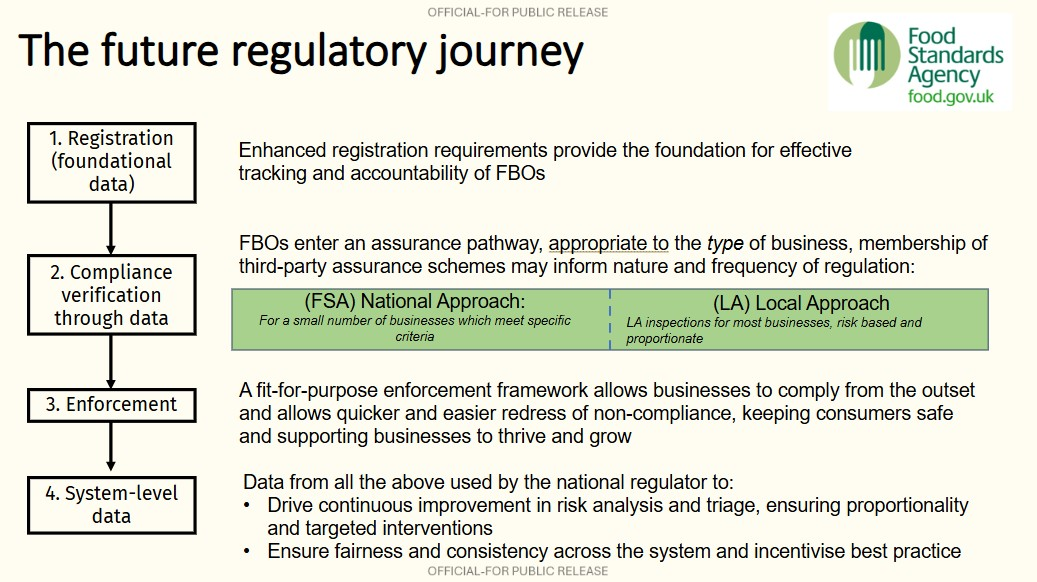
3.6 We have taken the high-level themes that emerged into account in our recommendations. We ask the Board to note that we will no longer refer to large businesses as ‘highly compliant’ or ‘regulation compliant’ to avoid any potential misunderstanding. Businesses’ compliance profile can change, and the future system should be designed with this in mind.
4. Future of Food Regulation programme - recommendations
4.1 We recommend that the Board formally establishes the ‘Future of Food Regulation Programme’ with the vision to deliver ‘an effective, resilient and trusted regulatory system that is fit for the future to ensure that food is safe and what it says it is.’ Based on the work done so far, we believe it is important that that this programme is not limited to fulfilling the important request from the UK Government for proposals for a national approach to regulation but also provides proposals to governments that will better support delivery of regulation at local level too. Within this proposed vision, we are clear that ‘resilient’ must relate to having the necessary financial and human resources to deliver the future model.
4.2 The FSA has received funding to support the policy development for reform of the regulatory model in England. We also want to explore opportunities to improve the regulatory system across Northern Ireland and Wales. We will engage stakeholders from all three nations as we design and develop options, and coordinate with colleagues working on the Food Standards Scotland SAFER programme as far as possible.
4.3 Options will be assessed fully to ensure that they do not have unintended deregulatory consequences, and that the differing legislative landscapes and government priorities are taken into account. We will be explicit where proposals to our Board and to Ministers are common across all nations and which are nation-specific, ensuring that any divergence is justified.
4.4 Our approach to the programme, with the overall goal set out in paragraph 4.1, will be to pursue a series of workstreams on different aspects of the regulatory model. These workstreams will be informed by stakeholder engagement including direct input from working groups and technical advisory committees. We will put together an impartial, evidence-based problem diagnosis for each. We will develop options, and will consider the costs, benefits, impacts and risks of each. We are committed to public consultation on proposals which will change the regulatory framework. We will continue to closely engage the Board at regular points as the programme progresses.
4.5 We recommend that the Board commissions officials to develop six workstreams within the Future of Food Regulation Programme to develop response to the challenges identified at this point. Full descriptions of the workstreams are in Annex 3. In summary, these are:
-
Assessing the current registration model
-
Developing a regulatory framework including roles and accountabilities for businesses which are regulated nationally, locally and online, including assessing the role of primary authority and third-party assurance schemes
-
Developing a modernised enforcement framework
-
Evolving FHRS to assess impacts of reforms and modernise it as required
-
Evolving how we provide guidance to local authorities and businesses
-
Assessing options for sustainability of financial and human resources in the system
4.6 These will be underpinned by enabling workstreams that include:
-
Stakeholder engagement and consultation
-
Research and evidence, including international best practice
-
Data and digital development
-
Legislative strategy and development
4.7 We intend to initially consider how a national system of regulation could function in the retail sector. This will build on the work already completed by the previous Senior Stakeholder Forum on next steps following the National Level Regulation pilot and notes the value the pilots in the retail sector brought. We will then assess how this might apply to large businesses beyond the retail sector by engaging with other sectors and conducting an initial discovery on their operating models.
4.8 A small number of stakeholders have raised whether FSA Operations should be in scope. We have established ways of working and national oversight mechanisms for this part of the regulatory system and these arrangements are regularly audited. We do not intend to review this as part of the Future of Food Regulation work.
5. Future of Food Regulation – next steps
5.1 If the Board endorses the proposals, the programme will be formally established in April 2026.
5.2 The programme’s early priorities will be a high-level analysis of each workstream to assess the ‘as is’ state and determine next steps for design and development including data and digital requirements. This will build on work previously carried out, recognising that we are not starting afresh on most of this work. We will need to progress work on the national approach to regulation at pace to allow us to deliver on the government’s ask, should a legislative vehicle become available.
5.3 In parallel to this high-level analysis, we will complete a legislative mapping exercise to identify which proposals may need primary legislation, which can be achieved through secondary legislation, and which can be achieved through non-legislative means. This legislative mapping exercise will include consideration of the different powers in place across nations, to support dialogue with Ministers in Northern Ireland and Wales.
5.4 Our intention is to engage with stakeholders throughout, using working groups and technical advisory forums to develop initial proposals and concentrated phases of stakeholder engagement with a wider range of stakeholders over the next 12 months to iterate the policy design choices and options appraisals delivered by these working groups. Our stakeholder engagement will mirror key phases in the programme, so we can get feedback/insight from stakeholders as decisions are made and if a legislative opportunity becomes available.
5.5 In summary, as next steps we will:
-
Develop detailed work plan, if the programme is approved, by June 2026
-
Complete the legislative mapping exercise and provide an update to the Board on the legislative strategy for the programme by June 26, noting that decisions on legislation are the responsibility of Ministers
-
Return to the subsequent Board meetings with reform proposals under these workstreams in line with timings to be set out in the detailed workplan, informed by appropriate research, evidence-gathering and stakeholder engagement.
6. Stakeholder engagement
6.1 Stakeholder engagement and meaningful consultation will be vital for the success of the programme. We will develop a stakeholder engagement and communications plan to ensure that stakeholder skills, knowledge and experience suitably inform design and development proposals. We will engage stakeholders in England, Northern Ireland and Wales throughout, and liaise with colleagues in Scotland on an ongoing basis.
6.2 We propose setting up a small, senior advisory group from across the food system who can act as strategic advisors to the FSA throughout the design, development and implementation of the reforms. While decision-making will be retained by the FSA Executive and Board, this group will provide strategic steers at key decision-making junctures and will ensure that policy development has had adequate input from necessary stakeholders.
6.3 We recommend that the Board continues its ongoing engagement through frontline visits and considers holding a round-table discussion with senior stakeholders to hear their views directly. We are keen to engage with stakeholders early and often, to ensure that we have a ‘no surprises’ position ahead of the formal consultation that we will be required to undertake.
6.4 We will continue to work alongside other government departments such as the Ministry of Housing, Communities and Local Government (MHCLG), the Department for Business and Trade (DBT), the Department for Environment, Food and Rural Affairs (Defra), the Department for Health and Social Care (DHSC) in England, the Welsh Government and the Department of Health in Northern Ireland to ensure that we are considering the changing context as we work through the programme.
6.5 Delivery of the full programme ambition will require primary, secondary and non-legislative changes in England. There is therefore a key dependency on securing the opportunity to make new legislation. We intend to work at pace so that we are ready for the earliest feasible opportunity to bring forward reforms dependent on primary legislation, while continuing to progress broader work that can be delivered without primary legislation.
7. Conclusions
7.1 The Board has accepted the ask from UK government and the FSA is taking forward development of a national approach to regulation. We have heard stakeholder concerns, and we are committed to ensuring that we respond to this feedback through our programme design. We will ensure that stakeholders’ expertise and experience is reflected in the options appraisal.
7.2 We also want to take this opportunity to pursue reforms that have been long called-for in the local authority led delivery model. This will include exploring the feasibility and appetite for issues such as sustainable funding of food services, including a permit to trade and pursuing statutory FHRS.
7.3 The programme is operating in a context of unprecedented change, and the programme timeline will depend heavily on the timing of opportunities to progress primary legislation. We must be ready for the earliest feasible opportunity while continuing to progress broader work that does not depend on primary legislation. We will therefore keep timelines and delivery plans under scrutiny while discussions on primary options continue. Regular updates will be provided to the Board.
7.4 We will continue to monitor developments with the proposed UK-EU SPS Agreement. We will ensure these are fully considered as we develop our proposals and will keep the potential implications for the Future of Food Regulation Programme under regular review.
8. Decision
8.1 The Board is asked to:
-
Agree the high-level scope and component parts of the Future of Food Regulation Programme, in particular the point that the programme should not be limited to developing proposals on national level regulation but should also develop proposals to better support delivery of regulation at local level too.
-
Commission officials to begin more detailed design and options appraisal, noting the initial feedback from stakeholders and that this is being used to inform the development of our work.
-
Agree the proposed approach to future engagement and confirm that this meets your expectations for designing and developing options.
-
Agree the outlined next steps, noting that timelines are indicative at this stage, given the uncertainty on the opportunity for primary legislation and that, as the process of detailed design and options appraisal continues, adjustments may be required to the scope and sequencing of projects.
Annex 1 Summary of Stakeholder events
In January and February 2026, we delivered a mixed engagement programme. This comprised 11 focussed stakeholder engagement events with 402 attendees, 17 Food Liaison Group touchpoints with 150 Local Authority (LA) Lead Officers and 9 strategic Executive/Board level engagement with a cumulative audience of around 630. In addition, we made a recording of the session available on FSA LINK, our platform for sharing information with local authorities, as a courtesy to LA officers who could not attend our sessions directly. This reached approximately 3000 more stakeholders.
|
Name of Engagement |
Date of Engagement |
FSA Lead Name, Title |
|---|---|---|
|
Food Standards Chair, Minister for Mental Health and Wellbeing Sarah Murphy MS |
4 February |
Susan Jebb, FSA Chair |
|
CIEH reception marking 150 years since Disraeli's Public Health Act |
11 February |
Beth Chaudhary, Rachel Cooper, Co-Directors of Strategy & Regulatory Compliance |
|
Senior Engagement & Update Session Introducing Future of Food Regulation |
12 February |
Karen McCloskey, Head of Regulatory Reform |
|
HSE Keeping in Touch / Future of Food Regulation Intro |
10 February |
Nathan Barnhouse, Head of Regulatory Compliance |
|
10 Large Retailers Update |
9 February |
Andrew Ashworth, Head of Business Compliance |
|
UK Hospitality Food Expert Group Meeting |
29 January |
Karen McCloskey, Head of Regulatory Reform |
|
FSA LINK Update on Future of Food Regulation Published to All Local Authorities and District Council Users in 3 Nations |
17 February |
Karen McCloskey, Head of Regulatory Reform |
|
Local Authority Food Liaison Groups |
January and February |
Local Authority Relationship Managers, FSA |
|
Future of Food Regulation Wales Engagement |
3 and 17 February |
Karen McCloskey, Head of Regulatory Reform |
|
CIEH/ CTSI Year Ahead Conference |
5 February |
Katie Pettifer, FSA Chief Executive |
|
ACTSO Business Meeting |
21 January |
Karen McCloskey, Head of Regulatory Reform |
|
Local Authority Reference Panel Update |
18 February |
Karen McCloskey, Head of Regulatory Reform |
|
National Food Hygiene Focus Group, National Food Standards Information Focus Group Extraordinary Meeting |
4 February |
Karen McCloskey, Head of Regulatory Reform |
|
National Agricultural Panel Meeting |
12 February |
Rebecca Jones, Reform Workstream Lead |
|
Food Standards Scotland SAFER Programme Team |
12 February |
Beth Chaudhary, Rachel Cooper, Co-Directors of Strategy & Regulatory Compliance |
|
Primary Authorities of 10 Large Retailers Update |
10 February |
Andrew Ashworth, Head of Business Compliance |
|
OPSS, HSE and Food Standards Agency Regulatory Hub |
22 January |
Karen McCloskey, Head of Regulatory Reform |
|
Consumer Stakeholder Forum |
5 February |
Susan Jebb, FSA Chair |
|
Northern Ireland Food Manager's Group |
19 February |
Karen McCloskey, Head of Regulatory Reform |
|
Environmental Health NI |
21 January |
Karen McCloskey, Head of Regulatory Reform
|
|
Third-Party Assurance Providers Update |
19 February |
Karen McCloskey, Head of Regulatory Reform and Rebecca Jones, Reform Workstream Lead |
|
Primary Authority Food and Workplace Safety Panel. One-off meeting with FSA |
11 February |
Andrew Ashworth, Head of Business Compliance |
Annex 2: Summary of Stakeholder feedback in January/February 2026
1. In general, stakeholders welcomed modernisation and reform. There was broad agreement that looking at the system holistically was useful, and we heard that stakeholders were pleased to see long-standing issues being considered as part of the programme.
2. Large retailers were keen to see us building on the Enterprise Level pilots that we have previously run. Some businesses and third-party assurance providers welcomed a move to a national approach to regulation for large businesses but were keen to point out that different sectors operate in different ways, and that a ‘one size fits all’ approach would not be viable. Businesses encouraged us to look at international models which they consider effective, with the Dutch model cited in various engagement sessions as an example of what works well.
3. Third-party assurance schemes had heard concerns from local authorities that they would be asked to take over competent authority roles and functions. While this is not what we presented or envisage, most of the third-party assurance providers we spoke to were keen to dispel this notion, indicating that the schemes and their members would not welcome this idea. However, they were keen to consider what role third-party assurance could play in the system of the future with various offers to link in with their international models for research purposes.
4. Local authorities were focussed on the areas which they see as having greatest value in terms of supporting consumer food safety outcomes. They wanted to see additional resources to provide opportunities to support businesses to thrive and grow, an increased focus on financial sustainability of the service, and improved enforcement powers to address negligent or malicious actors swiftly and proportionately. They called on the FSA Board to do more to progress our long-standing ambition to introduce mandatory FHRS in England and online. They also repeated requests for the FSA to propose to Ministers a ‘permit to trade’ or licensing approach for businesses and called for the FSA to do more to lobby for resources for LAs.
5. Local authority environmental health teams had a broadly negative view of a national approach to regulation. They perceived a lack of evidence for this approach and were concerned about broader implications across regulatory services such as health and safety visits not being completed if the FSA becomes the national regulator or more acute resourcing challenges if the Primary Authority income model is disrupted.
6. Local authorities cited perceived failure of previous change programmes and communications around the NLR pilot as having led to a perception that we had already concluded how an approach to national regulation might work without doing a proper options appraisal and impact assessment. There was a perception that based on the NLR proof-of-concept that the FSA intended to move to a model of regulating large businesses solely by checking their own data at a corporate level, without any physical inspections by a regulator. As a result, they had inferred a deregulatory intent.
7. There was strong resistance to a remote, data-led model, with local authority officers citing lists of successful prosecutions against large supermarkets which resulted from businesses failing to implement their corporate systems locally. They were keen to understand how local issues might be resolved which are at risk of being ‘swallowed up’ in a national approach and to understand how complaints would be handled. When we shared that the Board have been clear that there will need to be in-person checks, they wanted to understand who would do these and with what frequency. They expressed concerns that this could be completely outsourced to third-party assurance providers with no accountability mechanism.
8. Local authorities also questioned on what basis we were assuming that the FSA would become the competent authority for large businesses. They were concerned that this could compromise the impartiality which is at the heart of why the FSA was established if the FSA had a direct relationship with these businesses and were concerned that the FSA would be reluctant to take appropriate enforcement action against large businesses who fail to meet required standards. They posed the question ‘who will regulate the FSA?’ and raised concerns that a move to this model might exacerbate workforce challenges which are already acute in some local authorities. They could not see, in what we presented, a commitment by the FSA to continue to address workforce challenges in local authorities.
9. Local authorities also raised the challenges that we have collectively experienced working with Management Information System (MIS) providers to roll out the Food Standards Delivery Model (FSDM) and requested that we consider this and learn lessons from it as we aim to introduce additional reforms and data requirements or digital infrastructure.
10. There were immediate questions from local authorities, businesses and primary authorities about the role of Primary Authority Partnerships (PAPs) in the new model. Businesses and primary authorities see value in these and, since primary authorities can recover the costs of these services, they provide resilience across regulatory services. However, we also heard some concerns about the primary authority model which cited conflicts of interest caused by businesses paying for assured advice and a tension that can occur between enforcing authorities and primary authorities when they disagree on a position.
11. Throughout our engagement with local authorities, we repeatedly pointed to being in the early stages of this work and that we need to build on the lessons from the proof-of-concept to move to design and appraisal of policy options. While some local authority officers seemed more reassured by this, and began proposing suggestions for how it could work, others remained sceptical. Heads of Service could see opportunities in what we outlined and asked us to genuinely engage and listen to the concerns of their frontline officers.
12. There was concern from a range of stakeholders over what data standards we would adhere to and they stressed the importance of trust in data. There were questions around ownership and integrity of and access to data which will need to be considered and fully explored in the next stages, building on work to date.
13. There remains a strong pride in FHRS across businesses and local authorities, with colleagues in Northern Ireland and Wales proud of its statutory status. Local authorities and businesses in England were keen to see mandatory display in England and online, although some indicated that they would like to see it updated. There was some concern that the Board would like to see large businesses removed from FHRS completely. When we communicated that the Board’s steer is currently that they have no appetite to remove businesses from the scope of FHRS but that you are open to evolving FHRS, this provided reassurance and stakeholders were keen to understand what evolution might look like.
14. In discussion with other regulators, we identified that some current functions in local delivery occur by happenstance alongside food safety checks e.g. health and safety. If roles shift without considered design, these incidental benefits could disappear and business burdens may rise, or consumer safety risks might grow.
15. Multiple stakeholders raised concerns about the scope of the work that had grown significantly from the original ask from government which focussed on supermarkets. They questioned how we could scope a model of national regulation for manufacturing and out of home sectors when we had not fully proved that the model could work in retail and did not have a shared understanding and definition of what ‘out of home’ could encapsulate. They also questioned the description of large businesses as ‘highly compliant’ and ‘regulation compliant’.
16. Cost and funding of the future model was also a key consideration. Local authorities favoured a permit to trade or licencing approach that the food business operator pays for. Businesses across sectors were clear that they would need to understand the cost associated with any new model and what the added value was for them. They were unanimous that they would oppose paying a fee for the current system and urged us to be mindful of the context where their operating costs have already increased substantially in the past few years.
17. Stakeholders raised concerns about the timeline required if new legislation is required in this parliament. While many expressed a willingness to collaborate with us, there was concern that competing demands and pressures might limit their ability to participate. From businesses, local authorities and professional bodies, we heard that they are experiencing unprecedented change. Local authorities specifically identified concern over their capacity for change at a time of local government reorganisation in England, while businesses indicated a preference for coordinated ‘change moments’ rather than frequent updates.
Annex 3: Descriptions of proposed workstreams
Assessing the current registration model
This will build on the findings of the enhanced registration pilot in Wales which are still being finalised.
It will assess current challenges with registration across each country and consider solutions to these problems.
It will be interdependent with the workstream on ensuring that the future model is sustainable in terms of human and financial resources and will explore options for sustainable funding linked to the point of registration such as licensing, fees for registration and permit to trade.
Developing a regulatory framework including roles and accountabilities for businesses which are regulated nationally, locally and online including assessing the role of primary authority and third-party assurance schemes
This work will consist of three separate but interdependent workstreams.
National regulation: Will design and assess options for how a system of national regulation might work including defining large businesses, eligibility criteria, what is regulated, by who and how and what enforcement powers are necessary. It will consider data ownership, integrity, trust and validation and will define roles and accountabilities for the future model. It will consider the role that primary authority and third-party assurance schemes have in the new model.
Local regulation: Will consider the implications of any changes to accommodate a model of national regulation will have on the existing local delivery model and seek to design coherence to avoid unintended consequences. It will assess issues in the current system and will design and assess options for solutions to these challenges.
Online regulation: Will consider issues posed by current gaps in regulation for online marketplaces. It will tie into broader cross government and cross-regulator work on online regulation. It will define how online businesses need to register, the regulatory framework that they would be held accountable to and the enforcement framework that would be applied.
We need to be clear that the FSA can develop detailed analysis of the current issues and gaps in the system for food and can contribute proposals for how this might work for food and feed businesses. However, this is part of a wider cross-government and cross-regulator scope and so will have interdependence with ongoing work and timelines led by other government departments.
Developing a modernised enforcement framework
This workstream will define the ‘as is’ state of the enforcement framework and consider the ‘to be’ state of the enforcement framework as options for how national, local, and online regulation evolve.
Evolving FHRS
This work will assess the impacts of reform proposals on the current FHRS system while they are being designed and developed and seek to evolve it, as necessary. Further work will be required to test the Board’s appetite for evolution, but the Board has already signaled that they do not want to remove businesses from the scope of FHRS.
We want to ensure that FHRS continues to bolster consumer confidence in the food system. We would like to deliver on the Board’s ambition to deliver statutory FHRS in England and online.
Evolving how we provide guidance to local authorities and businesses
This work will determine how we can identify gaps in guidance provided to local authorities and businesses. It will revise processes and procedures for businesses and local authorities requesting guidance. It will determine how FSA guidance for businesses and local authorities can be made more accessible. It will consider options for proactively promoting existing guidance. It will consider what role the FSA will play as a national/ supporting regulator (if any) within the primary authority policy area. It will also revise processes for archiving and removing guidance and effectively communicating this to stakeholders
Assessing options for sustainability of financial and human resources in the system
This work will complete the final stages of the local authority resourcing project which are within the FSA’s remit including roll out of the local authority Resource Tool for standards and combined services and will oversee completion of the research to further understand a reported ‘cliff edge’ in local authority resourcing. The outcomes of this research will inform FSA conversations across government to identify next steps to mitigate the risks that arise from a declining workforce.
This work will also consider options for sustainable funding of the national and local regulatory models, taking into account rising costs being experienced by businesses and proposals put forward by stakeholders during previous engagement on sustainable funding. This will include the options presented to the FSA Board in March 2025.
As options for the new delivery model develop, this workstream will assess the skills, capacity and capability required to deliver them.