page
The Risky Foods Framework – Options for the future
FSA 26/06/06 - Report by James Cooper and Natasha Smith
1. Summary
1.1 This paper:
- Recaps the Risky Foods Framework, as agreed by the Board in 2016
- Explores how the framework has been used in practice for Raw Drinking Milk and less than thoroughly cooked burgers
- Invites the Board’s views on whether the framework remains a useful policy and decision‑making tool.
2. Introduction
2.1 The Risky Foods Framework (Annex A) was developed to help the FSA to make soundly based, consistent and transparent decisions in identifying risky foods and in developing proportionate controls for them.
2.2 Most foods fall into one of two categories, either they are safe providing they comply with relevant general regulation and good practice (many foods, such as bread or canned goods), or they present risks which are so high they are always unacceptable (such as specified risk materials under Transmissible Spongiform Encephalopathies (TSE) controls).
2.3 Risky foods fall in a middle ground. They are those for which the risks exceed the nature or levels considered broadly acceptable by the FSA, but which some people may accept for other benefits, such as choice or perceived health benefit. These risks are unacceptable unless specific additional controls are designed and consistently applied. The framework supports decision-making in areas where scientific, behavioural and economic factors interact to aid identification of such foods, and to monitor the controls applied to them to ensure they remain fit for purpose.
2.4 The framework has been applied to a limited number of issues, specifically ‘less than thoroughly cooked burgers’ and ‘Raw Drinking Milk’, where it supported a risk management approach to mitigate risks as far as possible and risk communication to allow for consumer choice rather than prohibition.
2.5 Alongside identifying controls, the framework also attempts to identify triggers which could prompt a review of foods that have already gone through the process. This might include changes in the nature of the hazard, potential exposure, effectiveness of controls in practice or acceptability of controls that lead to increased risks. Potential risky foods would be assessed using the framework and revert to the Board for decision on material changes to current risk management and/or risk communication approaches.
2.6 In reality, no additional products have been screened as potential candidates for the framework beyond the two listed above. There are some issues that might have benefited from this screening, for example cold smoked fish following the Listeria outbreak that impacted certain vulnerable groups and some products of animal origin where there is a growing trend for them to be eaten raw (e.g. prawns), but these were managed through other means.
2.7 Since its development, the political, policy, scientific and consumer context has changed, including risk communication, proportional regulation and an evolution in the FSA role in providing guidance to businesses. It is therefore sensible to review if the framework should be retained.
3. The Risky Foods Framework – what it is and what it was designed to do
3.1 The full risky foods framework is attached at Annex A and is summarised in the section below.
Purpose of the framework
3.2 The Risky Foods Framework was agreed by the Board in 2016 to support the development of proportionate controls for risky foods. It was created to address situations where:
- The risk is intrinsic to the food or consumption practice.
- Even when produced and handled legally and hygienically, a residual risk remains.
- There is a tension between consumer protection and consumer choice.
3.3 These situations lead to the potential need for trade-offs, and the risky foods framework is designed to aid decision making where:
- The nature and level of risk exceed the nature and/or levels considered broadly acceptable by the FSA, but which some people may accept for other benefits, such as choice.
- These risks are unacceptable unless specific additional controls are designed and consistently applied.
Key features of the framework
3.4 Risky foods are those where there is an opportunity, through the use of specific additional controls carefully designed and consistently applied, to mitigate and/or communicate the risk that food presents. It brings together:
- Scientific evidence on hazard and exposure
- Consumer behaviour and vulnerability
- Practical enforceability and regulatory impact (the ability of food businesses to demonstrate compliance with obligations to supply food that is safe)
- Wider government policies, legislation and other mechanisms available to support risk management
3.5 It supports decisions on whether controls should include the following and whether these should be delivered through legislative change:
- Prohibition
- Restriction to specific settings
- Tightly controlled production and sale
- Enhanced consumer information and warnings
3.6 The Board recognised at the time that full application of the framework is resource‑intensive and should therefore be reserved for higher impact issues.
4. Using the framework in practice
Case study 1 - Less Than Thoroughly Cooked Burgers
Why less than thoroughly cooked burgers were suitable for the framework
4.1 Less than thoroughly cooked burgers (LTTCB) were identified as an appropriate candidate for application of the Risky Foods Framework because:
- They present a well‑evidenced microbiological risk, particularly from pathogens such as Shiga toxin producing E. coli arising from the meat.
- The risk is intrinsic to the product and cooking practice, given that bacteria on the meat surface can be distributed throughout mince used to produce the burger during mincing.
- The risk cannot be fully mitigated through standard hygiene controls alone, with thorough cooking remaining the primary control.
- There was evidence of an increase in consumer demand and change in business practice, particularly in catering settings, to offer burgers served rare or medium.
- The issue creates a tension between consumer protection and consumer choice, particularly where consumers may not fully understand the risk.
Board consideration and outcomes
4.2 The application of the Risky Foods Framework supported a structured assessment of risk, consumer behaviour, regulatory and enforcement options. Consistent with the framework approach, the Board supported a position that LTTCB are a high‑risk food, however the risk was not so unacceptable as to require outright prohibition provided robust controls are in place. The agreed approach focused on risk mitigation through tightly controlled production and informed consumer choice, rather than banning the practice.
4.3 Controls developed through the framework approach covered both the production of meat and minced meat by the supplier and the food businesses producing burgers. These included:
- The use of validated production processes to achieve specified pathogen reduction (e.g. searing or other validated safety steps).
- Strict sourcing and traceability requirements for meat used in burgers.
- Clear consumer-facing information and warnings, particularly in out‑of‑home settings.
- Operational controls in food businesses, including documented food safety management systems demonstrating how risks are controlled.
- Targeted enforcement and assurance activity by regulators (FSA guidance for Local Authorities).
4.4 This approach aligns with the framework’s emphasis on tightly controlled production and sale, enhanced consumer and enforcement officer information, and warnings rather than prohibition.
Learning from the less than thoroughly cooked burgers case
4.5 Application of the framework to burgers resulted in the structured, evidence‑based approach supporting transparent decision-making with a clear rationale for permitting continued availability under defined controls. It also confirmed that correct application of the framework is resource-intensive and requires engagement with/contributions from multiple internal and external players.
4.6 Residual risk remains even when controls are applied, requiring a combination of mitigation measures and clear consumer information as well as advice to enforcement officers. The approach taken enables adult consumers to make informed choices, while ensuring that risks, particularly to vulnerable groups, are explicitly communicated. Other learning includes that effective implementation depends on the ability of food businesses to demonstrate and maintain validated controls, and for regulators to verify compliance in practice based on sufficient knowledge to make sound decisions. The work also demonstrated the importance of working closely with local authorities (LAs) in an area where consumer protection required a joined-up enforcement approach between the FSA and LAs.
Case study 2 - Raw Drinking Milk
Why Raw Drinking Milk was suitable for the framework
4.7 Raw Drinking Milk (RDM) was identified as an appropriate candidate for application of the Risky Foods Framework because:
- It carries a well‑evidenced microbiological risk, including pathogens that can cause severe illness.
- The risk cannot be fully eliminated through hygiene controls alone (although even with additional other controls there remains residual risk).
- A proportion of consumers actively seek out the product for perceived benefits, raising issues of informed choice.
- There was a perceived increase in consumption of RDM and potential mechanisms through which RDM was being supplied e.g. vending machines and internet sales were not envisaged when the existing controls were last reviewed.
Board consideration and outcomes
4.8 In 2018, the Board considered RDM using the Risky Foods Framework and agreed that RDM is a high‑risk food, but that the level of risk was not so unacceptable as to justify banning sales outright. It therefore agreed that continued sale could be justified provided strict controls determined through the second stage of the framework were applied, some of which involved reaffirming or strengthening existing controls. These controls include:
- Direct‑to‑consumer sales only
- Registration and inspection of producers
- Strengthened mandatory health warnings to specifically refer to vulnerable consumers
- Strengthened Food Business Operator (FBO) and enforcement verification of controls (including a suite of pathogen testing in addition to the established testing for hygiene indicator organisms).
4.9 The approach balanced the protection of vulnerable consumers, who are explicitly advised not to consume RDM, alongside respect for adult consumer choice, where risk is clearly communicated and controls are in place.
Learning from the RDM case
4.10 Application of the framework provided a transparent rationale for allowing continued sale under enhanced controls. It gave the Board confidence that the appropriate policy analysis had been completed and their decision was evidence‑based and proportionate. It was again confirmed that correct application of the framework is resource-intensive and requires engagement with/contributions from multiple internal and external players.
4.11 The regulatory frameworks permitting sale of RDM in England, Wales and Northern Ireland are largely aligned, whereas its sale is banned in Scotland. There are some operational differences in enforcement powers across the three nations, particularly regarding the use of Remedial Action Notices (RANs) in Wales and NI. In contrast, to stop sales in England the Dairy Hygiene Inspectors need evidence of an imminent risk to health to be successful in applying to a court to issue a Hygiene Emergency Prohibition Notice. It can be very difficult to obtain evidence to satisfy this test (such as detection of pathogens in the RDM).
4.12 In the early 1980s Scotland experienced a large number of incidents and outbreaks (defined as being two or more linked cases of illness) related to RDM, including eight deaths between 1980 and 1982. In response to these public health concerns, the Secretary of State for Scotland introduced a ban on the sale of unpasteurised cows’ drinking milk in 1983 (under the Milk based Drinks (Scotland) Regulations 1983). The prohibition was later extended in 2006 to cover RDM from all farmed animal species. All of this evidence was considered as part of the risky foods framework assessment
5. Ongoing applicability of the framework
5.1 There is nothing fundamental in the scientific underpinning of the framework that means it is out of date. There is potentially a question as to whether given changing political, policy, scientific, and consumer context, including risk communication, proportional regulation and a shift in the FSA role in providing guidance to businesses, is it still a necessary or optimal approach. The primary indicator being its lack of recent use.
5.2 The framework could continue to be valuable in structuring advice to the Board on novel or emerging foods where risk and consumer choice are in tension. Recent examples where it could have been used are cold smoked fish and raw prawns. It could help in supporting consistent evidence-based decisions across different food types and hazards as well as improving transparency where FSA decisions involve accepting residual risk, supported by risk mitigation and communication, rather than eliminating it entirely. It may also be useful to support decision-making where risks are concentrated in particular products or settings, there is strong or increasing consumer demand despite known risks, or traditional regulatory tools (e.g. hygiene enforcement alone) are insufficient.
5.3 Since the framework was agreed, the risk and policy landscape has evolved, including increased understanding of inequality impacts and more mature FSA policy processes. There is greater emphasis on risk communication and behavioural insight. Regulatory practice has continued to shift towards proportionate, outcomes‑focused approaches.
5.4 A full review and update of the framework could usefully consider:
- Whether the framework remains appropriately calibrated for today’s context and FSA future plans for considering risks and intelligence.
- Whether it should be updated to reflect learning from RDM and other policy decisions (including reviewing where it could have been used and was not).
- Whether it should be simplified or supported by clearer screening criteria to reduce resource burden.
5.5 However, such a review would be resource-intensive. Since the framework was introduced, the FSA has evolved its approach to horizon scanning and intelligence gathering. A key question is whether we consider there will continue to be specific situations likely to emerge that cannot be managed within existing processes and would therefore justify the need for an updated version of the framework. The framework has only been used fully twice, and we could only identify a couple of other examples where it might have otherwise been used but ultimately risks were successfully considered and managed in other ways.
5.6 We have a well-established Risk Analysis Process and as part of the FSA Ready programme we are continuing to review the overall approach to risk and intelligence. Other processes and procedures, either current or envisaged, may replace the need for the framework approach for identifying risks and managing them.
6. Next steps and Board steer
6.1 The risky food framework was designed for the purpose of identifying and managing the risks from foods that fall between clearly acceptable and unacceptable risks. The two case studies set out how the framework has been used and has delivered in practice.
- Does the Board continue to support the conclusions drawn from the framework on these issues and therefore feel the framework has delivered this purpose?
6.2 Given the Board’s conclusion on the above and the discussion on the ongoing applicability of the framework in section 5, should we:
-
Retain the framework as is, as a potentially useful tool alongside other risk management processes (recommended),
-
Consider a more detailed evaluation and potential update to the framework with a view to broadening use, or
-
Retire the framework itself and incorporate the philosophy and processes from the framework into wider risk identification and management?
Annex A – Current risky foods framework
Developing Proportionate Controls for Risky Foods
Introduction - Why We Need a Framework
1. This framework has been developed by the FSA, working with our expert advisers, to support us in developing proportionate controls for risky foods. It complements our existing approaches to managing food risks, most of which do not relate to risky foods.
2. We identified a need for a framework during consideration of our approach to controls for raw drinking milk and burgers served rare. (footnote 1) Both of these can be regarded as ‘risky’ foods, in that they present a higher risk of ill effects to consumers than the more common presentations of these foods (pasteurised milk, burgers cooked through). They are also foods which some consumers wish to eat, and some businesses wish to sell, in their more ‘risky’ form. Our approach to these foods needs to find the right balance between protection from risk - focusing where we can make the greatest impact on public health - and supporting consumer choice; and business growth and innovation, reflecting and supporting our ambition for a future of regulation that is effective, proportionate, robust, and sustainable.
3. We recognised that in most cases we controlled foods on the basis that they were either safe, provided they comply with relevant general regulations and good practice (for example, bread, dried pasta, canned goods), or as presenting risks which were so high that they were always unacceptable (for example, specified risk materials (SRM) under TSE controls). Neither category achieves the right balance of protection and choice for risky foods, which instead fall in a third category where risks are unacceptable unless specific additional controls were designed and consistently applied. We needed a framework to help us to make sound, consistent and transparent decisions in identifying ‘risky’ foods and in developing proportionate specific controls for them.
4. An initial draft framework was discussed by the Board in September 2015, as part of its discussions on burgers served rare.2 We revised it following that discussion, working closely with an ad hoc Working Group comprising experts from four of our independent Scientific Advisory Committees and co-opted experts, convened by our CSA. This work produced the current version of the framework.
5. The framework comprises
-
A narrative setting out the background to the framework and its aims and key concepts (including the three zones of acceptability of risk), and how we will use it, including the sources in information which will provide inputs to identify candidates for assessment or review.
-
A decision tree setting out the process of applying the framework in practice, including the key questions and considerations at each stage (Annex B).
-
Guidance on use of the decision tree and the key considerations and areas of evidence which should inform a judgement at each point (Annex C).
Aims and use
6. The aim of this framework is to help the FSA to make soundly based, consistent and transparent decisions in identifying risky foods and in developing proportionate controls for them.
7. The primary users of the framework will be risk managers in FSA. They will use it to structure assessments of new combinations of foods and risks, reviews of decisions on controls already in place, and to identify the triggers which would prompt review of foods that have already gone through the framework.
8. It will also provide clear context for those who are asked to provide expert and other input to this process, and, as part of this, help to promote effective dialogue between FSA and its Scientific Advisory Committees (SACs), in line with recommendation 6 of the Triennial Review of the FSA’s SACs (footnote 2).
9. The framework also aims to promote transparency, awareness and understanding of our approach, and of the decisions that result, helping people to engage with this process and to help us to refine it through scrutiny, comment and challenge on how we apply it in practice.
10. It is not intended to be a detailed guide to assessing risks and benefits or the other areas of evidence that will inform its use, such as regulatory impact. Risk managers applying the framework will work with FSA and external experts who are familiar with these assessments. However, the framework will help risk managers by highlighting the factors, types and sources of evidence, advice and analysis they will need to consider, and flagging those which are particularly important in the context of the risky foods framework (this is covered principally in the guidance notes).
Acceptability of risks from food
11. The concept of risky foods arises from the way FSA considers the risks presented by different foods and the extent to which those risks are acceptable, and what this means for how these risks can be controlled in an effective and proportionate way. This needs to reflect the fact that different foods presented in different ways will have different risks for different groups of people. It also needs to consider acceptability to FSA as the regulator responsible for protecting consumers from risks associated with food, but also acceptability to consumers, to food businesses and to others, reflecting our role in representing consumers’ wider interests in relation to food, and the need to act in a proportionate manner, considering costs, benefits and other factors.
12. We consider acceptability of risk with reference to three ‘zones of acceptability’, shown in Figure 1 with the approach to controls which applies in each zone:
-
Foods for which the risk is so high they are always unacceptable (such as Specified Risk Materials under TSE controls) - the red zone
-
Foods for which the risk is low enough to be broadly acceptable and may be regarded as safe provided the usual controls and good practice for food production apply (many foods, such as bread or canned goods) - the green zone
-
Foods for which the risks exceed the nature or levels considered broadly acceptable by the FSA, but which some people may accept for other benefits, such as choice. These risks are unacceptable unless specific additional controls are designed and consistently applied - the amber zone.
13. Using the model described above, risky foods would be managed in the amber zone.
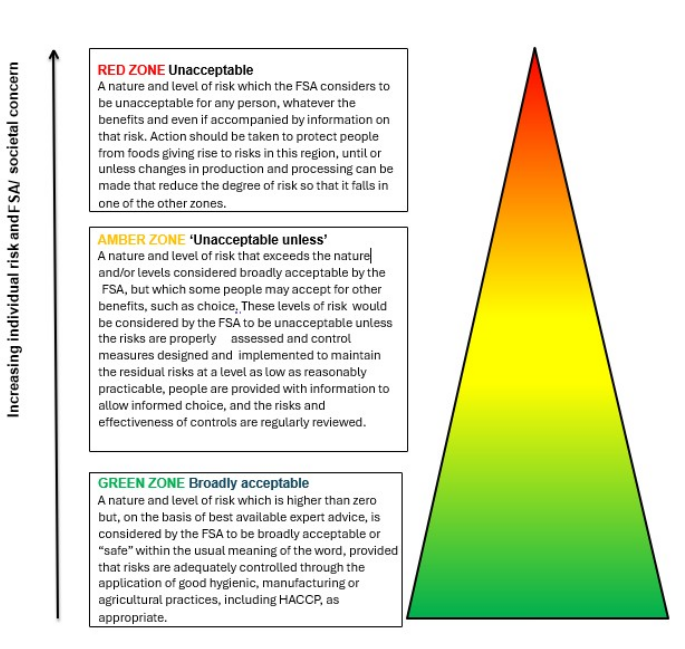
Figure 1 - Conceptual Model for Acceptability Of Risk (footnote 3)
14. In deciding which foods and risks fall within which category, we need to consider:
-
The nature of the risks and who these affect and how
-
Any benefits from consumption of the food
-
The effectiveness of controls
-
The acceptability of the risks and of the controls, to FSA and to citizens, businesses, enforcement bodies and others.
15. Our assessment of all of these aspects will be informed by our best understanding of the evidence in each area and on discussion with experts and other stakeholders.
16. Given that the criteria for categorisation are multi-dimensional, and the assessment needs to reflect uncertainties in the evidence, values and other subjective factors, and the specifics of each case, it is not possible to set fixed boundaries between the three zones. Figure 1 reflects this in a simplified way, with no hard boundaries between them. Nevertheless, the FSA as a regulator has to make clear and consistent decisions about which foods fall in which category and which controls apply, and to do this in a robust, transparent and proportionate way.
Identifying and Managing Risky Foods
17. We also need clear criteria for identifying risky foods for assessment using the framework. These seek to balance a number of considerations:
-
We need to identify risky foods so that we can manage them appropriately, in their own right and consistently with how we manage other risky foods
-
There is a vast range of foods and risks and we need to be able to focus on those foods which merit assessment as risky foods
-
The process of identifying risky foods and carrying out detailed assessment or review using the framework will require significant resource
-
Managing foods in the amber zone involves a significant resource for us and for others to develop, implement and verify the additional controls needed
-
We need to prioritise activity with the greatest impact on public health or other benefits to consumers.
18. The framework seeks to balance these through two features:
(a) Clear criteria to identify risky foods for consideration using the framework
(b) A two-stage approach, with a stage one screening step to check whether a detailed assessment at stage two is merited (and if not, what other action should result).
Risky foods
19. To be considered using the framework, a risky food must meet three criteria:
a) A heightened risk relative to other foods or other presentations of the same food, based on risk per serving (or per consumption event) but taking into account the number and types of people affected and the severity of the effects. (footnote 4)
b) A real or perceived benefit from sale or consumption specific to this food (usually this relates to some people who wish to eat it and/or businesses who wish to sell it, in its ‘risky’ form), or a disproportionate impact from preventing its sale/consumption
c) Existing controls to manage risks from this food are absent or there are grounds to believe that they cannot manage the risks and benefits in an effective and acceptable way (for example, the ‘default’ control measure would remove the food entirely or remove the characteristics valued by some consumers - such as cooking a burger thoroughly; the existing regime is no longer effective or acceptable; a new risk has emerged which the existing regime does not address effectively)
Assessing the evidence
20. The framework is intended to work on existing cases and in response to actual or possible changes as new risks emerge or evidence on known risks changes. This could be evidence that the criteria are met now, or that they might be met as a result of information indicating a real or plausible trend or future change.
21. In assessing foods against these three criteria, there are four key dimensions which form the main areas for evidence and analysis, both to identify and prioritise foods for consideration (at stage one) and in the subsequent detailed assessment at stage two. These are:
-
The nature of the hazard
-
The potential exposure
-
The effectiveness of controls in practice
-
This has two aspects: (a) effectiveness of controls in managing risk assuming they are applied as intended, and (b) actual or expected levels and patterns of compliance in practice and how this affects the risks to which people are exposed.
-
The acceptability/defensibility of controls. (footnote 5)
22. This also has several dimensions, including: the other factors used to assess the impact of regulation and whether it is proportionate (benefits to health and any wider benefits, and costs, and who these accrue to, consistency, equity); wider considerations affecting FSA’s sense of their acceptability (for instance, with regard to consistency, equity); and/or challenge from consumers, businesses or from a legal, or enforcement, perspective.
23. This includes assessing any vulnerabilities which affect any of these dimensions (are any groups more likely to be affected or less able to benefit or exercise choice?).
24. For new food-risk combinations, and for considering the case for review of foods already assessed and managed as risky foods using the framework, this assessment will focus on whether there is evidence of a material change in one or more of these dimensions. 7 In considering existing food-risk combinations as potential candidates for assessment as risky foods using the framework, consideration of change will still be useful, but the assessment will also need to consider whether the evidence on the current situation shows that the three criteria are met, and if so, how.
Assessing risks
25. It follows that, in many cases, the framework will be applied to foods eaten with a relatively low frequency of consumption (at a population level) with a relatively higher possibility of detriment per serving. We need to consider the impact of action on public health in setting priorities for assessment using the framework.
26. It is difficult to assess absolute risks for individual foods with confidence, particularly those consumed infrequently or by relatively few people, and data on actual incidence of ill effects will often be sparse, for new and existing risks. Evidence on absolute risks should be used where relevant and possible, but it will also be useful to consider risk relative to a relevant comparator, such as a less risky presentation of the same food, or a current state versus a possible future state.
Identifying foods to consider
27. We will use several strands of evidence to identify possible changes that might prompt consideration using the framework. This is illustrated in Figure 2, and includes:
-
Research, data gathering and analysis on sources and impacts of food risks
-
Monitoring and surveillance in food and public health under established systems, including incidents, outbreaks and emerging risks
-
Wider information gathering and analysis including on horizon scanning and food crime
-
Evidence gathering set up to inform review against specific triggers identified as part of a previous consideration using the framework
-
Information from SACs who will be asked to identify relevant changes, as part of their regular horizon scanning and forward looks
A two-stage approach
Stage one (screening): deciding whether to apply the framework
28. This stage has two aims:
-
To ensure that risk managers are alert to the need to consider whether a different approach might be merited in light of changes or of other evidence
-
To ensure we only deploy a full assessment using the framework where there is a clear rationale for doing so
29. This stage involves collating the data required for a first consideration of an issue including a preliminary profiling of risk and benefit, and consideration of any existing controls, to determine whether the three criteria are met. This considers evidence of a material change and/or of the current situation (for existing risks), as outlined above. There are three possible outcomes:
|
Insufficient information to determine whether criteria are met. |
Out of scope for stage two. Information requirements should be defined. Risk manager to make a judgement on whether to actively seek or generate the information, taking into account the cost, effort and time required as well as the nature of the potential risk. |
|
Sufficient information to conclude the criteria are not met (no material change or rationale based on existing situation) |
Out of scope for stage 2 May set/re-set the clock for future review |
|
Sufficient information to conclude the criteria are met (is or plausibly may be material change, or rationale based on existing situation) |
Apply the framework. Move to full assessment in stage two if there is not an established risk management approach that will manage the risks and balance risks and benefits in an effective and acceptable way. |
30. This requires judgement. Gaps in information should be captured, with uncertainties in the assessment and their effects on the conclusions and the confidence placed in them. However, if information gaps are such that it is not possible to draw a conclusion with any confidence, then the outcome is ‘insufficient information to proceed’ with a decision on what if any action is needed to address information gaps.
Stage two: Detailed consideration
This stage aims to support structured assessments and decisions on three points:
a) where a food should sit in the zone of acceptability and, if this suggests it might sit in the amber zone
b) What additional controls, information and measures for verification are needed
c) What triggers would be for a review
31. This requires a more detailed assessment of risks and benefits and of the effectiveness and acceptability of options for controls. It may be helpful to consider contingent risk assessment (which assesses the risks that are expected to arise under different scenarios for controls). This stage will also require a description, at least in the qualitative sense, of consumers’ other interests and other detriments and benefits.
32. Again, gaps in information should be captured along with uncertainties in the assessment, and their effects on the conclusions and the confidence placed in them. Where possible, this should include identifying areas of uncertainty where a plausible change in the evidence would lead to a different conclusion. This in turn would inform consideration of triggers for review.
33. Where information is sparse and uncertainty high, it may not provide a clear-cut basis for assigning the food into one of the three zones of acceptability. In these cases, a decision may depend particularly on judgements about acceptability of risks or controls, which have a strong subjective element. It is particularly important to set out clearly the basis for the decision and to consider whether this is consist with decisions in similar cases, the rationale for any differences in approach, and how any changes in information or assumptions which would lead to a different decision. Again, this would inform consideration of triggers for review.
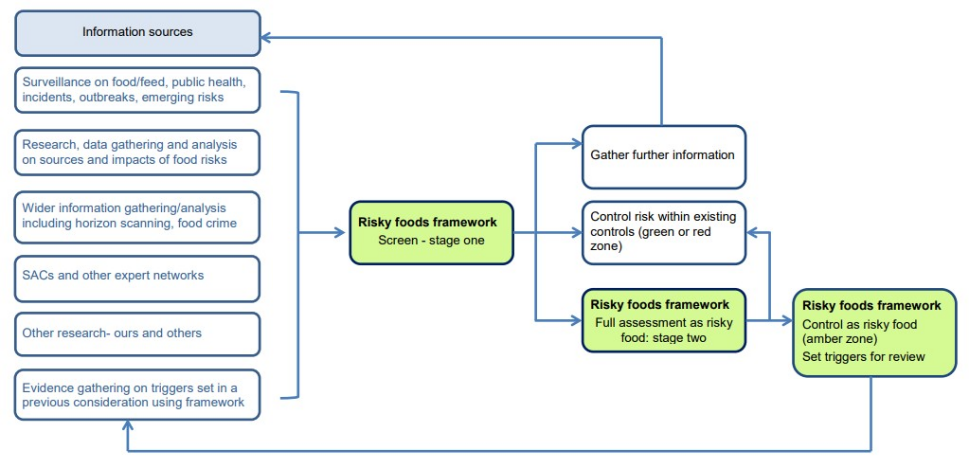
Figure 2: Inputs to identify of possible cases for screening or review using the risky foods framework
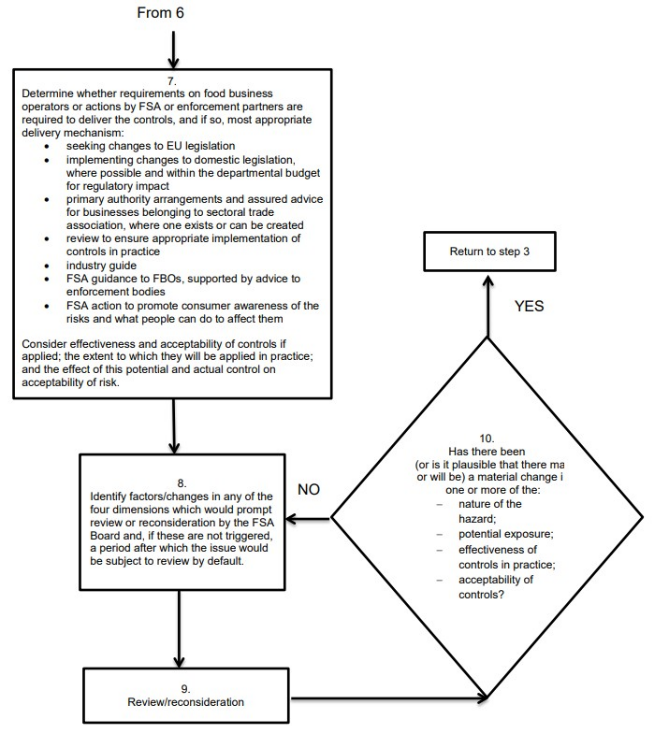
Annex B: Flow Chart: Applying the Framework for Proportionate
Controls For Risky Foods
Stage 2 – Applying the Framework
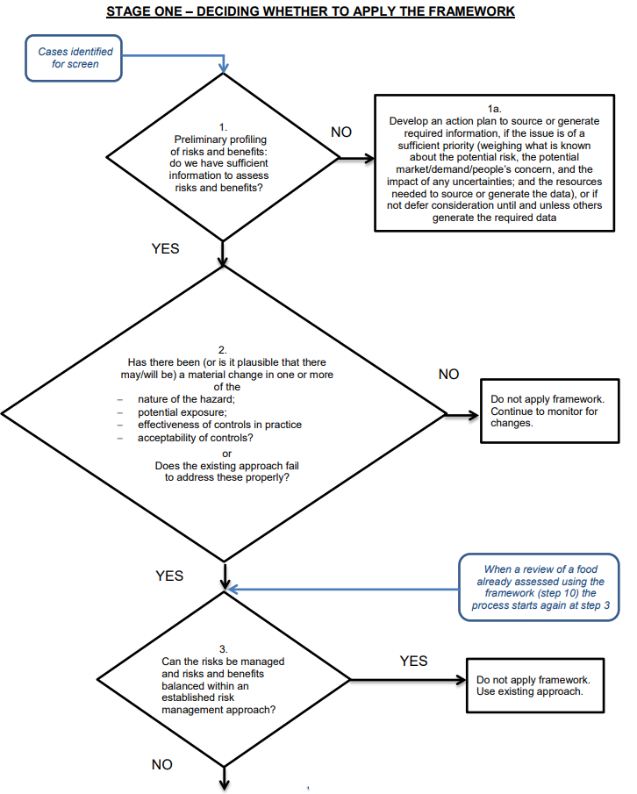
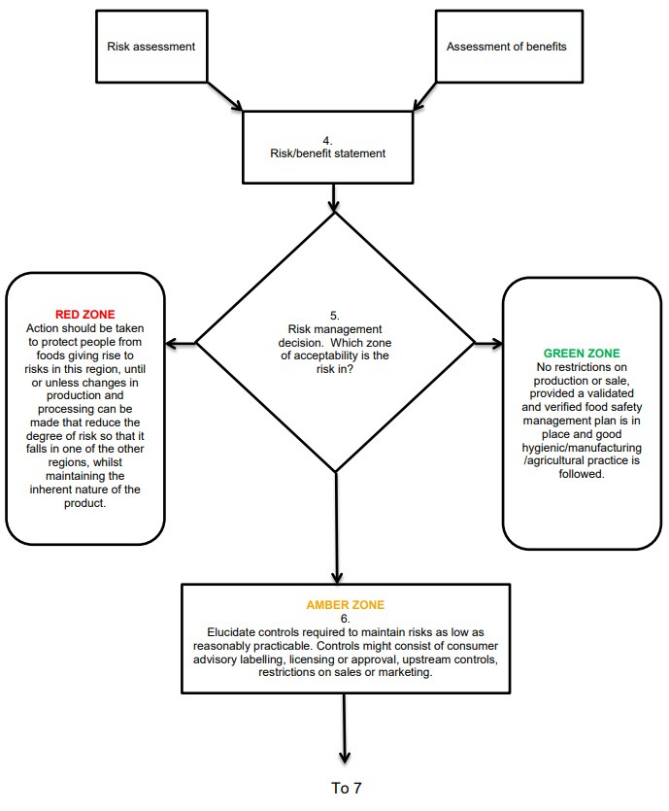
Annex C – Guidance for using the flowchart: points to consider and areas for evidence and advice
This is not intended as a detailed guide to carrying out assessments of risks and benefits to people’s health or of the other areas of evidence that will inform the use of the framework, such as regulatory impact. Risk managers applying the framework will work with FSA and external experts who are familiar with these assessments. This guidance aims to help risk managers by highlighting some of the important issues and types and sources of evidence, advice and analysis they will need to consider, and flags those which are particularly important in the context of the risky foods framework.
|
Stage one Outcome: decision on whether to apply the framework, reflecting the three criteria (heightened risk; specific benefit; existing controls absent or not able to balance risk and benefit effectively and/or acceptably), and informed by the lens of change. |
|||
|
Step |
Description |
Points to consider |
Areas for evidence and advice Each stage draws on evidence and advice from the preceding steps |
|---|---|---|---|
|
1 |
Preliminary profiling of risks and benefits |
Do we have the information to make an initial assessment of risks and benefits? Consider to whom the risks and benefits accrue, including the possibility of secondary cases of illness. Is the risk limited to the person making the choice? Consider the reason(s) for increased risks and whether they are specific to this food or more general. Gaps in information can and should be captured in discussing the uncertainties in the assessment and their effects on the nature of the conclusions and the confidence placed in it. However, if information gaps are too extensive then this many mean it is not possible to draw a conclusion with any confidence - that is, there is insufficient information to proceed. |
Nature of hazard and exposure This follows the established process for risk assessment. Consult FSA risk assessment and analytics teams and consider whether advice is needed from one or more Scientific Advisory Committees. Ideally, this will compare rate of events for those consuming the food deliberately in an informed way (choosing it) and those who consume unknowingly or not by choice. Available data are likely to be limited, and comparisons of relative risk may be more feasible. It is likely to help to identify a comparator and to assess risk relative to this. This could be between a current and future state (a change or trend) or between more and less risky presentations of the food (e.g. pasteurised versus raw drinking milk) Where possible consider the totality of hazards (and any benefits) presented by a particular food (for example, burgers may present risks from other pathogens besides E. coli O157). Areas for consideration include: − nature of the food/product − nature of effect(s) including severity of (e.g. deaths, hospitalisations) − amount of the food people consume (no. of servings), frequency of consumption (how commonly/rarely foods are consumed), profile of people consuming |
|
|
|
|
− level of risk (for example cases per million servings (individual risk) and total cases per year (population risk) − population affected/at risk (general population or sub-groups e.g. children, adults or other aspects of vulnerability; are those more vulnerable aware of this and can/will they take any action to mitigate this) possibility of secondary cases of illness) − distribution of incidence on location and time (all at once/in same place is different to spread out evenly over space/time). − how the food is currently sourced, prepared, consumed and how this affects the risk
Evidence for any beneficial effects on health (where possible to follow a comparable profiling based on who is affected and how and on individual and population impacts)
Evidence for other benefits, costs or other detriments Definition of benefit, cost or other detriment − What is it (nature, severity, scale - individual and population) − Who does it accrue to? − What is its impact Guidance on Regulatory Impact Assessment will be relevant here |
|
1a |
If insufficient information |
If there is insufficient information to proceed, then the information needed should be defined. The risk manager will then need to make a judgement about whether to actively seek or generate the information (or to defer consideration until and unless others generate the required data), taking into account the cost, effort and time required as well as the nature of the potential risk. |
In making this judgement, consider and weigh what is known about: − the potential risk − the potential market/demand − people’s concerns − the impact of any uncertainties − the resources needed to source or generate the data
|
|
2 |
Has there been a material change? Or (for existing food-risk combinations) does the existing approach fail to address these four dimensions properly?
|
Has there been (or is it plausible that there may/will be) a material change in one or more of the
Or (for existing food-risk combinations) does the existing approach fail to address these four dimensions properly? Consider what the reference points or comparators are that defines the change If no change (or gap in existing approach) Do not apply framework. Consider whether to set criteria/time for review. If there is/may be a material change (or gap in existing approach) If the conclusion is that there is evidence of a change or trend (or gap), but we not able to say with confidence that it is material at this stage, this should leads to identification of triggers or prompts in the form of information which would allow us to identify when/if it can be assessed with confidence as material (and whether this should be sought proactively or tracked through more of a watching brief) |
Many of the factors which would prompt consideration using the framework (subject to step 3) can be expressed as a change in one of these four dimensions, even for existing foods. Assessment for existing foods should also consider any other evidence that the current approach is not able to address these four dimensions properly, and where this exists describe it and the rationale for why it should prompt consideration using the framework. Exposure Consider data on sales, volume, numbers of outlets etc. as well as on who is consuming in what quantities Effectiveness of controls This has two elements: (a) the effectiveness of controls assuming they are applied as intended, (b) actual or expected level and pattern of compliance in practice (including effectiveness of enforcement) and how this affects the exposure to risk If controls include consumer information, how effective is this? Consider capacity to act to ensure an effective control of the risks, including resource available to FSA to consider and address the issue, and to local enforcement and food businesses to enact and check controls, and the effect this will have on behaviour and compliance. Acceptability This includes the other factors used to assess the impact of regulation and whether it is proportionate (benefits to health and any wider benefits, and costs, and who these accrue to, consistency, equity) and also to wider considerations affecting FSA’s own sense of their acceptability (e.g. on basis of consistency, equity) and/or acceptability to or challenge from consumers, by businesses, or from a legal/enforcement perspective. Consider changes in the food system and the wider environment which could in turn impact on risk, exposure, vulnerability and changes in knowledge across any of these dimensions. Describe the current/previous situation (or other comparator) Is change deliberate/designed (e.g. an increase in demand/supply, in production processes or a change in policy) or unintentional (e.g. food safety incident, environmental change). |
|
3 |
Is there an established risk management approach that will manage the risks and balance risks and benefits? |
|
See above on effectiveness and acceptability. If it is not clear whether and how an existing approach would apply (for example it is clear whether a new food falls under the novel foods regulations) it may be necessary to consider whether assessment as aa risky food would be merited in the interim. |
|
Stage two Outcome: decisions on three points: (a). where a food should sit in the zone of acceptability and, if this suggests it might sit in the amber zone (b). what additional controls, information and measures for verification are needed (c). what triggers would be for a review |
|||
|
Step |
Description |
Points to consider |
Areas for evidence and advice Each stage draws on evidence and advice from the preceding steps |
|---|---|---|---|
|
4 |
Risk/benefit statement |
Consider the nature of any benefit which is seen to balance risk (e.g. choice, trade). Consider who receives the risks, other detriments and who receives the benefits and whether and how this raises issues of equity and of consistency across different risks.
|
This requires a more detailed assessment of risks and benefits. It will build on the information captured in Stage One and the evidence and advice considered there (see above). Consider all the relevant risks (and benefits) from the food in question. It may be helpful to consider at this stage contingent risk assessment (which assesses the risks that are expected to arise under different scenarios for controls). It will also require a description, at least in qualitative sense, of consumers’ other interests and other detriments and benefits. Existing risk-benefit frameworks (such as EFSA’s) may be helpful in identifying questions to ask and in help to identify evidence needs, including around uncertainty and vulnerable groups. This should include elucidation and description (at least in qualitative sense) of consumers’ other interests, and any other detriments or benefits Assessment and comparison of risks and benefits needs to consider who they accrue to and the fact that their distributions may be different: for example, risks may be a high increment for a few people; benefits may be low increment for many. |
|
5 |
Risk management decision. Which zone of acceptability is the food in? |
This is a key step which brings together the issues and strands considered so far. Gaps in information should be captured in discussing the uncertainties in the assessment and their effects on the nature of the conclusion and the confidence placed in it. Where possible, this should include identifying areas of uncertainty where a plausible change in the evidence would lead to a different conclusion. This in turn would inform consideration of triggers for review (step 9). Where information is sparse and uncertainty high, it may not provide a clear-cut basis for assigning the food into one or other of the three zones of acceptability. If so, it is particularly important to set out clearly the basis for the decision and to consider whether this is consist with decisions in similar cases (and the rationale for any differences in approach), and how any changes in information or assumptions which would lead to a different decision. |
This draws on the (expanded) assessment of risks and benefits and also considers the effectiveness and acceptability of options for controls, again building on the information already captured (see guidance on Stage One). For foods which present more than one hazard (or benefit) consider how different control measures and options will affect the overall risk-benefit profile)? The decision needs to reflect the acceptability of the overall combination of risks (and benefits) from the food. Consider whether ‘normalisation’ of a risky foods could lead to a (further) change in exposure (for example if people mistakenly assume it is safe to serve rare burgers at home because they have eaten one in a restaurant which applies the additional controls required to manage risk in that setting)
|
|
6 |
Amber zone Elucidate controls |
This stage examines the possible options for control in more detail and the extent to which they will manage risks effectively and appropriately |
These two steps look in more detail at the options for control and what would be necessary and acceptable to manage the risks in the ‘amber zone’. Step 6 looks at the effectiveness of options for combinations of controls in managing risk assuming they are applied as intended Step 7 looks at what would be required to effect and to assure the application of these controls, and the actual or expected level and pattern of compliance in practice, and the effect of this on the risk to which people are exposed. Options for enacting controls This will draw on the guidance and evidence and analysis that support regulatory impact assessment. If controls include consumer information, how effective are different options in communicating risks and supporting informed decisions? Compliance Consider capacity to act to ensure an effective control of the risks, including resource available to FSA to consider and address the issue, and to local enforcement and food businesses to enact and check controls, and the effect this will have on behaviour and compliance. Acceptability of controls and resulting risks This has a number of dimensions. It includes the other factors used to assess to impact of regulation and whether it is proportionate and also to wider considerations affecting FSA’s own sense of their acceptability (e.g. on basis of consistency, equity) and/or acceptability to or challenge from consumers, by businesses, or from a legal/enforcement perspective. Consider how people - businesses and consumers - may act in response to information or other aspects of the controls required in the amber zone, and how might views on acceptability change, for example if the food becomes more available, or if people experience ill effects themselves, or become more aware of other people experiencing ill effects from the food in question (or, conversely, eat it or are aware of other people eating it without ill effects). |
|
7 |
Determine whether requirements on food business operators are required to deliver the controls, and if so, most appropriate delivery mechanism: |
Options for enacting controls include: − seeking changes to EU legislation − implementing changes to domestic legislation, where possible and within the departmental budget for regulatory impact − primary authority arrangements and assured advice for businesses belonging to sectoral trade association, where one exists or can be created − review to ensure appropriate implementation of controls in practice − industry guide − FSA guidance to FBOs, supported by advice to enforcement bodies − FSA action to promote consumer awareness of the risks and what people can do to affect them
Consider effectiveness and acceptability of controls if applied; the extent to which they will be applied in practice; and the effect of this potential and actual control on acceptability of risk.
|
|
Identify factors or changes in any of the four dimensions which would prompt review or reconsideration by the FSA Board and, if these are not triggered, a period after which the issue would be subject to review by default. |
This stage establishes the criteria and timescale for review. This includes identification of any triggers for review, and the mechanisms by which these triggers will be tracked. Risk managers will need to consider where evidence for triggers will be sought proactively or through a watching brief, and/or whether there will be a general review across the piece after a fixed period, taking into account the cost, effort and time required by each approach, as well as the nature of the potential risk. Proactive and specific measures could include measures set up as part of the specific additional controls for this food, or proactive analysis drawing on existing mechanisms such as outbreak surveillance. General measures would include a number of activities which we use to inform awareness and potential review across all risks (such as horizon scanning, emerging risks, ongoing incident and outbreak analysis). |
This step involves reviewing the information and assessment that has informed the decision and identifying those things for which a change could lead to a different decision (either in terms of the classification in the three zones of acceptability or in the nature of controls deemed to be effective and acceptable to manage the risk in the amber zone). These changes would then be the basis for triggers. Where possible, these should describe the type of change involved (nature, direction, magnitude). Triggers would ideally be multidimensional (such as the direction of an arrow in a detriment vs likelihood plot). This could be direct evidence of a change, or evidence which leads to a plausible possibility that risk has changed. It would draw on more than ‘data’, and would include information, insight, understanding. Iterative dialogue between risk managers and risk assessors (in FSA and in the SACs) will help to elucidate what sorts of changes could be useful as triggers in respect of the risk-benefit assessment. EFSA guidance on re-evaluation of risk in different areas could be a useful tool for risk assessors considering changes in that aspect. In considering triggers, the approach would need to be open to identifying and responding to developments which were not and could not be foreseen, as well as specific changes which might be identified in advance as ‘triggers’ for a review.
|
-
July 2015 FSA Board Paper on raw drinking milk: www.food.gov.uk/sites/default/files/fsa150704.pdf 2 September 2015 Board Paper on rare burgers: www.food.gov.uk/sites/default/files/fsa150904.pdf).
-
Adapted from: The Institute of Engineering and Technology (2015) Determining the Acceptability of Risk.
Health & Safety Briefing No. 36. Available at: http://www.theiet.org/factfiles/health/hsb36-page.cfm?type=pdf Based on: Health & Safety Executive (2001) Reducing risks, protecting people: HSE’s decision-making process. Available at: http://www.hse.gov.uk/risk/theory/r2p2.pdf
-
Risks reflect people’s vulnerabilities and behaviours as well as the properties of the food itself
-
Note, this refers to the suitability of controls as applied in the case of a specific food/risk, not to the acceptability at a macro level of the wider approach to risk management e.g. risk-based regulation. 7 Change here covers changes which can be identified with confidence and changes in our understanding and assessment of one of these dimensions in the face of uncertainty.