Supplementary guidance to applicants for assessment of Cell Cultivated Products (CCP) in food: Allergenicity & Nutrition
4. Allergenicity assessment within supplementary guidance to applicants for assessment of Cell Cultivated Products (CCP) in food: Allergenicity & Nutrition
Allergenicity assessment of Cell Cultivated Products (CCP)
4. Allergenicity assessment
The guidelines for allergenicity assessment within novel foods are outlined in Section 2.11 of the 2016 EFSA guidance and assimilated Regulation (EU) 2015/2283 and forms the basis of allergenicity assessment principles.
The principles for investigation of potential allergens includes detection of known allergens used in manufacture (Section 4.1 & 4.2) and assessing the allergenic potential of new proteins (Section 4.3). This section will explain how these principles apply to CCP applications.
It is expected that CCPs will be consumed by diverse and broad populations and may include exposure of individuals to allergens that they have not previously encountered. Therefore, CCPs require careful assessment to understand allergenicity risks ensuring consumer safety.
The allergenicity assessment must not only consider CCPs as a novel food, but also the impact of the novel production method.
CCPs may be manufactured using known allergens; however, their safety must be assessed to ensure they do not pose an increased risk to consumers. The application should consider genetic changes throughout the production process on the cell lines and show that genetic drift has been considered regarding allergenicity.
4.1 Known allergens used in manufacture
Consideration is to be taken for all raw materials (including but not limited to source animal, cell line, scaffolds or cell culture media, etc.) used within all stages of production, from the cell isolation stages through to the post-harvesting processes, and preparation of the final product.
4.1.1 Allergens requiring mandatory disclosure
Where a known allergenic food, as listed in Regulation (EU) 1169/2011 Annex II, or products derived from it have been used in the production process of the CCP (including but not limited to source animal, cell line, scaffolds or cell culture media, etc.), the presence of the allergen is to be determined in the final product through analytical methods that detect protein. This may include Enzyme-Linked Immunosorbent Assay (ELISA) or mass spectrometry.
Where the allergenic components are modified (e.g. wheat isolate), any changes this introduces to the relative risk should be characterised and justified within the application.
4.1.2 Common allergens
Where other known allergenic components (e.g. legumes used in a scaffold) are used within the production process, the following steps should be considered:
- A comprehensive literature review to understand the allergen and the nature of reactions associated with it (including severity), the potency of the allergen and any detection approaches.
- If this review indicates the allergen will be present in the final product, this should be supported by detection of the common allergen in the final product. Analytical methods should be used that detect protein such as ELISA or mass spectrometry for quantifying whether the allergenic component remains in the final product and at what concentration.
4.2 Allergenicity of the source animal
If a CCP is produced using a cell line sourced from an organism, recognised as a priority food allergen, such as fish, crustaceans, or molluscan shellfish, which require mandatory allergen labelling, then the CCP itself will also be treated as a priority allergenic food. The allergenicity assessment will then focus on the relative allergenic potency of the CCP to the comparator.
Data from protein profiling performed as part of the compositional analysis and digestibility undertaken in the ADME can be used to assess this. If there is an indication that allergenic potency is likely to be increased, there may be a need for additional testing including clinical reactivity to inform food allergen management plans.
Protein profiling should be compared to an appropriate conventional meat comparator. If the protein profile of the CCP substantially differs to the comparator, the changes need to be evaluated. This would need to take account of whether there is a change in levels or digestibility of an otherwise uncommon allergen. Confirmation of changes in allergenic potency may require testing in allergic populations.
CCPs originating from mammalian cell lines may cause IgE-mediated food allergies through exposure to the proteins carrying galactose-α-1,3-galactose, also known as α-Gal. The levels of this carbohydrate should be established relative to the comparator.
4.2.1 Veterinary medicine and antimicrobials
Where veterinary medicines or antimicrobials have been used in the source animal prior to sample collection (either a slaughtered or live animal), there should be evidence of a withdrawal period prior to sample collection or there should be data demonstrating residual levels within the CCP. There should also be consideration to antimicrobial use within any stage of the production, where residues remain in the final product these could have allergenic potential.
Guidance on residue testing will be included in future CCP hazard guidance publications.
4.3 Assessing allergenic potential of new proteins
The detection of allergens and understanding the risk should be considered as part of the allergenicity assessment (Figure 1). Allergenicity assessment should be conducted on the CCP as a novel food as it is intended to be consumed.
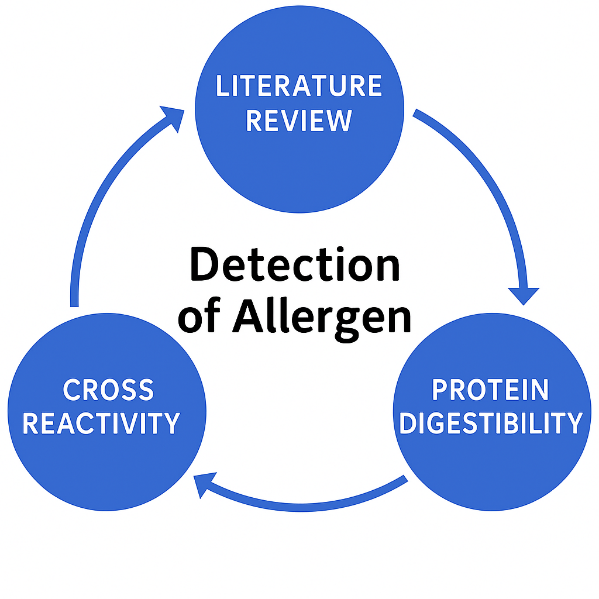
Figure 1: Allergenicity assessment
A literature review of all raw ingredients throughout the entire production process of the CCP, including its source, raw materials, and production products (e.g. scaffold material) and whether any reactions have been reported to it or its components, is to be generated and documented within the application dossier. Gaps in literature should be addressed and justified.
Information on the following should be provided to give a holistic view on the risk of new allergic proteins being present or the likelihood of cross reactivity to known allergens.
- Data from protein profiling performed as part of the compositional analysis.
- Information on the abundance of the proteins present both for the novel food and for any specific potential allergen requiring further analysis.
- Digestibility of the novel food undertaken in the ADME as a marker of stability for specific proteins.
This cycle may need to be repeated for individual components or proteins if potential areas for further investigating are identified. Allergenicity assessment is an evidence-based iterative process in which progression through successive stages depends on the availability and evaluation of data.
At this stage applicants will wish to consider if phylogenetic analysis may be required to understand if the source of the protein of interest is related to a priority food allergen and could pose a cross-reactivity risk.
Where the data above suggests further investigation is needed, on a specific protein or potentially allergic food, bioinformatic analysis of the protein of interest’s amino acid sequence can be used to explore potential cross reactivity with known allergens. Where a protein sequence of at least eighty amino acids shares 35% or more similarities with a known allergen, this should be considered for further investigation.
The following databases might be considered for use to perform an alignment search of the amino acid sequence of the protein(s) of allergenic potential:
http://www.allergenonline.org https://comparedatabase.org https://allergen.org
If there is an identified protein that may cause reactions in sensitive individuals, testing may be needed to understand the clinical relevance of the findings in humans. A human serum specific IgE binding assay (e.g. ELISA) may be performed. Where a positive result is recorded, further investigation into the allergenic potential in humans should be conducted e.g. Skin prick test and/or oral food challenges.
The assessment of allergenicity uses a weight of evidence approach integrating a range of evidence sources to understands the allergenic risks to consumers. Full analysis using all sections of this guidance will not be required for all products. Indicators found in data should determine whether the next layer of analysis is warranted.