Precision bred organisms: application guidance
FAQ for precision breeding application guidance
England specific
FAQs for those making precision breeding applications.
This resource should be read in conjunction with the FSA’s regulated products application guidance and the FSA’s technical guidance for Precision Bred Organisms.
The “Precision Breeding Act 2023 and the Genetic Technology (Precision Breeding) Regulations 2025” (‘the Regulations’) are designed to provide a proportionate, science-based regulatory system for the authorisation of precision bred food and feed.
The FSA’s framework ensures that precision bred food and feed is as safe as traditionally bred food and feed. The FSA’s tiered approach to precision bred food and feed ensures that those organisms, where the risk is well understood, can move through the regulatory process swiftly through an applicant led Tier 1 safety assessment. For more significant changes to the organism or how it will be used, a bespoke safety assessment through Tier 2 provides assurance that food and feed is safe for consumption.
Applications via the Regulation 20 (Tier 1) route consist of statements using clear descriptive text that justify how the precision bred organism meets the applicant’s conclusions to the Tier 1 safety assessment. Where appropriate these statements should include quantitative values to support the conclusions. Submission of detailed quantitative data studies or dossiers is not required but applicants should hold any supporting evidence relevant to their Tier 1 safety assessment.
If precision bred and traditionally bred organisms are equivalent, why do applicants have to provide so much information on PBOs?
All food and feed businesses – whether marketing traditionally bred organisms (TBOs) or precision bred organisms (PBOs) - have a duty to ensure that the food and feed they market is compliant with existing food and feed safety legislation. Under Assimilated Regulation (EC) 178/2002 known as “General Food Law” food must not be marketed if it is injurious to health or is unfit for human consumption. Animal feed fed to food producing animals must not have an adverse effect on human or animal health, or make the food derived from the animal unsafe for human consumption.
Before considering an application for precision breeding food and feed marketing authorisation, applicants should have regard to existing duties and requirements imposed by the overarching regulations that underpin food safety in the UK.
In addition to complying with the specific requirements for the authorisation of a PBO for use in food and feed, all food and feed businesses are expected to exercise appropriate due diligence in ensuring food and feed containing or consisting of PBOs is safe. The FSA provides food businesses with guidance to help make sure they understand their statutory obligations under food and feed law.
There is no evidence that PBOs are intrinsically more hazardous than TBOs. However, this is a new and rapidly developing technology. This means tiered safety assessment, proportionate to the level of potential risk, is appropriate. This provides both the relevant level of scrutiny for individual PBOs to ensure that potential safety risks are identified and effectively managed, whilst also providing consumer reassurance.
What is the difference between Tier 1, Tier 2, Regulation 20 and Regulation 22?
Under the Genetic Technology (Precision Breeding) Regulations 2025 (‘The Regulations’) all PBOs must undergo a Tier 1 safety assessment, which is an applicant-led safety assessment to determine whether the criteria in Regulation 20 (1) have been met. If they are, a Regulation 20 (Tier 1) application is made to the FSA. If during the Tier 1 assessment an applicant determines that one or more of the criteria in Regulation 20 (1) have not been met, a Regulation 22 (Tier 2) application must be made for the FSA to complete a safety assessment for the PBO.
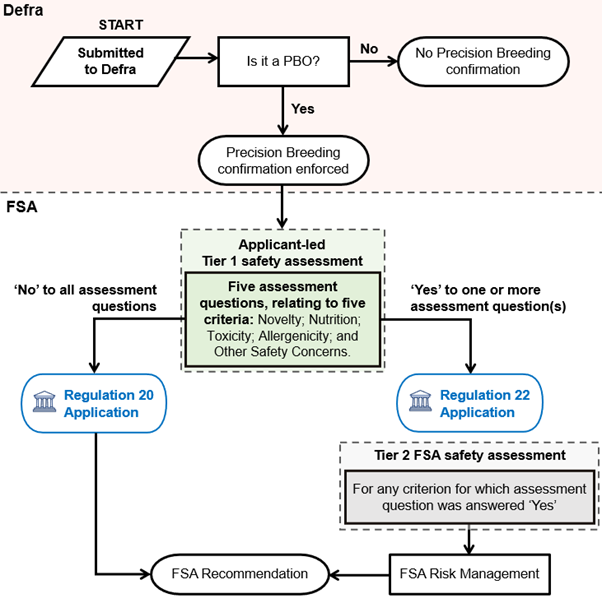
A flowchart providing an overview of the pathways to seek PB food or feed marketing authorisation, starting with the confirmation that an organism is a PBO by Defra Secretary of States. Section 3 of the guidance describes the assessment process. The Tier 1 safety assessment led by the applicant uses five assessment questions relating to Novelty, Nutrition, Toxicity, Allergenicity, and Other Safety Concerns. When all the assessment questions are answered ‘No’, no further safety assessment is required and the applicant submits an application under Regulation 20 for FSA recommendation. Where one or more of the assessment questions is answered ‘Yes’, a Tier 2 safety assessment is required for the corresponding criterion(s) and the applicant submits an application under Regulation 22 which may require additional data or information for assessment by FSA. Risk management will be considered before FSA recommendation of Tier 2 PBOs.
Questions on Tier 1 applicant-led safety assessment
What are substances of interest, how do I identify them, and what is their relevance to the safety assessment of PBOs?
Substances of interest are substances with levels or activity that are predicted to change as a result of the genetic change(s), which are known to have the potential to impact nutrition, toxicity or allergenicity.
Substances of interest are identified during the Tier 1 safety assessment of the PBO phenotype, as outlined in Part 2 and Section 7 of the technical guidance. Substances of interest that are identified to be present in the edible tissues of the PBO must be assessed for their impact on nutrition, toxicity and allergenicity to identify potential food/feed safety concerns.
Focusing the compositional assessment of PBOs on substances of interest enables a targeted, hypothesis-driven approach to safety assessment.
Do I need to identify all substances of interest in the plant, or just those in the edible parts of the plant?
As part of the Tier 1 safety assessment, applicants must identify all substances of interest in the plant, not just those in edible parts, following Section 7 of the technical guidance.
Identifying all substances of interest enables a clear picture of any possible risks to be built, allowing applicants to work out which changes resulting from precision breeding might affect safety or nutritional quality. Subsequent steps then narrow the scope, focusing only on substances of interest present in edible tissues. This ensures that all plausible pathways to harm are considered. It also provides a clear rationale for excluding substances, that whilst changed due to genetic changes made in plant, do not impact food or feed safety or quality.
Will identifying all substances of interest, potentially lead to identifying hundreds of substances of interest?
While a single genetic change can have widespread effects on gene expression or production of substances, altered substances are only of interest if they have potential to impact nutrition, toxicity or allergenicity (Sections 7, 7.5 of technical guidance). Where multiple substances of interest are identified, further consideration is required through the subsequent assessment steps outlined in Sections 7.5/8/12/13/14 of the technical guidance to determine their possible impact on nutrition, toxicity, or allergenicity.
What determines whether a substance of interest is ‘biologically relevant’?
Substances of interest are only biologically relevant if they are identified as being present at a concentration within the ranges that must be ingested for the substance to have a physiological effect on the consumer.
Do I need to conduct compositional analysis of my precision bred plant to identify all substances of interest, that may be biologically relevant?
As described above, each substance of interest in the edible tissues should be considered. However, this information can be inferred from any relevant existing knowledge of the plant (for example, expression data or compositional information) and does not require the applicant to conduct systematic wide ranging compositional tests. In some cases, it will be possible to infer from scientific literature that a substance of interest is not present at biologically relevant levels and does not require further assessment.
Instructions on when compositional data is needed are included in Part 3 of the technical guidance. Part 3, Section 9 outlines sources of evidence that can be used to determine the significance of identified changes in substances of interest, including when proprietary quantitative data can be used.
What is meant by ‘nutritionally disadvantageous’ to the consumer and how does it differ from safety?
Food or feed derived from a PBO is disadvantageous to the consumer if the nutritional quality of the PBO is altered in a way that is detrimental to nutrition of the consumer, taking into account their whole diet. Applicants must assess for nutritional quality as well as allergenic and toxicological safety. For example, increasing vitamin A levels in a PBO may reduce concentrations of other nutrients like vitamin C, iron or zinc; this would be nutritionally disadvantageous if the plant was normally an important source for any of these other substances in the diet. A change like this would not be a safety concern but could be nutritionally disadvantageous.
What is a suitable benchmark reference and what do I do if there isn’t one?
A suitable benchmark reference is a variety or dataset that represents the normal compositional range for the species or trait being assessed. The selected benchmark reference must have a similar role in the diet as the PBO, meaning it is consumed by the same population and provides a similar nutritional benefit. When a suitable benchmark reference from the same species is not available, varieties from the same plant family, or varieties with a same trait from comparable genetic change may be acceptable. Instructions on benchmark references are included in Sections 9.1, 17.2 and 17.3 of the technical guidance. Where further guidance is needed to identify a suitable benchmark reference, applicants may use the Business Support Service to seek advice.
Whilst benchmark references are available for the majority of edible plant species in the UK, there may on occasion be no suitable benchmark references available (for example, when a PBO is a niche crop). In these instances, applicants will need to generate their own compositional data on identified substances of interest in a suitable reference variety to use as benchmarking.
Questions on data requirement for applications
Do I need to provide quantitative data in my Regulation 20 (Tier 1) application as part of a Tier 1 safety assessment?
A summary of the quantitative data used to determine whether the criteria in Regulation 20 have been met, should only be submitted in your Regulation 20 (Tier 1) application, if it is necessary to support your conclusions. This is determined by the nature of the PBO and the genetic change introduced.
For example, an intentional change to a nutrient in a PBO must be quantified to determine significance: If this value is within the ranges found in a suitable benchmark reference, average quantity and standard deviation must be provided in the application to support the statement that the genetic change does not “significantly alter the nutritional quality of the organism as it is being consumed as food or feed at the date of the application in a way that is likely to be disadvantageous to the consumer” (Regulation 20 (1) (c) (i)) (Technical guidance Figure 5, Sections 9.2 and 17.2).
For example: if the purpose of the PBO was to alter vitamin A concentration and the applicant had established it was not nutritionally disadvantageous they would submit something along the lines of ‘the average vitamin A concentration (20mg/g) is within the ranges found within TBO in data set X’.
Applicants could also reference a publicly available benchmark reference, where there are data sets available for a range of crops.
Where changes in composition have no relevance to food or feed (if the substances of interest identified play no role in nutrition, toxicity or allergenicity, or if they are not in edible parts of the plant, or if they are present at concentration that are not physiologically relevant for consumers), compositional evidence is not required.
If there’s no suggestion that an identified substance of interest may impact safety or nutritional quality, is it sufficient to state just that in my application? If not, what evidence do I need to provide?
After completing the safety assessment steps in Section 7 of the technical guidance if no substances of interest are identified in the PBO, or where the body of scientific evidence does not provide a hypothesis for a credible impact of a substance of interest on nutrition, toxicity or allergenicity, no further information is required on the substance.
The Tier 1 safety assessment in Sections 12, 13 or 14 can be completed by providing a statement outlining the rationale and conclusion for each criterion of Regulation 20 in the corresponding section of the application form.
Evidence to support these conclusions can be published data, datasets, scientific knowledge from the literature.
General questions on regulatory process
I’m new to this regulatory process or am unsure how to conduct a safety assessment on my precision bred plant; am I able to seek assistance from the FSA with my application?
Information for applicants including guidance documents for submitting applications can be found here. If after consulting this information questions remain, you can submit these to our new, dedicated business support service for PBO applicants.
Will my Tier 1 safety assessment be checked as part of an application under Regulation 20?
Yes. As required by the regulations, all Regulation 20 (Tier 1) applications will be verified to ensure they contain the information specified in paragraph 1 of Schedule 4. These applications must be sufficiently detailed as required by Regulation 20 (4).
How do I know if a Tier 1 safety assessment is sufficient or an additional Tier 2 safety assessment of my PBO is required?
The technical guidance provides a step-by-step guide for assessing the safety of a PBO prior to seeking a food and feed marketing authorisation. It guides applicants through the Tier 1 safety assessment process to determine whether the criteria in Regulation 20 have been met or not, by identifying traits which could potentially impact safety and nutritional quality. If such traits are present, the tiered approach ensures the PBO(s) is identified as needing a Tier 2 FSA safety assessment. This provides additional assurance, in the form of a bespoke safety assessment and provision of risk management advice by the FSA.
What happens if I apply under Regulation 20 following a Tier 1 safety assessment, but a Tier 2 assessment is actually needed?
If an application is submitted under Regulation 20 (Tier 1), and during verification it is identified that a Regulation 22 (Tier 2) assessment is required, the application will be deemed invalid. The applicant will be advised to resubmit the application under Regulation 22 (Tier 2).
Is one Tier safer than the other?
Authorised PBOs are equally safe irrespective of application route. PBOs are only authorised where scientific evidence demonstrates safety.
In some instances, a Tier 2 assessment may be required to give additional clarity on the safety of a PBO or where risk management considerations are required, however this does not impact the overall safety of an authorised PBO.
How long will it take for decisions to be made on applications for a Regulation 20 (Tier 1) PBO and a Regulation 22 (Tier 2) PBO respectively?
We expect to make recommendations to the Secretary of State on Regulation 20 (Tier 1) applications around two months after receiving a valid application. Regulation 22 (Tier 2) applications will take up to 12-24 months, subject to complexity, once the process is fully established, because they require a bespoke safety assessment based on the information provided in the application. Each application will be assessed on its own merits, meaning some may be completed faster than these indicative timelines, others may take longer.
What should I do if new information relevant to the safety of my PBO comes to light after food and feed marketing authorisation is granted?
If new information comes to light after your PBO has been authorised for use in food and feed, you have a legal obligation under The Regulations to notify the FSA immediately, provide details of the new information, and comply with follow-up actions.
Can I make a parallel application to EFSA?
Currently, an organism that is considered a PBO in England is considered a genetically modified organism (GMO) in the EU, where all organisms produced by genetic technology are captured by assimilated Regulation (EC) No 1829/2003 (framework for genetically modified foods and feeds) in the EU. They will require a different supporting data package for an application to the European Food Safety Authority (EFSA).
How do I obtain advice/ Pre-applicant support?
Organisations intending to apply to the FSA for food and feed marketing authorisation of a PBO can request support through our Precision Breeding Business Support Service (BSS) before submitting their application. Please review the guidance provided on the BSS webpage and complete the accompanying enquiry form.