Supplementary guidance to applicants for assessment of Cell Cultivated Products (CCP) in food: Allergenicity & Nutrition
This document outlines the scientific requirements for evaluating the allergenicity and nutritional aspects of Cell Cultivated Products (CCPs) when seeking market authorisation as novel foods in Great Britain.
Purpose and summary information relating to the supplementary guidance to applicants for assessment of Cell Cultivated Products (CCP) in food
Revision number |
Date |
Purpose of revision |
Revised by |
|
1.0 |
04 December 2025 |
First version published |
FSA/FSS |
Purpose
This document outlines the scientific requirements for evaluating the allergenicity and nutritional aspects of Cell Cultivated Products (CCPs) when seeking market authorisation as novel foods in Great Britain. This is supplemental guidance to the 2016 EFSA technical guidance which supports applicants through assimilated Regulation (EU) 2017/2469 -which details administrative and scientific requirements for novel food applications under Article 10 of assimilated Regulation (EU) 2015/2283 for novel foods.
This guidance aims to help applicants understand how the allergenicity and nutritional sections of Article 10 of assimilated Regulation (EU) 2015/2283 and the 2016 EFSA technical guidance apply to CCP safety assessments, specifically regarding the risks of nutritional disadvantage and allergenicity and how to evidence this within a CCP novel food application.
Summary
Through the CCP sandbox programme (Feb 2025- Feb 2027), the FSA and FSS will fast-track our knowledge about CCPs and use this to produce guidance on a range of topics relevant to these products. The guidance aims to better guide companies on how to make products in a safe way and how they can demonstrate this to us. The FSA and FSS are using the learnings from the CCP sandbox programme alongside expert elicitation and literature review to publish these guidance documents to provide clarity to businesses on the path to market.
This supplementary guidance provides detailed scientific considerations for assessing the nutrition and allergenicity of CCPs, supporting the general requirements of assimilated Regulation (EU) 2015/2283. It describes the safety assessment process applicants should follow when preparing a CCP dossier for regulatory review.
By following this guidance, applicants can address common issues, ensure their submissions are comprehensive, and facilitate efficient regulatory evaluation. The goal is to support the development and authorisation of CCPs that are safe, accounting for risks associated with nutrition and allergenicity.
This guidance applies specifically to Cell Cultivated Products (CCPs) regulated as novel foods in GB.
1. Scope
This guidance applies specifically to Cell Cultivated Products (CCPs) regulated as novel foods in GB. Specifically, this guidance applies to CCPs defined as food products produced by culturing animal cells, including those from meat, seafood (fish and shellfish), fat, offal, or fertilised eggs in a controlled environment, without the use of traditional farming or animal slaughter. The primary focus of this guidance is on products derived from both invertebrate and vertebrate animal cells such as mammalian, fish, shellfish, or avian cells, particularly those intended to replicate the appearance and characteristics of conventional meat or seafood.
Applicants seeking market authorisation for CCPs must comply with assimilated Regulation (EU) 2015/2283. This includes providing evidence of hazard identification, characterisation, and implementation of appropriate mitigations to ensure safety. This guidance will focus on allergenicity and nutrition risks of CCPs as novel foods. While this guidance outlines key considerations for CCP applications, it is not exhaustive. As scientific methods develop, alternative approaches to those referenced within this guidance may be suitable to support the assessment of nutritional quality and allergenicity and may be accepted. All approaches used should be scientifically justified, generate reliable and conclusive data, and satisfy the applicable regulations for novel foods.
All safety assessments should be supported by scientific evidence, with analyses conducted in accredited laboratories using nationally or internationally recognised and validated methods. Applicants are also encouraged to adhere to OECD guidelines on Good Laboratory Practice (GLP) and chemical testing where applicable. Where this is not possible, fully validated internal methods with appropriate controls may be used, provided they are scientifically justified.
The Food Standards Agency (FSA) and Food Standards Scotland (FSS) will review all applications to ensure compliance with regulatory standards. Additional information may be requested during the verification process to address any gaps or uncertainties identified in the submission.
General considerations for CCP applications
2. General Considerations for CCP Applications
This guidance supports applicants in the development of regulatory dossiers to assist the applicant in assessing the allergenicity and nutritional value of CCPs as novel foods.
Applicants are expected to embed safety management into their process, with consideration for food safety and nutritional quality. Applicants will need to assess their CCPs with consideration of nutritional value, allergens, and overall food safety.
Applicants must ensure they are using the latest version of this supplementary guidance found on the FSA webpage alongside the assimilated Regulation (EU) 2015/2283 and 2016 technical guidance put in place by The European Food Safety Authority (EFSA) for novel food applications.
Nutritional information contained within the supplementary guidance to applicants for assessment of Cell Cultivated Products (CCP) in food: Allergenicity & Nutrition
3. Nutritional information
Under Regulation (EU) 2015/2283 and Section 2.9 of the 2016 EFSA guidance for novel foods, applications should demonstrate that a novel food is not nutritionally disadvantageous compared to any food it may replace. Evidence includes compositional data, bioavailability of nutrients and assessment of anticipated intake under the proposed conditions of use. This guidance intends to outline the scientific and regulatory requirements for assessing the nutritional quality and how this can apply to CCPs as novel foods.
Nutritional quality is a combination of multiple interrelated factors, including nutrient content (composition), digestibility, bioavailability, and the contribution of the CCP to the diet. To ensure it is not nutritionally disadvantageous under the proposed conditions of use considering the impact on different population subgroups who are anticipated to consume the novel food. This includes the impact on nutritional intake and status with replacement of conventional meats for CCPs.
Analytical methods, specifically used for nutritional assessment, should be completed by accredited laboratories using internationally recognised methods. Where in-house methods are used, these should be fully described and the method validated. Copies of the certificates(s) of analysis should be provided.
3.1 Composition
Applicants must provide both qualitative and quantitative data on the macro- and micronutrient composition of the CCP. The analysis should address the following key points:
- Protein profile: Clearly define the protein profile of the CCP, including any post-translational modifications where relevant, and compare it to the relevant conventional counterpart. Consideration should be given to any potential residues from culture media or scaffolds.
- Scope of analysis: Conduct compositional analysis on both the CCP as submitted for novel food authorisation (e.g., cell biomass) and, if applicable, the final food as it is intended to be consumed, including after any cooking or preparation steps.
- Batch analysis: Perform nutritional analysis on at least five independent, representative batches using validated or internationally recognised methods. If fewer batches are analysed (e.g., in continuous or semi-continuous manufacturing), provide a strong scientific justification to ensure robust and reliable data. Justification may include evidence that fewer batches do not compromise safety or nutritional adequacy and that the product is homogeneous across production runs and representative of the novel food manufacture. For continuous processes, ensure batch representation from at least two different starting cell stocks. The definition and justification of a batch must be included in the application.
- Batch consistency: Demonstrate that batch analysis results are consistent within a predetermined specification. If variability is observed, explain its sources and how it will be controlled.
- Presentation of results: Present compositional data in a table, including batch specifications, minimum and maximum specification limits, and details of the analytical techniques used (including Limit of Detection (LOD) and Limit of Quantification (LOQ).
- Micronutrients of concern: Pay special attention to micronutrients relevant to public health in the UK, such as iron, zinc, selenium, vitamin B12, folate, riboflavin, vitamin D, essential amino acids, creatine, and long-chain fatty acids (such as omega-3). Compare these to conventional meat or seafood as appropriate. Additionally, consider and compare levels of any antinutrients present.
- Comparator justification: Justify the choice of comparator food (e.g., chicken breast for a CCP imitating chicken), considering the intended use of the CCP (full replacement or ingredient in a composite food). Refer to Section 3.3.
Best practice
Applications should include amino acid and fatty acid profiles of the defined novel food. Conventional meat contains all the essential amino acids and is a useful source of creatine the content of these nutrients should also be considered, also the bioavailability and digestibility of the form of certain nutrients e.g. haem/non-haem iron, folates/folic acid. The role of the novel food in the consumer’s diet needs to be understood to evaluate the impact of the novel food on the nutritional status of the consumer e.g. total conventional meat replacement or ingredient added at a low percentage to a pre-existing product.
If the CCP’s nutritional profile is not equivalent to its comparator (e.g., lower iron content than conventional meat), assess the potential impact on consumer nutritional status and provide a justification that its consumption will not adversely affect health or mitigations required.
It is recognised that, although the proposed uses and quantities of CCPs may not currently be sufficient to replace conventional meats, the impact of any nutritional disadvantage should still be assessed.
3.2 Absorption, Distribution, Metabolism and Excretion (ADME)
ADME investigations, including protein digestibility of the CCP or associated breakdown products should be assessed on the food as it is intended to be consumed.
The ADME profile should consider poorly digestible components within the novel food such as antinutritional factors, nutrients with poor bioavailability or non-protein nitrogen sources, including the impact in the colon and microbiome.
- Nutritional quality: Digestibility is a key factor determining the nutritional value of foods and allows the evaluation of protein quality. Protein quality and digestibility are to be assessed using in vitro appropriately validated methods such as Digestible Indispensable Amino Acid Score (DIAAS). Alternative methods can be used provided they are explained and justified within the application.
- Allergenicity assessment: Digestibility affects the way in which protein is presented to the gut mucosal immune system. Since peptides are poorly immunogenic, rapidly digested proteins will have a lower allergenic potential. In vitro digestibility tests for allergenicity assessment should differ from those used in nutritional assessment by sampling earlier during digestion.
3.3 Comparator foods
When assessed against its comparator, the CCP should not be nutritionally disadvantageous and adversely affect the nutritional status of consumers by increasing the risk of inadequate or excess nutritional intake under the proposed conditions of use.
To establish a suitable comparator, consider whether the CCP novel food will be a replacement for conventional meat products or included as an ingredient in another food:
- Conventional meat replacement: the appropriate comparator should be the conventional meat it intends to replace.
- Ingredient within food: an appropriate comparator will require justification. Where inclusion of the novel food ingredient is more than 50% it should be justified whether conventional meat is an appropriate comparator.
The appropriate comparator is to be defined and justified within the application. Any rationale should include a justification for the cell types present within the novel food, as intended to be consumed, and a comparative assessment for the cell types and their prevalence within the conventional meat comparator.
- The expected role of the novel food within the consumer diet needs to be explained to understand the impact to the nutritional status of the consumer.
- Applicants should use analytical techniques that yield comparable results and employ technology to enable a comparison between the CCP analysis outcomes and a suitably justified comparator from published scientific literature. The results should be generated with equivalent techniques or there should be a justification as to why they are comparable.
- Applications should contain a summary of the systemic processes used to collect and report on the comprehensive literature review/research of micronutrients/macronutrients and allergens within the comparator.
- Where there is not a suitable direct comparator the applicant is to consider the appropriateness of an alternative (e.g. it is not appropriate for example to compare fat with muscle tissue).
3.4 Stability
The nutritional stability assessment of the CCP post-production is evaluated to assess hazards that may arise through storage (including transport). Stability testing considers constituents and parameters of the novel food that may be susceptible to changes during storage.
Applicants should consider:
- Chemical, physiochemical, and microbiological stability of the CCP under the intended/proposed storage conditions.
- Degradation products in the CCP, including the creation or reduction of antinutrient factors during storage and cooking.
- Monitoring period of stability testing to cover the end of the proposed shelf life with intermediate interval testing. Including testing of macro- and micronutrient at both beginning and end timepoints to evaluate any potential degradation of the nutrients and whether they pose a safety risk including the risk of allergens.
Where nutrient composition alters following storage, these should be fully explained and justified within the application.
3.5 Specifications
3.6 History of use
The history of use review should consider within a literature review the consumption of the source materials, including but not limited to the animal of origin, cell culture ingredients, and any scaffolds used. Although current data is limited, where possible it should be provided, including data from consumption of relevant CCPs which have been approved for use in other jurisdictions. These should be used to identify and consider potential hazards.
3.7 Proposed uses and intake levels
Applicants must review and specify the intended use for the CCP and how it’s use could impact the nutritional status of consumers within the GB population.
It is advisory for the applicant to estimate consumption/intake of the CCP based on the appropriate food categories for the intended use, and to estimate exposures accordingly.
Exposure assessment should typically be based on national dietary survey information and may be conducted using tools such as DietEx. For UK consumers the relevant dietary surveys are the National Diet and Nutrition Survey (NDNS) and the Diet and Nutrition Survey of Infants and Young Children (DNSIYC).
Estimations of the daily intake of the CCP should be calculated for all relevant age groups, independently. Exposure assessments should include a consideration of high intake consumers of the novel food, based on estimated consumption at the 95th or 97.5th percentile.
The assessment should consider the inclusion rate of the novel food within the product as intended to be consumed. Where the final product is a composite food, there should be consideration for the impact on the total nutritional intake for the consumer.
Allergenicity assessment of Cell Cultivated Products (CCP)
4. Allergenicity assessment
The guidelines for allergenicity assessment within novel foods are outlined in Section 2.11 of the 2016 EFSA guidance and assimilated Regulation (EU) 2015/2283 and forms the basis of allergenicity assessment principles.
The principles for investigation of potential allergens includes detection of known allergens used in manufacture (Section 4.1 & 4.2) and assessing the allergenic potential of new proteins (Section 4.3). This section will explain how these principles apply to CCP applications.
It is expected that CCPs will be consumed by diverse and broad populations and may include exposure of individuals to allergens that they have not previously encountered. Therefore, CCPs require careful assessment to understand allergenicity risks ensuring consumer safety.
The allergenicity assessment must not only consider CCPs as a novel food, but also the impact of the novel production method.
CCPs may be manufactured using known allergens; however, their safety must be assessed to ensure they do not pose an increased risk to consumers. The application should consider genetic changes throughout the production process on the cell lines and show that genetic drift has been considered regarding allergenicity.
4.1 Known allergens used in manufacture
Consideration is to be taken for all raw materials (including but not limited to source animal, cell line, scaffolds or cell culture media, etc.) used within all stages of production, from the cell isolation stages through to the post-harvesting processes, and preparation of the final product.
4.1.1 Allergens requiring mandatory disclosure
Where a known allergenic food, as listed in Regulation (EU) 1169/2011 Annex II, or products derived from it have been used in the production process of the CCP (including but not limited to source animal, cell line, scaffolds or cell culture media, etc.), the presence of the allergen is to be determined in the final product through analytical methods that detect protein. This may include Enzyme-Linked Immunosorbent Assay (ELISA) or mass spectrometry.
Where the allergenic components are modified (e.g. wheat isolate), any changes this introduces to the relative risk should be characterised and justified within the application.
4.1.2 Common allergens
Where other known allergenic components (e.g. legumes used in a scaffold) are used within the production process, the following steps should be considered:
- A comprehensive literature review to understand the allergen and the nature of reactions associated with it (including severity), the potency of the allergen and any detection approaches.
- If this review indicates the allergen will be present in the final product, this should be supported by detection of the common allergen in the final product. Analytical methods should be used that detect protein such as ELISA or mass spectrometry for quantifying whether the allergenic component remains in the final product and at what concentration.
4.2 Allergenicity of the source animal
If a CCP is produced using a cell line sourced from an organism, recognised as a priority food allergen, such as fish, crustaceans, or molluscan shellfish, which require mandatory allergen labelling, then the CCP itself will also be treated as a priority allergenic food. The allergenicity assessment will then focus on the relative allergenic potency of the CCP to the comparator.
Data from protein profiling performed as part of the compositional analysis and digestibility undertaken in the ADME can be used to assess this. If there is an indication that allergenic potency is likely to be increased, there may be a need for additional testing including clinical reactivity to inform food allergen management plans.
Protein profiling should be compared to an appropriate conventional meat comparator. If the protein profile of the CCP substantially differs to the comparator, the changes need to be evaluated. This would need to take account of whether there is a change in levels or digestibility of an otherwise uncommon allergen. Confirmation of changes in allergenic potency may require testing in allergic populations.
CCPs originating from mammalian cell lines may cause IgE-mediated food allergies through exposure to the proteins carrying galactose-α-1,3-galactose, also known as α-Gal. The levels of this carbohydrate should be established relative to the comparator.
4.2.1 Veterinary medicine and antimicrobials
Where veterinary medicines or antimicrobials have been used in the source animal prior to sample collection (either a slaughtered or live animal), there should be evidence of a withdrawal period prior to sample collection or there should be data demonstrating residual levels within the CCP. There should also be consideration to antimicrobial use within any stage of the production, where residues remain in the final product these could have allergenic potential.
Guidance on residue testing will be included in future CCP hazard guidance publications.
4.3 Assessing allergenic potential of new proteins
The detection of allergens and understanding the risk should be considered as part of the allergenicity assessment (Figure 1). Allergenicity assessment should be conducted on the CCP as a novel food as it is intended to be consumed.
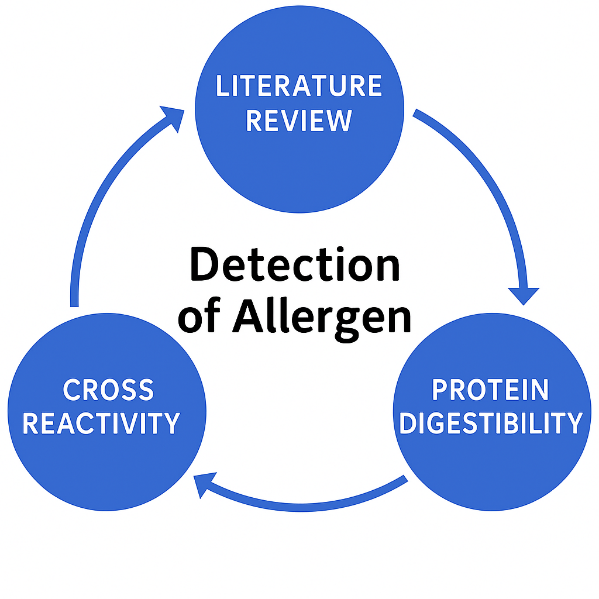
Figure 1: Allergenicity assessment
A literature review of all raw ingredients throughout the entire production process of the CCP, including its source, raw materials, and production products (e.g. scaffold material) and whether any reactions have been reported to it or its components, is to be generated and documented within the application dossier. Gaps in literature should be addressed and justified.
Information on the following should be provided to give a holistic view on the risk of new allergic proteins being present or the likelihood of cross reactivity to known allergens.
- Data from protein profiling performed as part of the compositional analysis.
- Information on the abundance of the proteins present both for the novel food and for any specific potential allergen requiring further analysis.
- Digestibility of the novel food undertaken in the ADME as a marker of stability for specific proteins.
This cycle may need to be repeated for individual components or proteins if potential areas for further investigating are identified. Allergenicity assessment is an evidence-based iterative process in which progression through successive stages depends on the availability and evaluation of data.
At this stage applicants will wish to consider if phylogenetic analysis may be required to understand if the source of the protein of interest is related to a priority food allergen and could pose a cross-reactivity risk.
Where the data above suggests further investigation is needed, on a specific protein or potentially allergic food, bioinformatic analysis of the protein of interest’s amino acid sequence can be used to explore potential cross reactivity with known allergens. Where a protein sequence of at least eighty amino acids shares 35% or more similarities with a known allergen, this should be considered for further investigation.
The following databases might be considered for use to perform an alignment search of the amino acid sequence of the protein(s) of allergenic potential:
http://www.allergenonline.org https://comparedatabase.org https://allergen.org
If there is an identified protein that may cause reactions in sensitive individuals, testing may be needed to understand the clinical relevance of the findings in humans. A human serum specific IgE binding assay (e.g. ELISA) may be performed. Where a positive result is recorded, further investigation into the allergenic potential in humans should be conducted e.g. Skin prick test and/or oral food challenges.
The assessment of allergenicity uses a weight of evidence approach integrating a range of evidence sources to understands the allergenic risks to consumers. Full analysis using all sections of this guidance will not be required for all products. Indicators found in data should determine whether the next layer of analysis is warranted.
Concludig
Concluding remarks to include in CCP applications
The information requested across all the sections should be integrated as a concise overall consideration on how it supports the safety of the CCP under the proposed condition of use.
Acknowledgements
Members of the Advisory Committee on Novel foods and Processes (ACNFP) and the Subcommittee on Cell Cultivated Products (CCPs) who provided expert views at the CCP subgroup meeting CCP01 (06/2025) and reviewed this guidance as part of ACNFP-173 meeting (08/2025).
Abbreviations
|
Acronym |
Definition |
|
ACNFP |
Advisory Committee on Novel foods and Processes |
|
ADME |
Absorption, Distribution, Metabolism and Excretion |
|
CCP |
Cell Cultivated Product |
|
DIAAS |
Digestible Indispensable Amino Acid Score |
|
DNSIYC |
Diet and Nutrition Survey of Infants and Young Children |
|
EFSA |
European Food Standards Agency |
|
ELISA |
Enzyme-Linked Immunosorbent Assay |
|
EU |
European Union |
|
FSA |
Food Standards Agency |
|
FSS |
Food Standards Scotland |
|
GB |
Great Britain |
|
GLP |
Good Laboratory Practise |
|
IgE |
Immunoglobulin E |
|
NDNS |
National Diet and Nutrition Survey |
|
OECD |
Organisation for Economic Co-operation and Development |
|
PMM |
Post Market Monitoring |
|
UK |
United Kingdom |
Definitions
|
Key Words |
Definitions |
|
Allergen |
A protein molecule which leads to an allergic response due to recognition by serum IgE from an allergic individual, or recognition of gluten proteins due to celiac disease. |
|
Batch(s) |
A defined quantity of the novel food produced under uniform conditions during a particular cycle of manufacture. The specifics of the batch are to be defined and justified by the applicant. |
|
Comparator |
A reference foodstuff with which the CCP is compared |
|
Composition |
The combination of substances that individually and collectively comprise the nutritional, toxicological and allergenic properties of the CCP intended for food use |
|
Conventional meat |
Edible tissue obtained from animal or seafood sources |
|
Cross reactivity |
Identification of structurally similar proteins |
|
Culture media |
A nutrient-rich solution used to grow cells outside of their natural organism. |
|
History of Safe Food Use (HSFU) |
A history of safe food use (HSFU) means that the safety of the food/ingredient in question has been confirmed with compositional data from experience of continued food use in the customary diet of a significant number of people in the UK or EU beginning before 15 May 1997 (Novel Food assimilated Regulation (EU) 2015/2283). |
|
Immunoglobulin E (IgE) |
Antibodies produced by the immune system involved in most food allergic responses |
|
in vitro |
Performed outside living organisms in a controlled environment, such as in a test tube. |
|
Novel food |
Foods that do not have a significant history of consumption in the UK or EU prior to May 1997, as set in the Novel Food assimilated Regulation (EU) 2015/2283. |
|
Scaffold |
A porous structure that provides a physical framework that supports cell growth by mimicking the natural extracellular matrix and allows for complex tissue-like organisation of cells in vitro. |