page
Food Standards Agency and the Institute of Grocery Distribution: working principles
Shared principles for coordinated government and industry responses to food incidents.
Summary
The Targeted Response Forum provides a structured way for earlier, cross‑sector sharing of information and signals across the food supply chain. This helps industry, regulators, non-governmental organisations (NGOs) and other stakeholders manage emerging or potential food safety, food integrity and consumer interest incidents more effectively.
The Forum was developed in response to lessons from complex incidents in recent years and focuses on collaborative awareness and coordination. It supports improved alignment when multiple brands or businesses are affected while aiming to protect consumers and maintain public confidence in the food system.
Participation is voluntary and does not provide legal advice or change any organisation’s legal or regulatory responsibilities. Clear rules of engagement set strict limits on what can be shared with the Forum prohibiting discussion of competitive matters and allowing only information already in the public domain, or aggregated historic public data to be shared.
Organisations must continue to comply with competition law and seek independent legal advice as needed (with rules maintained by the Institute for Grocery Distribution (IGD)).
The Food Standards Agency (FSA) and local authorities retain their statutory responsibilities and enforcement roles, including informing affected local authorities in the usual way and involving them in corrective and containment decisions; relevant public health authorities (such as UK Health Security Agency (UKHSA), depending on the UK nations impacted) can be invited to participate.
There is no change to how and when product recalls or public alerts are issued, nor to the FSA’s principles of transparency and requirements to inform consumers where necessary.
Vision
Connecting all relevant companies to an incident response process at the earliest opportunity, enabling a rapid industry response that protects the consumer.
Introduction
As the frequency and complexity of incidents continues to increase, there is a need for industry and the public sector bodies to work together better, to prevent, minimise and manage food incidents effectively.
This document outlines the working principles for the FSA and IGD to establish a collaborative working process to better share information during food safety, food standards and consumer interests' incidents.
Two-way information sharing with key partners including local authorities, regulatory and law enforcement bodies and those working within the food and drink sectors will be strengthened.
Objectives
- to ensure a coordinated response to food safety, integrity and consumer interest incidents
- to protect public health by preventing and managing foodborne illnesses
- to maintain public confidence in the food supply chain
- to share signals, intelligence and horizon scanning information to strengthen preventative approaches
Scope
This terms of reference applies to all food safety, integrity and consumer interest incidents that may pose a concern to the consumer including product contamination, adulteration and outbreaks of foodborne illnesses.
Incident response options
| Response | Risk | Owner | Detail |
|---|---|---|---|
| Response 1 | Specific company/product | FSA | Existing FSA incident management process (no out-of-the-ordinary forums or wider exceptional FSA communications required) |
| Response 2 | Industry wide | FSA | Current evidence gathering process to stay the same. FSA to work with existing industry and trade associations to exchange relevant information with stakeholders. |
| Response 3 | Industry wide | Industry and FSA | Relevant stakeholders (FSA, industry, relevant UK health bodies), convened in a Targeted Response Forum for situational assessment of risks, impacts and burden of response |
Response 1: Single or small number of localised companies and product
If the detected incident is attributed to a specific company or small number of companies and product, with limited number of local authorities involved.
In this case, there is no change to the existing FSA incident management prevention and response processes. No wider out-of-the-ordinary forums or wider exceptional FSA communications will be required.
Response 2: Industry wide cascade
In response to a detected risk to public health, integrity, consumer interests or consumer confidence. Where there are industry wide implications, (spanning several categories or supply chains), and the widespread cascade of information throughout industry is critical. For example, the 2025 recall of products containing garlic, possibly contaminated with peanut.
Current evidence gathering process to stay the same and no Targeted Response Forum to be created.
FSA to work with industry and trade associations to streamline and improve the process throughout the supply chain.
Response 3: Targeted Response Forum
In response to a detected risk to public health, integrity, consumer interests or consumer confidence. Where there are industry wide implications (spanning several categories or supply chains), and it is critical to convene only the parties directly affected to work collaboratively with the FSA and public health authorities to efficiently identify the cause and determine action. For example, the 2024 E. Coli outbreak linked to food to go.
Why we’re working with the Institute of Grocery Distribution
- IGD to support the FSA to convene all affected parties (in collaboration with other sectoral associations)
- IGD offer a unique role in industry - to act as an independent, trusted convener, uniting stakeholders from across the entire agrifood supply chain
- IGD work closely with relevant sectoral associations to compliment the activities and actions of the FSA’s food industry liaison group (FILG), to make sure all stakeholders are informed at the earliest opportunity to ensure a rapid response
Targeted Response Forum working principles
- either industry or the FSA will contact IGD in response to an incident where it is considered critical to convene directly affected stakeholders to work collaboratively with the FSA and relevant UK public health authorities to efficiently identify the source, cause, and determine appropriate action to protect consumers safety and interests
- industry and the FSA will advise IGD on all critical stakeholders related to the incident
- IGD (in collaboration with relevant sectoral associations) will then contact all Targeted Response Forum participants, including the relevant IGD representative, (footnote 1) industry, FSA and relevant UK public health authorities to schedule a virtual or in person meeting
- the Targeted Response Forum will be co-chaired by the representative (under the auspices of IGD) and the FSA Incident Manager
- IGD will act as an independent convener of the Forum
- minutes and actions will be recorded in the meeting by the IGD representative and circulated to all participants for an agreed accurate record of discussions, actions and decisions
- information regarding the response will be cascaded by the FSA to wider industry and wider government organisations as required (see response 2)
- sectoral association inclusion will be agreed between the FSA and the Targeted Response Forum participants
Conditions of the Forum
Participation in the Targeted Response Forum is optional. An impacted brand owner may decline to take part in the Forum. In this instance, the Forum can still take place with the agreement of other impacted brand owners.
The Forum must impact multiple brand owners to be stood up.
Threshold of incident to trigger the Forum: every incident will be appraised on a case-by-case basis, but the below principles must apply:
- multiple brand owners must be affected
- impacts must be multi-sectoral
The FSA or industry can request the Forum to be stood up through IGD and the IGD representative.
IGD rules of engagement for the Targeted Response Forum are included in a separate document.
Incident response decision tree
The below sets out an indicative decision tree for the determination of whether a Targeted Response Forum should be created. As set out in the principles all incidents will need to be appraised on a case by case basis.
Targeted Response Forum process
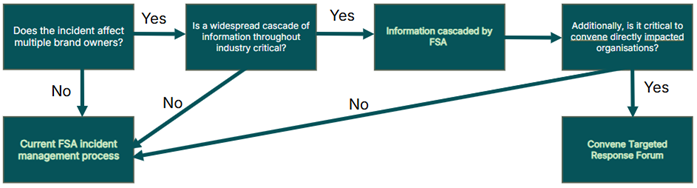
Process flow diagram for determining whether a Targeted Response Forum is appropriate for the food incident response. The process begins by asking whether the incident affects multiple brand owners. If no, the incident follows the current FSA incident management process. If yes, the next decision asks whether a widespread cascade of information across industry is critical. If no, the incident again follows the current FSA incident management process. If yes, information is cascaded by the FSA. A further decision then asks whether it is critical to convene directly impacted organisations. If no, the process returns to the current FSA incident management process. If yes, a Targeted Response Forum is convened.
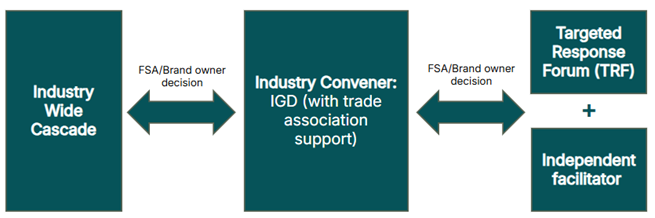
Diagram showing how information about decisions made by the FSA and Brand owners move between an industry‑wide cascade, the Institute of Grocery Distribution (IGD) as industry convener, and a Targeted Response Forum with independent facilitators. On the left is an 'Industry Wide Cascade'. A two‑way arrow labelled 'FSA and/or brand owner decision' connects this to 'Industry Convener: IGD (with trade association support)'. Another two‑way arrow, also labelled 'FSA and/or brand owner decision', connects IGD to the 'Targeted Response Forum (TRF)'. The TRF is shown working with an independent facilitator. The diagram illustrates how decisions determine whether information is managed through an industry‑wide cascade or escalated to a Targeted Response Forum convened by IGD.
Additional roles and responsibilities
FSA to communicate clear evidenced based findings or evidence of regulatory breaches findings with support from UK Health Security Agency (UKHSA), allowing for a clear and robust decision process that protects the consumer. Relevant enforcement authorities will be involved in decision making.
FSA to share written confirmation of FSA advice and the basis for the advice, based on current information, and circulated to the forum individuals as required, and agreed by data owners.
All Targeted Response Forum communications, supported by IGD will adhere to Chatham House rule and IGD’s competition compliance statement. Further details can be found in the Targeted Response Forum Rules of Engagement.
FSA and IGD to agree the need for a post incident review on a case-by-case basis after each Forum stand up. Where reviews are held, a report will be developed to capture learnings, recommendation and action owners for each recommendation.
Review
IGD Technical Leaders Forum and FSA to conduct regular reviews of ways of working to ensure its effectiveness.
Types of food incident
There as multiple ways a food incident can manifest. Examples may include:
Biological hazards
Includes microorganisms such as bacteria, viruses, parasites and fungi that can cause foodborne illnesses. Common examples are salmonella species (spp.), E. coli and listeria.
Chemical hazards
These involve harmful substances that can contaminate food, such as allergens, pesticides, food additives and toxins. Chemical hazards can be naturally occurring or introduced during food processing.
Physical hazards
These are foreign objects like glass, metal fragments, plastic pieces and stones that can cause injury or choking when present in food.
Incorrect labelling
Incorrect labelling prevents consumers having the information they need to make safe and informed choices. Examples include:
Allergen labelling
It is essential to clearly label any allergens present in the food, such as peanuts, tree nuts, celery, cereals containing gluten, milk, eggs, fish, crustaceans, molluscs, lupin, soy, mustard, sulphites and sesame.
Mislabelling allergens can lead to severe health risks for individuals with allergies.
Expiration dates
Labels should include expiration or ‘use by’ dates to inform consumers about the shelf life of the product and prevent consumption of spoiled food.
Country of origin
Indicating the country of origin can be important for traceability and for consumers who prefer products from specific regions.
Warnings and precautions
Any potential hazards, such as choking risks for small children or the presence of hazardous substances, should be clearly labelled.
Storage instructions
Proper storage instructions help maintain the safety and quality of the food. This includes information on refrigeration, freezing, or keeping the product in a cool, dry place.