Manual for Official Controls
Chapter 2.10 Inspection and Attendance
Guidance for FSA officials to allow for reduced Official Veterinarian attendance at approved slaughterhouses and game handling establishments.
Sections
1. Updated [Official Attendance at FSA approved slaughterhouses and game handling establishments]
In this section
- 1.1 Introduction
- 1.2 Classification of approved slaughterhouses and approved game handling establishments (AGHEs) in relation to official attendance during post-mortem inspection (PMI):
- 1.3 Reduced OV attendance and delayed PMI authorisation - general criteria and conditions
- 1.4 Reduced OV attendance authorisation - specific criteria and conditions
- 1.5 Delayed PMI authorisation - specific criteria and conditions
- 1.6 Particular considerations - red/white meat slaughterhouses and AGHEs
- 1.7 Implementation of reduced OV attendance and delayed PMI
- 1.8 Monitoring of reduced OV attendance and delayed PMI
- 1.9 Removal of reduced OV attendance and delayed PMI
1.1 Introduction
1.1.1 Purpose
The official controls regulations (OCR) main requirement is for an Official Veterinarian (OV) to be present, among other official controls, during the time ante-mortem inspection (AMI) and post-mortem inspection (PMI) activities are required. Nevertheless, there are circumstances in which the OCR allows for reduced OV attendance at approved slaughterhouses and approved game handling establishments (AGHEs) during the performance of PMI if certain criteria and conditions are met.
This chapter provides guidance for FSA officials to identify, risk-assess, make decisions and monitor the effective implementation of this flexibility and derogation - which are included in the OCR - that allow for a reduced OV attendance at approved slaughterhouses and GHEs. Effective implementation of these flexibilities/derogations permits the FSA an increased flexibility in the deployment of OVs and MHIs without compromising public health, animal health & welfare.
This chapter provides also a risk-based framework to aid consistent assessment and decision making in respect the authorisation, by the FSA, to implement the above-mentioned derogations in approved slaughterhouses and AGHEs.
1.1.2 Definitions
The OCR introduces two definitions of relevance:
'Under the responsibility of the official veterinarian’ means that the OV assigns the performance of an action to an MHI, and the OV is not present in the premises during the assignation of this action to the MHI.
‘Under the supervision of the official veterinarian’ means that an action is performed by an MHI under the responsibility of the OV and the OV is present in the premises during the delegation of this task to the official auxiliary who is on site.'
Legislative reference: The assimilated Official Controls Regulation (EU) 2017/625, Article 17, paragraphs a) and b).
1.1.3 Definitions specific rules on official controls and actions by the competent authorities
Article 18 of the Official Controls Regulation (EU) 2017/625 (OCR) sets out specific rules on official controls and the action taken by the competent authorities in relation to the production of products of animal origin intended for human consumption. This means that officials are required to verify the Food Business Operators (FBOs) compliance with:
- Regulation (EC) No 852/2004
- Regulation (EC) No 853/2004
- Regulation (EC) No 1069/2009
- Regulation (EC) 1099/2009 as applicable
The above-mentioned official controls cover:
- ante-mortem inspection (AMI) (including checks on animal health and welfare and clinical signs of notifiable diseases)
- post-mortem inspection (PMI)
- also, the verification of the FBOs compliance with:
- the requirements applicable to the hygiene of meat production
- the presence of residues of veterinary medicinal products and contaminants
- the handling and disposal of animal by-products/specified risk material
- the microbiological criterion
- the audits of good hygiene practices and procedures based on Hazard Analysis and Critical Control Point (HACCP) principles
- the verification of compliance with disease prevention and control measures where relevant
Legal references: Assimilated Official Controls Regulation (EU) 2017/625, Article 18, paragraphs 1 and 2.
1.2 Classification of approved slaughterhouses and AGHEs in relation to official attendance during PMI
As noted in topic 1.1.1, the OCR’s main requirement is for an OV to be present, among other official controls, during the time AMI and PMI activities are required. Nevertheless, there are two circumstances where, if certain criteria and conditions are met, the OCR allows the FSA to apply derogations/flexibilities in the deployment of OVs in approved slaughterhouses and AGHEs during the performance of PMI.
Mindful of this and in relation to OV attendance, approved slaughterhouses and AGHEs can be broadly classified as establishments with:
- Full Time OV Attendance: the OV is present in the approved slaughterhouse and the AGHE when AMI and PMI activities may be taking place and ensuring that other official control activities required by legislation are carried out. PMI might be performed by the OV or by an OA working under the supervision of the OV (OV on site)
- Reduced OV Attendance: the OV is present in the approved slaughterhouse and the AGHE when AMI and slaughtering activities may be taking place, and the PMI is performed by an OA working under the responsibility of the OV (OV not on site) and ensuring that other official control activities required by legislation are carried out
- Delayed PMI (also known as “cold inspection”): the OV is present in the approved slaughterhouse and AGHE when AMI may be taking place (in the case of approved slaughterhouses) and the PMI, which must be performed by an OV, is delayed by a maximum period of 24 hours from slaughter (in the case of slaughterhouses) or arrival to the AGHE
The implementation of Reduced OV attendance and Delayed PMI in approved slaughterhouses and AGHEs must be authorised by the FSA. Authorisation by the FSA is granted as long as certain criteria and conditions are met.
Legislative references:
- Article 18 paragraph 2 (c) of the assimilated Official Controls Regulation (EU) 2017/625
- Article 7 of assimilated Regulation (EU) 2019/624
- Article 13 (1) of assimilated Regulation (EU) 2019/627.
1.3 Reduced OV attendance and delayed PMI authorisation: general criteria and conditions
1.3.1 Introduction
A risk assessment is to be carried out by FSA officials to determine whether Reduced OV attendance and/or Delayed PMI can be implemented at specific approved slaughterhouse or AGHE.
The FSA has developed a risk-based framework to aid consistent risk-assessment and decision making in respect the authorisation, by FSA officials, of establishments for the purposes of authorising Reduced OV attendance or delayed PMI (also known as ‘cold inspection’).
The risk-based framework includes the completion, by FSA officials, of a risk-assessment form (annex 1), a post-implementation monitoring 6 months after initial authorisation and a risk-assessment review to be performed annually or as often as necessary.
This section 1.3 provides guidelines for officials on the General Criteria and Conditions that must be met for the authorisation, by the FSA, of Reduced OV attendance and/or Delayed PMI inspection in approved slaughterhouses and AGHEs.
1.3.2 General criteria and conditions
Approved slaughterhouses and/or AGHEs can only be authorised by the FSA to implement Reduced OV attendance or Delayed PMI as long as the following two criteria and conditions are met:
- the approved slaughterhouse/AGHE meet the definition of ‘low capacity’
- the slaughterhouse/AGHE slaughter handle less than 1,000 Livestock Units (LSU) or less than 150,000 poultry, lagomorphs or small wild game per year
The FSA risk assessment form (annex 1) reflects, at section 1, the above-mentioned criteria and conditions.
Legislative reference: Article 7 (1) (a) of assimilated Regulation (EU) 2019/624
1.3.3 Definition of low-capacity
‘Low-capacity slaughterhouse’ means a slaughterhouse in which slaughtering takes place only during part of the working day (considering a whole working day as 8 hours or more) or takes place during the whole working day but not on each working day of the week (considering that the week has 5 working days).
‘Low-capacity game-handling establishment’ means a game-handling establishment in which game-handling takes place only during part of the working day (considering a whole working day as 8 hours or more) or takes place during the whole working day but not on each working day of the week (considering that the week has 5 working days).
Legal reference: Article 2 paragraph 17 and 18 of assimilated Regulation (EU) 2019/624.
1.3.4 Conversion rates for livestock units (LSU)
Livestock units are defined in Article 13 of Regulation (EU) 2019/627 and in article 7 of Regulation (EU) 2019/624. The table below reflects the conversion rates in line with the above-mentioned regulations. These conversion rates must be used to assess if the establishment meets the throughput threshold, established by the OCR, to authorise Reduced OV attendance or Delayed PMI.
| Species | Livestock units |
|---|---|
| Adult bovine animals (more than 300 kg live weight) | 1 |
| Other bovine animals | 0.50 |
| Equidae | 1 |
| Pigs with a live weight over 100 kg | 0.20 |
| Other pigs | 0.15 |
| Ovine and caprine animals and small (<100 kg live weight) Cervidae | 0.05 |
| Lambs, kids and piglets of less than 15 kg live weight | 0.05 |
| Large game | 0.2 |
1.4 Reduced OV attendance authorisation: specific criteria and conditions
1.4.1 Introduction
Other than the general criteria and conditions noted in section 1.3, approved slaughterhouses and AGHEs can only be authorised by the FSA to implement Reduced OV attendance as long as specific criteria and conditions are met. Section 1.4 provides guidelines for officials to risk-assess the specific criteria and conditions that must be met for the authorisation, by the FSA, of Reduced OV attendance in approved slaughterhouses and AGHEs.
The FSA risk assessment form (annex 1) reflects, at section 3, the specific criteria and conditions to be considered when carrying out the risk-assessment. These criteria & conditions are briefly described below.
1.4.1.2 Facilities for storage of meat with abnormalities
The approved slaughterhouse/AGHE must have adequate facilities for storage of meat with uncommon conditions for OV to inspect in person, for all species slaughtered.
1.4.1.3 Number of carcases slaughtered/handled and throughput/working pattern
The following points are to be considered for the authorisation when carrying out the risk-assessment:
- The establishment’s capacity /daily throughput/ species of animals slaughtered or handled (in the case of AGHE) and the speed of the line should be assessed and deemed acceptable
- OAs should have enough time to inspect all carcases and body parts as per regulations, including enough time to assess and put aside meat with uncommon conditions for OV inspection
- FBO should ensure that only young and healthy animals are slaughtered, or adequate arrangements should be in place for slaughter of older animals (older animals are likely to have a greater number of abnormalities normally requiring OV attention)
1.4.1.4 Establishment’s performance and compliance history
The FSA authorisation for reduced OV attendance should only be granted in establishments with good compliance history utilising the outcomes from the last completed FBO audit and other intelligence gather from the delivery of official controls:
- ‘Good’ or ‘Generally satisfactory’ outcome of the last FSA audit
- any non-compliances raised by the FSA team are promptly resolved by the FBO (no need to routinely escalate to formal enforcement, hygiene improvement notice (HINs), remedial action notice (RANs)
- good welfare standards – no ‘critical’ welfare non-compliances
- Food safety management system/-s based on HACCP principles effectively implemented and maintained (including adequate controls over removal and disposal of specified risk material (SRM), as appropriate)
- the history of the performance of slaughter / meat handling activities
1.4.1.5 Scenarios which require procedures in place for OV attendance at the approved slaughterhouse/AGHE during PMI
Unless instructed otherwise by the FSA, the activities and circumstances which require OV attendance at PMI (OV on site during the performance of the PMI by the OA) are detailed below. FBO must have, and effectively implement, procedures in place for OV attendance in the case of:
- animals originating from farms under animal health movement restrictions. FBOs should not accept animals originating from farms under animal health restrictions unless provisions are made for the post-mortem inspection to be carried out under the supervision of the OV
- cattle from herds not declared officially free of TB
- cattle, sheep and goats from herds that have not been declared officially free of brucellosis (BR)
- an outbreak of a notifiable animal disease to which the animals concerned are susceptible and which come from the affected region
- AGHEs, if the hunter’s declaration refers to TB the OV must make a professional judgement and inform APHA using TB5.
- confirming identity and verify correct disposal of carcases when a non-negative BSE test result is received
1.4.1.6 Ante-mortem arrangements/ ante- and PMI records (last 3-month period)
Positive ante-mortem release system must be implemented and maintained in approved slaughterhouses to ensure that only animals that have undergone ante-mortem inspection have been slaughtered for human consumption.
FSA ante and post-mortem inspection records for the establishment wishing to implement reduced OV attendance should not indicate frequent and regular findings that would require OV consultation / inspection.
1.4.1.7 Official inspection tasks
The OV must be allowed sufficient time to carry out, as described in section 1.1 at point 1.1.3, specific official control tasks (i.e., ante-mortem inspection in approved slaughterhouses) and as appropriate, verification activities including carry out enforcement. However, the Regulations do not require OVs to remain at an establishment once they have completed their responsibilities as above unless they have identified public, animal health and / or welfare issues that require their continued presence.
Before Reduced OV Attendance arrangements are implemented, the Field Veterinary Co-ordinator (FVC) and OV must be satisfied that there are adequate and suitably trained staff and effective FSA procedures in place to cover and provide assurances on:
- In regards to PMI - all animals slaughtered/hunted for human consumption must be subject to PMI as per regulations.
- SRM removal and handling, as appropriate - the OV is expected to use the ‘Risk Based Decision Tool (RBT) for SRM Inspections’ on a regular basis to set the frequency of checks as per chapter 2.7 on ‘Specified risk material controls. Depending on the frequency that was set (daily / every 5 days), the FSA team must carry out all SRM removal, handling and disposal verification checks as per details in chapter 2.7 on ‘Specified risk material controls’
- ABPs – FSA team must verify that all ABPs are correctly identified, stained and stored until collection as per the instruction in chapter 2.8 on ‘Animal by-products’
- animal identification – daily FSA cattle ID checks must be carried out to the frequency set by the OV (based on FBO’s compliance history) as per chapter 2.5 on ‘Animal identification’, section 4
- sampling – all required sampling takes place, and samples are appropriately identified and handled and sent to the appropriate laboratory for testing
- cleaning and disinfection (C&D) checks – team must ensure that C&D checks are carried out as per the frequency set for the plant
- records keeping and data input – a system must be in place to ensure that all records are kept and maintained, and all data is correctly and timely inputted into relevant systems
1.5 Delayed PMI (commonly known as ‘cold inspection’): specific criteria and conditions
1.5.1 Introduction
In scenarios when neither the OV nor the OA are present in the approved slaughterhouse or AGHE during slaughter and dressing, PMI can be delayed by a maximum period of 24 hours from slaughter or arrival in the AGHE provided a number of criteria and conditions are met (i.e., in slaughterhouses, the OV leaves the establishment once ante-mortem inspection duties have been performed and returns later to carry out post-mortem inspection).
Other than the general criteria and conditions noted in section 1.3, approved slaughterhouses and AGHEs can be authorised by the FSA to implement Delayed PMI as long as specific criteria and conditions are met. This section provides guidelines for FSA officials to risk-assess the specific criteria and conditions that must be met for the authorisation, by the FSA, of Delayed PMI in approved slaughterhouses and AGHEs.
The FSA risk assessment form (annex 1) reflects, at section 4, the specific criteria and conditions to be considered when carrying out the risk-assessment to authorise an establishment for Delayed PMI. These specific criteria & conditions are briefly described below.
Legislative reference: Article 13 (1) of assimilated Regulation (EU) 2019/627
1.5.2 The size of the FBO establishment and the type of animals processed
The approved slaughterhouse/AGHE must have adequate facilities and space which allow for:
- the slaughter (not applicable for AGHEs) and dressing of animals in compliance with Food Hygiene, TSE and Animal By-Products legislation
- the storage of carcases, offal and by products in compliance with Food Hygiene, TSE and Animal By-Products legislation whilst awaiting, a maximum period of 24 hours, for the performance of PMI by the OV
- slaughter (not applicable in AGHEs), dressing and storing of carcases (and carcase parts) including red and green offal so that robust correlation can be ensured. This is especially important for determining the age and identification of each animal and which carcases, part carcases and offal, can be health marked and passed fit for human consumption
1.5.3 PMI to be undertaken by the OV within a maximum period of 24 hours from slaughter or arrival in the AGHE
Arrangements must be agreed between the FBO and the ITL (see section 1.7 at point 1.7.7 in relation to the statement of resources (SOR)) to ensure adequate level deployment including for the PMI to be performed by the OV within a maximum period of 24 hours from slaughter or arrival to the approved slaughterhouse/AGHE.
1.5.4 Official inspection tasks
The OV must be allowed sufficient time to carry out, as described in section 1.1 at point 1.1.3, specific official control tasks as necessary (i.e., ante-mortem inspection in approved slaughterhouses, post-mortem inspection tasks) and as appropriate, verification activities (i.e., ABP, hygiene practices related verification activities) including carry out enforcement.
1.6 Particular considerations – red/white meat slaughterhouses and AGHEs
1.6.1 Performance of PMI by the OV in red/white meat slaughterhouses and AGHE
There are specific circumstances which require post-mortem inspection to be performed by an OV. These circumstances are:
- animals that have undergone emergency slaughter
- animals that are suspected of having a disease or condition that may adversely affect human health or animal health
- as noted in section 1.5, post-mortem inspection is to be performed by an OV in approved slaughterhouses and AGHEs authorised by the FSA to delay PMI a maximum period of 24 hours
- as instructed by the FSA, when stricter controls are necessary to take account of emerging diseases or diseases listed by the WOAH
Legislative reference: Article 8 of assimilated Regulation (EU) 2019/624
1.6.2 OV attendance at post-mortem inspection in poultry slaughterhouses
The OA may discard abnormal poultry meat. Uncommon abnormal meat does not need to be systematically inspected by the OV; however:
- the OV must have time to complete their specific inspection duties to inspect the viscera and body cavities of a representative sample of birds each day (statistically a minimum of 300 birds per day)
- the OV must have time to undertake a detailed inspection of a random sample of rejected carcases / parts of carcases from each batch of birds
1.6.3 Poultry premises with delayed evisceration (to differentiate from delayed PMI)
The OV/OA/plant inspection assistant (PIA) shall inspect all carcases and viscera following delayed evisceration. In establishments where PIAs are utilised, the OV must always attend during the evisceration process.
Where the OAs are carrying out PMI the FVC shall establish an OV site visit routine to verify operations dependant on throughput and general assessment.
The FBO must contact the FSA’s Inspection Team Leader at least 24 hours in advance so that the FSA can arrange for adequate supervision levels.
1.7 Implementation of reduced OV attendance or delayed PMI
1.7.1 FBO role
If an FBOs wishes to apply for Reduced OV attendance or Delayed PMI, the FBO needs to discuss their eligibility with their FSA ITL in the first instance during SOR meetings. The ITL should then contact the local FVC and inform the FVC of the FBO’s request. Any risks identified because of the OV not being on site during PMI must be fully considered by the FBO and the FSA.
1.7.2 FSA roles
FVC Role
The FVC is responsible for the co-ordination of tasks necessary to assess the suitability of the establishment for the FSA authorisation of Reduced OV attendance and Delayed PMI.
If the situation arises in which a FVC identifies an opportunity for an establishment to implement Reduced OV attendance or Delayed PMI, the FVC should make contact with the FBO and the ITL to explain/discuss the process including the general and specific criteria and conditions that must be met to allow the FSA authorisation.
Field Veterinary Leaders
FVLs will consider the decisions made at premises within the different clusters in their area for consistency of application.
Inspection Team Leaders
The ITLs/SDPs as appropriate, must ensure that OAs can fulfil the official controls as delegated by the OVs in the absence of the OV at individual premises.
ITLs shall adapt the SORs to capture the official attendance discussed and agreed with the FBO and the FVC (see Point 1.6.7 below for guidance).
Changing Business Implementation (CBI) Team
The CBI Team will maintain an accurate record of premises where Reduced OV attendance and/or Delayed PMI arrangements are implemented.
1.7.3 OV role
OVs support the FVC by providing relevant information/intelligence that helps with the risk-assessment (annex 1) and decision-making, by the FVC, to authorise Reduced OV attendance and/or Delayed PMI.
1.7.4 Examples where flexible attendance should be considered
Each establishment is different and opportunities for flexible attendance will vary. There are, however, common aspects that should be considered when looking at the operational pattern, process details and options for reduced level of official controls.
As an example, the following operational scenarios could indicate to the local FSA team and FBOs that there are opportunities for Reduced OV attendance:
- scheduled arrivals of animals allowing for planning of operations and OAs carry out post-mortem inspection under the responsibility of the OV
- several approved slaughterhouses and/or AGHEs located in the same local geographical area, one OV could attend multiple premises while OAs carry out PMI under the responsibility of the OV
1.7.5 Risk-assessment of approved slaughterhouses and AGHEs
The FVC should carry out a risk-assessment of each establishment in conjunction with the OV and FBO, taking into consideration the operating practices and agreed operating hours, using the assessment form for the authorisation of Reduced OV attendance PMI under the responsibility of the OV at annex 1.
| Step | Assessment process |
|---|---|
| 1 | FVC agrees a date with the FBO, OV and contractor AVM and visits the premises to carry out the assessment |
| 2 | FVC discusses the outcome of the assessment with a relevant FVL |
| 3 | FVC populates the outcome of the risk-assessment in annex 1 |
| 4 | FVC informs the ITL / Operations Manager (OM) / Head of Operational Delivery (HOD) about the recommendation, in writing |
| 5 | ITL notifies OV, contractor AVM and FBO about the recommendation and agrees SOR |
| 6 | FVC shares the completed annex 1 form with the Change Business Implementation (CBI) Team at CBI@food.gov.uk |
1.7.6 Appeals
Appeals by the FBO against the decision of the FVC should be made through the Statement of Resources appeal system.
1.7.7 Statement of resources
The Statement of Resources (SOR) meetings between the FSA and FBOs capture the service requirements for official controls. The Charges for Controls in Meat Premises guidance will help assess these service requirements and best options for delivery.
SORs must capture the flexibility arrangements agreed with the FBO in the other business information section of the SOR template. Inspection Team Leaders (ITLs) should capture the Reduced OV attendance or Delayed PMI on the SOR as follows:
- Outline the FVC recommendation of OV Flexibilities
- Capture broadly any flexible start/ finish time of the OV as recommended by the FVC liaising with the FBO and OV
- System for OV/FBO communications in adopting the flexibility recommendations, for example, a 1-hour reduction of OV attendance on a particular day for ante-mortem activities may be agreed daily between OV and FBO with a note made in the daybook by OV
ITLs must make business decisions for the SOR to establish the most cost-efficient service which may result from the FSA authorisation of Reduced OV attendance at individual premises. The OV may be retained on site carrying out other inspection duties thereby reducing other elements inspection team costs such as premium rate working of employed inspectors.
The OV may continue to provide a versatile resource in the team carrying out meat inspection, CCIR activities, detention line work and other monitoring and verification which must be considered by ITLs to establish the most cost-efficient service at individual establishments.
1.7.8 Comparison between full time OV attendance, reduced OV attendance and delayed PMI ('cold inspection')
The following chart shows the comparison between Full time OV attendance and Reduced OV attendance requirements:
| Full time OV attendance | AMI | PMI |
|---|---|---|
| Slaughterhouses | OV | OV / OA / PIA |
| AGHEs | N/A | OV / OA |
| Reduced attendance | AMI | PMI |
|---|---|---|
| Slaughterhouses | OV | OV / OA part time as necessary |
| AGHEs | N/A | OV / OA part time as necessary |
| Delayed PMI (cold inspection) | AMI | PMI |
|---|---|---|
| Slaughterhouses | OV | OV |
| AGHEs | N/A | OV |
1.8 Monitoring establishments with reduced OV attendance or delayed PMI
1.8.1 Monitoring
Establishments with Reduced OV attendance and/or Delayed PMI arrangements in place must be regularly monitored to verify the general and specific criteria and conditions that allow for the FSA authorisation are still met.
FBOs must be able to demonstrate that the implementation of Reduced OV attendance or Delayed PMI does not compromise or introduce additional public health, animal health and welfare risks.
As part of FSA monitoring, the FVC is required to carry out tree different assessments:
Post implementation assessment – to be carried out 6 months after the initial authorisation of Reduced OV attendance or Delayed PMI; following this assessment, the FVC must make a note of this visit in the Day-book and if there is evidence that an establishment is not fulfilling the criteria and conditions outline in annex 1, the FVC must populate annex 1 with the relevant findings and share the completed form with the CBI Team at CBI@food.gov.uk. Guidelines on the removal of the FSA authorisation are detailed in section 1.7.
Triggered assessment – to be carried out by the FVC, if there is evidence that an establishment no longer fulfils any of the criteria and conditions to maintain the above-mentioned arrangements (based on audit outcome, welfare concerns, compliance history or changes to operational procedures); the FVC should complete ‘Assessment for OV Flexible Attendance’ at annex 1 and shared the completed form with the CBI Team at CBI@food.gov.uk.
Annual review assessment – to be carried out by the FVC on an annual basis. The FVC must complete annex 1 to verify the establishment continue meeting the general and specific criteria and conditions that allow for the authorisation of Reduced OV attendance and/or Delayed PMI. The completed form must be sent to CBI at CBI@food.gov.uk.
Monitoring and triggers for review are as follows:
Audit outcome (Improvement Necessary / Urgent Improvement Necessary) – The FVC should monitor FSA audit data to assess performance of establishments. Plants that have previously been assessed as suitable for OV flexibilities falling into Improvement Necessary / Urgent Improvement Necessary FBO audit outcome categories must have OV flexibilities reviewed by the FVC. Where Urgent Improvement Necessary / Improvement Necessary audit score is a result of ongoing enforcement and open non-compliances, the OV flexibility should be removed. However, if the non-compliances are historic and closed, the local FSA team (FVC / FVL) should decide whether the OV flexibility should be removed / reduced or not.
Compliance of FBO – Establishments with flexible attendance in place but where hygiene standards have dropped (formal notices) or critical welfare NCs have been found should have the flexibility assessment arrangement reviewed/removed. FVC and contract OV/AVM communications should be established locally to ensure prompt action in these cases.
Changes to operational procedures – level of flexibility might need to be assessed if FBO or OV notifies the FVC of changes to operational procedures at the establishment (for example, changes in pattern, animal delivery, type of animals processed). FVC and contract OV/AVM communications should be established locally to ensure prompt action in these cases.
1.8.2 Outcome of FVC assessments
Following the completion of any assessment, the FVC should confirm to the ITL if the levels of attendance can be maintained (or further decreased).
In cases where the FVC gathers sufficient evidence that criteria and conditions for Reduced OV attendance and Delayed PMI are no longer met, the FVC must recommend an increased in the level of OV attendance by means of removing the FSA authorisation as detailed in section 1.7 Removal of authorisation for Reduced OV attendance and Delayed PMI.
1.8.3 Assessment of performance of official auxiliaries for establishments authorised for reduced OV attendance
The performance of OAs deployed in establishments authorised for Reduced OV attendance should be regularly assessed by the OV as follows:
- PMI verification checks which will allow OVs to monitor PM performance and accuracy of judgement
- OV should verify monthly that PMI records are accurate, and all procedures are followed. Records of that verification should be kept in the FSA Day Book
1.9 Removal of FSA authorisations for reduced OV attendance and delayed PMI
1.9.1 Review
The FSA authorisation for Reduced OV attendance and Delayed PMI are not permanent arrangements. This flexibility and derogation can be removed by FSA officials as/if necessary. If the FVC finds, as part of the monitoring assessment as noted at section 1.6, sufficient evidence that the criteria and conditions for Reduced OV attendance and/or Delayed PMI are no longer met, the FVC must recommend increasing the level of official attendance at the establishment by means of removing the FSA authorisation. In these scenarios, the FVC should follow the process steps below.
Note: The OV hours will be reviewed at each SOR meeting.
1.9.2 Process steps
The table below details process steps that should be followed during the review of flexible attendance arrangement by the FVC:
| Step | Process Steps |
|---|---|
| 1 | Outcome of the FVC risk-assessment (annex 1) indicates that the criteria and conditions for Reduced OV attendance and/or Delayed PMI are not met. |
| 2 | FVC discusses the outcome of the visit and evidence gathered with the relevant FVL. |
| 3 | FVC informs the ITL / OM / HOD about the recommendation to increase official attendance, in writing. |
| 4 | ITL notifies FBO about the recommendation and agrees SOR. |
| 5 |
FVC populates the outcome of the risk-assessment in annex 1 and shares the completed form with the Change Business Implementation (CBI) Team at CBI@food.gov.uk |
1.9.3 Appeals by the FBO
Appeals by the FBO against the decision of the FVC should be made through the Statement of Resources appeal system.
2. PIA system
In this section
- 2.1 Introduction
- 2.2 Legislation
- 2.3 Assessment arrangements
- 2.4 Roles and responsibilities
- 2.5 Establishment permit assessment
- 2.6 Establishment monitoring assessment
- 2.7 Withdrawal of establishment permit
- 2.8 Hybrid PIA / FSA systems
- 2.9 TUPE considerations
- 2.10 Assessment process for poultry establishments wishing to move to PIA system
- 2.11 Assessment process for poultry establishments already using PIAs
2.1 Introduction
This section outlines a standardised process to assess suitability of poultry slaughterhouses to use Poultry Inspection Assistants (PIAs) to carry out official control duties.
2.2 Legislation
Regulation 2017/625 Article 18(3) permits the use of slaughterhouse staff in establishments slaughtering poultry or lagomorphs to assist in the performance of tasks relating to official controls on the basis of a risk analysis and on condition that staff:
- act independently from the production staff of the slaughterhouse;
- have undergone appropriate training to carry out these tasks; and
- carry out these tasks in the presence and following the instructions of the official veterinarian or of the official auxiliary.
Slaughterhouse staff shall comply with the minimum training requirements set out in Chapter II of Annex II Regulation (EU) 2019/624 to the extent relevant for their assistance tasks.
2.3 Assessment arrangements
The FSA is responsible for carrying out a risk assessment on those premises wishing to implement a PIA system or to move from a MHI to a PIA system to confirm that they have a robust food safety management system in place. This is done through the “Establishment Permit Assessment” which is separate to the approval process.
The “Establishment Permit Assessment” will be carried out at each specific plant requesting the use of PIAs. There are three different scenarios detailed below:
Scenario 1
For plants using MHIs moving to a PIA system, the risk analysis is based in past FBO performance, so provided there is evidence of a sustained and effective food safety management system based on HACCP principles in place for at least six months, a PIA system can be implemented after the assessment as per MOC instructions has been completed.
If an FBO has been compliant for the previous 6 months and has sufficient number of PIAs trained and ready to operate, the implementation of the PIA system can be done without any delay (see point 2.9).
Scenario 2
For an approved establishment already using PIAs moving into new premises or changing ownership, the FSA can decide, on a case by case basis, if the timings to permit the introduction of the PIA system in the new establishment can be reduced. That can be done for instance by carrying out the assessment of the PIA system in the previous establishment, by temporarily supervising the PIA procedures in the new site with a small team of inspectors, or a mixture of measures appropriate to each case.
In this second scenario, the PIA implementation process can take just a few days, if the FBO had a history of compliance in the previous site and the PIA team is ready to move in.
Scenario 3
For a newly approved establishment with no previous history of PIA usage, the risk analysis considers that the FBO shall provide evidence of a sustained and effective food safety management system based on HACCP principles which in this case will be assessed throughout the approval process, which in normal circumstances will last between 3 and 6 months. Once a full approval is granted, the FBO can implement a PIA system, provided it meets the MOC assessment criteria.
In this last scenario, the PIA implementation process can take between 3 and 6 months, which should allow the FBO Food Safety Management System to be fully implemented, and to train and develop the PIA pool.
Following the implementation of the PIA system, in order to ensure a consistent approach, assessments must also be completed regularly on the establishment’s suitability to continue with PIA systems. This is known as the “Establishment Monitoring Assessment”. This assessment should be based on the effectiveness of the implementation of the FBO food safety management systems, PIA performance and capability of the PIAs to address hygienic and process issues. This interim monitoring assessment will take place at least once between full audits and/or when the competent authority considers necessary.
2.4 Roles and responsibilities
2.4.1 Head of Field Operations / Operations Head Veterinarian
The Head of Field Operations is the owner of this process with the Operational Head Veterinarian having the ultimate responsibility for all technical aspects.
2.4.2 ITL
The decision making process will take place at a cluster / business area level. ITLs, with the ultimate support of their HOD, will manage operational implications and will determine timescales for introduction of any changes, in consultation with the FBO and FVC / FVL. Human resources colleagues will provide support on staffing issues.
2.4.3 FVC
FVCs will be required to carry out necessary technical assessments in their clusters, on behalf of the HOD.
The FVC will use information provided by the OV and local FSA Team on the day-to-day running of the business by the FBO when making their assessment. They should discuss any resource implications with the ITL.
2.4.4 FVL
Where further assurance or guidance is required (for example, where the FBO does not agree with the FVC decision), an FVL may provide additional technical advice.
The FVL may also carry out the establishment assessments or provide advice to the ITL / FVC / HOD on the best course of action if technical issues arise.
2.4.5 Approvals and registrations team
The Approvals and Registrations Team will be responsible for the administration of the establishment permit process. They will maintain copies of the permit visit reports and keep records of all assessed establishments centrally. Following a successful establishment assessment, a letter will be sent from the Approvals and Registrations Team to the FBO confirming the establishment’s PIA permit.
They will also be responsible for coordinating the withdrawal of the establishment’s PIA permit if required.
2.4.6 Central Support Unit in York (CSU)
CSU will be responsible for keeping records of the establishment monitoring assessment visits and linking these to the audit frequency. A monitoring visit will be carried out between full audits or at any other time if the FVL/FVC considers it is necessary.
In addition, CSU will be responsible for the administration of the PIA authorisation and withdrawal processes.
2.4.7 OV
The OV is responsible for PIA assessments and constant monitoring of their performance. With regards to practical arrangements for post-mortem inspection in plants with PIA systems, the OV (or the official auxiliary (OA), if applicable) shall personally carry out a daily inspection of the viscera and body cavities of a representative sample of birds of each flock.
- The number of birds included in the flock’s representative sample shall be decided by the OV (or the OA) following a risk assessment based on data obtained from the Food Chain Information, AMI of the flock, daily post-mortem inspection findings, and any other relevant data.
- Article 2(3)(b) of retained Regulation (EC) No 2160/2003 defines “flock” as all poultry of the same health status kept on the same premises or in the same enclosure and constituting a single epidemiological unit; in the case of housed poultry, this includes all birds sharing the same airspace.
- The number of birds checked per flock and the outcomes, should be recorded in the daybook.
Legislative references:
- Retained Regulation (EU) 2019/627, Article 25(1)(a)
- Retained Regulation (EC) 2160/2003, Article 2(3)(b)
2.5 Establishment permit assessment
2.5.1 Notify ITL
An FBO should make a request to transfer to a PIA system to the ITL, who should inform the FVC / FVL at the earliest opportunity. The ITL will need to consider staffing implications and impact on existing FSA staffing at the premises.
2.5.2 FVC / FVL action
The FVC must visit the establishment and complete relevant parts of the ‘Assessment of PIA systems in poultry slaughterhouses’ PIA 4 form (annex 10). A technical decision is required on whether the necessary systems are in place and PIAs are trained as required (see chapter 10 section 3 on PIA training). This assessment should be completed in accordance with deadlines established by the FVC (FVL) and ITL (in consultation with the FBO).
2.5.3 Suitable outcome
In this instance the ITL and FVC / FVL will discuss time-scales and operational management of the process with the FBO.
The FVC / FVL should email a copy of the completed PIA 4 form to the Approvals and Registrations Team. The team should update the central record of assessed establishments, send an authorisation letter to the FBO and notify CSU of the outcome.
2.5.4 Unsuitable outcome
The FVC / FVL should share their findings with the FBO and ITL and include the reasons behind their decision in writing. An action plan should be provided by the FVC / FVL of the areas that need improvement with a proposed timescale. The FVC / FVL should monitor progress towards addressing the necessary requirements. Once corrective actions are implemented the FVC / FVL must carry out a further assessment within the proposed timescales, or earlier upon the request of the FBO.
After the further assessment has been completed, the FVC / FVL should notify the FBO and ITL of the outcome and email a copy of the completed PIA 4 form to the Approvals and Registrations Team for information and filing. The Approvals and Registrations Team should update the central record of assessed establishments and send a copy of the report to the FBO.
2.5.5 Appealing the outcome of a refused establishment permit assessment
Where the FBO does not agree with the FVC / FVL decision, they may appeal to the Operations Head Veterinarian. The Operations Head Veterinarian is responsible for appointing an FVL / FVC from a different area as an Investigating Officer.
The Investigating Officer (IO) will have 14 days to gather the required evidence, conduct the investigation and submit a report with findings and conclusions to the Operations Head Veterinarian.
The Investigating Officer might consider visiting the premises before concluding the report.
Upon completion of the investigation the Operations Head Veterinarian will advise the FBO of the outcome of the appeal in writing.
2.6 Establishment monitoring assessment
2.6.1 Monitoring
All establishments permitted to use PIA system shall undergo a regular monitoring assessment to determine if the food safety management systems continue to be effectively managed by the FBO.
The frequency of the monitoring assessment will be risk based and correlated with the audit frequency of the establishment.
At least one plant assessment should be carried out by FVC / FVL between full FBO audits. The frequency of the monitoring assessments is based on the current audit system outcome; establishments with the lowest audit score should be assessed at least once every two months and the best performing plants once every 18 months.
Monitoring
| Audit outcome | Full audit frequency |
|---|---|
| Good | 18 months |
| Generally satisfactory | 12 months |
| Improvement necessary | 3 months |
| Urgent Improvement necessary | 2 months |
An additional establishment monitoring assessment can be triggered, regardless of the audit frequency, if serious concerns are raised by FSA field team regarding poor level of compliance (for example, sudden decline in hygiene standards, insufficient staffing levels, serious HACCP failures).
For establishments awarded poor audit scores (‘Improvement Necessary’ or ‘Urgent Improvement Necessary’) an assessment should be carried out as soon as possible from the date of the audit report being sent to FBO.
During the assessment the FVC / FVL should complete relevant parts of the establishment assessment PIA 4 form.
Where the FVC / FVL already has a good knowledge of the establishment, it may be possible to complete the monitoring assessment as a desk-based exercise, in consultation with the establishment OV. Establishments falling within the Improvement Necessary / Urgent Improvement Necessary categories should be visited.
2.6.2 Suitable outcome
The establishment is considered suitable to continue with its PIA system. In this instance, the FVC / FVL will complete the establishment assessment PIA 4 form and discuss their findings and decision with the FBO, also informing the ITL of the outcome. A copy of the PIA 4 form should be sent to CSU.
2.6.3 Minor deficiencies outcome
The establishment has minor deficiencies that must be addressed to allow the FBO to continue using PIA systems. The FVC / FVL should advise the FBO in writing on corrective actions that are considered necessary to ensure that the PIA inspection system can continue. The FVC / FVL should also provide a reasonable time-scale for the completion of such actions.
In conjunction with the establishment OV, the FVC / FVL will monitor progress to ensure that the identified deficiencies are addressed. The FVC / FVL should use their professional judgement to decide if a further establishment visit is necessary. A copy of the PIA 4 form should be sent to the CSU.
2.6.4 Major deficiencies outcome
The establishment has major deficiencies that must be corrected to allow the FBO to continue using PIA systems. Where there are major deficiencies – such as serious or multiple hygiene breaches, poorly implemented / maintained food safety management system, PIAs failing to perform their duties to the required standard and / or allowing unhygienic / unfit product to enter into the food chain - the FVC / FVL should discuss findings with the FBO and ITL.
A support MHI may be introduced onsite as an interim measure until the necessary deficiencies are addressed. This will need to be within a short timescale, depending on the nature of the risks.
The FVC / FVL should provide the FBO with a written summary of identified deficiencies and a clear timeframe to rectify them.
In conjunction with the slaughterhouse OV, the FVC / FVL should monitor the establishment to ensure that the identified deficiencies are addressed.
The FVC / FVL should carry out an additional monitoring assessment within an agreed timeframe. In this assessment, the FVC / FVL must consider whether:
- the FBO has remedied the deficiencies;
- an extension to the MHI support role is needed; or
- a full reversion to a MHI system is necessary.
The ITL will need to consider operational implications and should liaise with their HOD and FVC / FVL as appropriate. A copy of the PIA 4 form should be emailed to the CSU.
Note: Reverting back to a MHI system should only happen as a last resort, where it is clear that arrangements are unsatisfactory and that the FBO is not taking appropriate responsibility to implement corrective actions and ensure that public health is safeguarded.
2.7 Withdrawal of establishment PIA permit
Where very serious deficiencies are identified during the routine monitoring assessment visit the FSA local management might consider increasing the level of official controls in the premises and deployment of additional FSA staff.
- FVC / FVL communicates to the FBO the deficiencies identified during the monitoring assessment and provides a timeframe for rectification. All identified issues and non-compliances have to be communicated to the local FSA management (ITL, HOD) at the same time.
- FVC / FVL is required to reassess the establishment within the agreed timeframe to evaluate improvement.
- FVC / FVL must communicate the outcome of the second assessment to the FBO and confirm the suitability of the PIA system or recommend to the Operations Head Veterinarian a withdrawal of establishment PIA authorisation if the observed improvement was not satisfactory.
- Findings of the FVC / FVL reassessment and recommendation made by FVC / FVL must be discussed within the local FSA team. Sufficient evidence supporting the recommendation should be presented to the Operations Head Veterinarian.
- Operations Head Veterinarian assesses the presented evidence and advises the FBO and the local FSA team in writing of his decision.
2.8 Hybrid PIA / FSA systems
Hybrid PIA / FSA systems may be acceptable under exceptional circumstances, for example, in larger industrial slaughterhouses where MHIs carry out online inspection duties at certain inspection points, and others are manned by PIAs. Typically, though, an FBO would be expected to have an OV only; an OV plus MHI team or OV plus PIA(s) model in place.
As described above, use of support MHIs may also be accepted as an interim measure at slaughterhouses using PIAs where it is judged that premises have major measurable deficiencies which must be corrected to allow the FBO to continue using PIA systems.
2.9 TUPE considerations
The Transfer of Undertakings (Protection of Employment) (TUPE) 2006 Regulations preserve employees' terms and conditions when a business or undertaking, or part of one, is transferred to a new employer. The FSA has received legal advice that the transfer from FSA MHI to PIA systems (or reverse) could be challenged under the TUPE 2006 Regulations.
ITLs must be aware of possible implications of TUPE when discussing staffing options with FBOs of poultry slaughterhouses and should consult with Human Resources colleagues in this event. Opportunities for redeployment within the FSA will still need to be considered, in the normal way.
It remains a commercial decision for the FBO in determining whether to move to a PIA system. FBOs wishing to implement a PIA system must seek their own legal advice on the impact of TUPE.
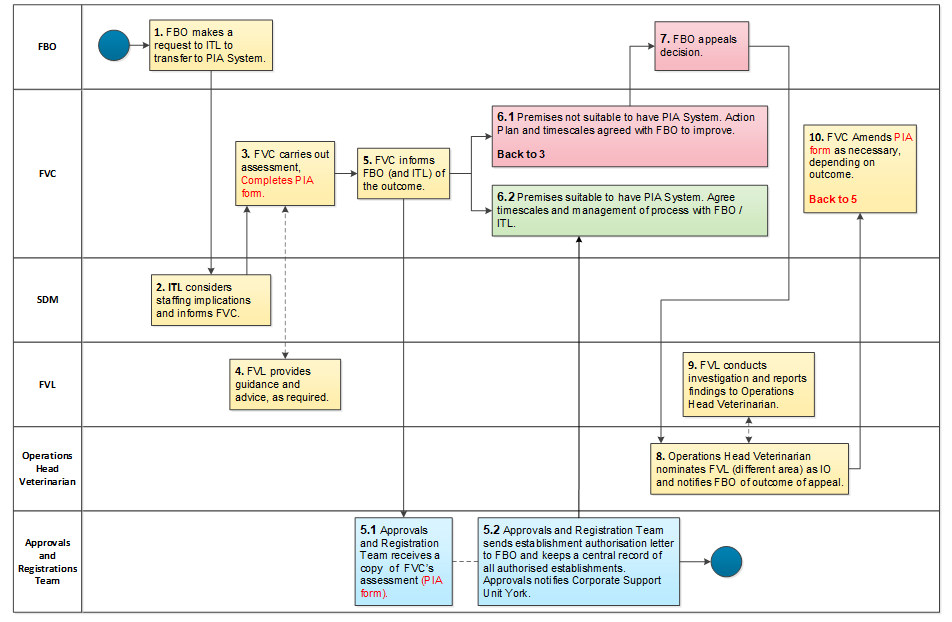
2.10 Assessment process for poultry establishments wishing to move to PIA system
The table below summarises the steps that need to be taken when assessing establishments that wish to move to the PIA system – as detailed in the chapter.
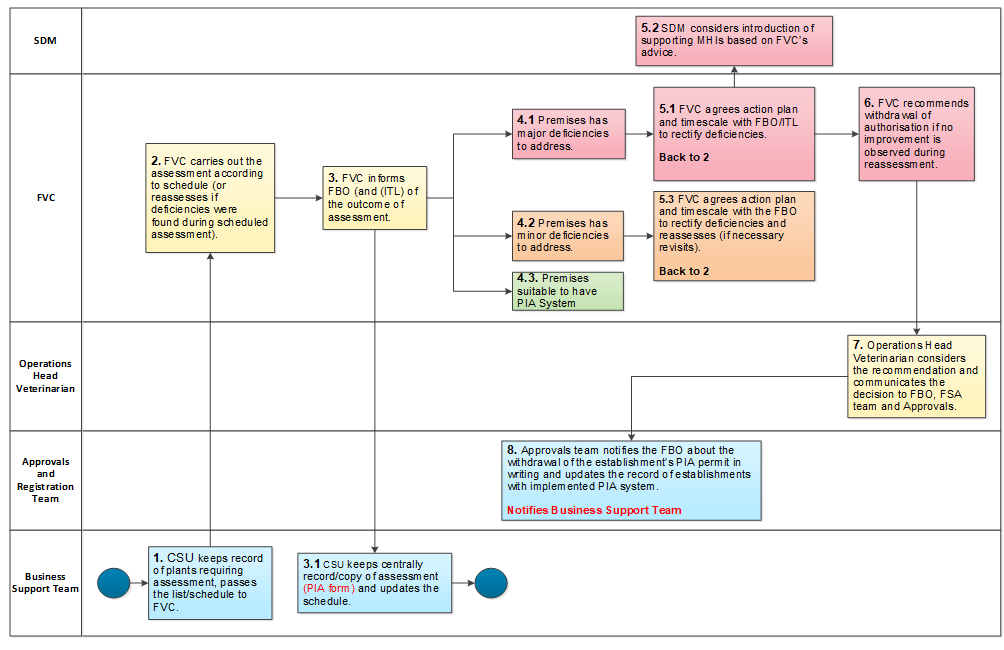
2.11 Assessment process for poultry establishments already using PIAs
The table below summarises the steps that need to be taken when assessing establishments already using the PIA system – as detailed in the chapter.
3. Inspection in co-located cutting plants
3.1 Introduction
3.1.1 Objective
This document sets outs the FSA Operational Policy for the inspection of co-located cutting plants (Co-CPs).
3.1.2 Legislation
Articles 18 (1) and (2) (d) of the retained Official Controls Regulation (EU) 2017/625 (OCR) lay down the requirements on official controls and the action to be taken by the competent authority (CA) in relation to the production of products of animal origin intended for human consumption, among others, in cutting plants.
3.2 OV inspection in co-located cutting plants
3.2.1 Cutting plants co-located with slaughterhouses and/or Game Handling Establishments (GHEs)
Many slaughterhouses and/or GHEs have a co-located cutting plant. Approved cutting plants co-located to a slaughterhouse and/or an GHE are also subject to official controls.
Retained Regulation (EU) 2019/627 sets down specific requirements for auditing activities performed by the Competent Authority (CA). The audits at FSA meat approved establishments are performed by the Veterinary Auditors or Audit Veterinary Leaders. How the FSA carries out audits in meat approved establishments can be found in Chapter 4.1 (Audit).
In order to verify food business operator's compliance, as per Article 14 of the OCR, audits have to be supplemented with regular inspections. In co-located cutting plants, these inspections are usually carried out by the OV or by Official Auxiliaries (OAs), working under the supervision of the OV. The frequency of these audits and inspections are determined on a risk-based approach.
In stand-alone cutting plants, the FSA has a programme of Unannounced Inspections (UAI) linked to the audit outcome defining the frequency of these UAI. The procedures for UAIs are detailed in Chapter 4.7
3.2.2 OV attendance
The level of OV attendance and frequency of the audits and inspections are outlined in chapter 4.1 (Audit).
In particular, chapter 4.1, sections 1.1.1 (OV presence) and 1.3 (Relationship between audit visits and OV attendance) cover the attendance by OVs and/or OAs at cutting plants depending on whether they are co-located with a slaughterhouse or GHE or are stand-alone cutting plants. In both cases, cutting plants need to be inspected between audits.
3.2.2.1 OV attendance at co-located CP (Co-CP)
At cutting plants co-located with slaughterhouses and/or GHEs, the OV is to determine the frequency at which to carry out inspections of the co-located establishment, so that compliance in all approved activities is verified.
The frequency of inspections is risk based and may vary depending on several factors, for example, approved activities, weekly throughput, export activities… To determine the frequency of those inspections, the OV should use the Co-CP risk-based decision tool (annex 5).
This tool will help the OV determine if the inspections of the Co-CP should take place weekly, monthly or bi-monthly. Those inspections need to be recorded using the Co-CP inspection report. The duration of those visits will depend on the size and volume of the operation. The time spent undertaking those inspections and completing the report needs to be recorded in the timesheet against the appropriate code for the co-located establishment.
In addition to this, OVs are also expected to walk around the co-located establishment regularly, but there is no need to record this time against the Co-CP or to produce a full report of these extra visits.
OVs should use the decision tool quarterly or, in sites where the Co-CPs operates less than 3 days per week, annually, and record the outcome in the plant daybook.
If there are any operational changes in the Co-CP or any concerns, the OV can amend the level of checks in consultation with the FVC accordingly. Any changes need to be reviewed regularly.
Co-CPs may need to be visited more regularly than the frequency obtained using the risk-based decision tool, for activities including SRM removal supervision, verification of export requirements; For example, where the OV is required to provide support health attestations (SHA) to facilitate exports from the co-located establishment, the number of inspections needs to allow for the OV to be able to verify compliance with the requirements for which veterinary certification is being provided. These visits can be used to support the formal inspection of the Co-CP, however there would still be a need to complete the formal inspection/report in addition to those. If the number of visits is more than the number required by the risk tool, there is no need to produce a report every time. Any deficiency however needs to be brought to the attention of the FBO and recorded in the daybook and Chronos as per the MOC instructions.
3.2.2.2. OV attendance on co-located cutting plants operating outside the normal operating hours.
At Co-CPs where the operations take place outside the normal operating hours of the slaughterhouse and the OV is not in attendance, the unannounced inspections (UAIs) are arranged centrally by the FSA and are carried out by other OVs or by OAs.
In establishments approved for ready to eat products (RTE), the inspections can only be undertaken by authorised and RTE trained OVs or authorised and RTE trained OAs. An increased frequency of visits is expected in RTE establishments reflecting the higher risk of the products being produced.
3.2.3 Record of the inspections
OVs and/or OAs need to record the findings of the inspections. The reports to be used are available via the K2 system.
In the case of Co-CPs, findings of the inspections need to be included in the daybook as well as in the specific report. Guidance on completion and storage of the co-located CP inspection report is available in annex 6.
4. Annexes
The following documents can be accessed by FSA staff in internal files:
- Annex 1: OV Flexible Attendance – Assessment
- Annex 2: Updated: [Removed ]
- Annex 3: PIA – Assessment of PIA systems in poultry slaughterhouses (PIA 4)
- Annex 4: Updated: [Removed ]
- Annex 5: Risk based decision tool for inspections to co-located cutting plants
- Annex 6: Guidance for the completion of the co-located cutting plant inspection report
Revision log
Published: 14 January 2022
Last updated: 9 February 2026