Precision bred organisms: application guidance
Guidance for applicants requiring a food and/or feed marketing authorisation for a Precision Bred Organism (PBO).
Precision bred organisms (PBOs) are plants or animals where the genetic makeup of the organism has been altered using techniques of modern biotechnology (such as gene editing) in a precise way.
Precision bred organisms (PBOs) are plants or animals where the genetic makeup of the organism has been altered using techniques of modern biotechnology (such as gene editing) in a precise way. To qualify as a PBO, the changes to the organism must be those that could have also been achieved through traditional breeding methods.
Precision breeding does not include organisms that contain DNA that isn’t present in the non-modified organism or in sexually compatible species. These organisms remain classified as genetically modified organisms (GMOs) and regulated as such. You can find guidance on applying for a food and feed marketing authorisation of a GMO on our website.
Before a PBO can be used in food or feed and placed on the market in England, it must first be authorised.
Guidance for applicants requiring a food and/or feed marketing authorisation for a Precision Bred Organism (PBO).
Obligations on food and feed businesses (“General Food Law” and other statutory requirements)
All food and feed businesses have a duty to ensure that the food and feed they market is compliant with existing food and feed safety legislation. Under Assimilated Regulation (EC) 178/2002, food must not be marketed if it is injurious to health or is unfit for human consumption. Animal feed fed to food producing animals must not have an adverse effect on human or animal health, or make the food derived from the animal unsafe for human consumption.
Before considering their application, applicants should have regard to existing duties and requirements imposed by the overarching regulations that underpin food safety in the UK.
In addition to complying with the specific requirements for the authorisation of a PBO for use in food and feed, all food and feed businesses are expected to exercise appropriate due diligence in ensuring food and feed containing or consisting of PBOs is safe. The FSA provides food businesses with guidance to help make sure they understand their statutory obligations under food and feed law.
The FSA has published technical guidance to support applicants throughout the application processes outlined in Regulations 20 and 22 of The Genetic Technology (Precision Breeding) Regulations 2025. It explains the level of due diligence we would expect food and feed business operators to exercise to ensure that the food and feed that they are producing is as safe as is reasonably possible, as well as specific measures that should be taken into account when determining which regulatory route applies to their PBO. It is not intended to be a comprehensive guide on food or feed safety and applicants are expected to refer directly to food and feed safety legislation and guidance in addition to this.
As the food safety authority, the FSA has the statutory function of providing advice and information on matters related to food and feed safety or other consumer interests in relation to food and feed. Our technical guidance serves to support compliance with the statutory requirements in law. It establishes best practice on what the FSA considers the key considerations that must be made to ascertain the safety of a PBO.
The requirements are not exhaustive, and applicants should consult the FSA if there are any key factors not outlined in the guidance that they have identified through due diligence that may impact the safety of the PBO (or any food or feed produced from it). Applicants can contact the FSA at regulatedproducts@food.gov.uk.
The Genetic Technology (Precision Breeding) Regulations 2025 establish enforcement powers for Local Authorities in England to monitor compliance and take action on non-compliance with the Regulations. Local Authorities also have existing powers in The Food Safety Act (1990) to take action on food and feed businesses where precision bred food or feed is found to be unsafe and to prosecute those responsible.
The Genetic Technology (Precision Breeding) Act and The Genetic Technology (Precision Breeding) Regulations 2025
Before a PBO can be used in a food or feed product and placed on the market in England, it must be authorised under The Genetic Technology (Precision Breeding) Regulations 2025. The Regulations are made under powers established in The Genetic Technology (Precision Breeding) Act 2023. The Regulations outline the statutory requirements on applicants to consider the safety of the use of their PBO in food and feed and submit an application under the correct regulatory route.
Pwysig
Application for a precision bred confirmation
Before you can apply to the Food Standards Agency for a food and feed marketing authorisation for a precision bred organism, you must first obtain a precision bred confirmation from the Secretary of State for Environment, Food and Rural Affairs. You must do this by submitting a marketing notice to Defra in line with the requirements in the Genetic Technology (Precision Breeding) Regulations 2025.
Defra has published new guidance documents to support the understanding of the Genetic Technology (Precision Breeding) Regulations 2025, including the PBO confirmation process, on its website.
Under the requirements in The Genetic Technology (Precision Breeding) Act, The Advisory Committee on Releases to the Environment (ACRE) will provide a recommendation to the Secretary of State on the marketing notice before the Secretary of State determines whether to issue a precision bred confirmation. The statutory time limit for ACRE to consider the marketing notice is 90 days.
All confirmed PBOs will be published by Defra on its public register.
Applications to the FSA for a PBO food and feed marketing authorisation that do not include the precision bred confirmation issued by the Secretary of State will not be considered valid.
Application for a food and feed marketing authorisation
There are two routes to authorisation for PBOs used in food and feed, set out Regulation 20 and Regulation 22 of the Genetic Technology (Precision Breeding) Regulations 2025:
Regulation 20 ('Tier 1'): PBOs that are very similar to traditionally bred varieties, which consumers are familiar with and for which potential safety risks are understood. Applicant-led Tier 1 safety assessments are required but there is no requirement for a Tier 2 FSA safety assessment.
Regulation 22 ('Tier 2): PBOs with traits where the risks are not fully understood. Specifically, this would include novelty or PBOs that have compositional changes which could affect nutritional quality, toxicity or allergenicity, or other safety concerns where potential food and feed safety risks need further consideration. A bespoke Tier 2 FSA safety assessment is required, including a more detailed examination of the characteristics of the PBO.
Prior to applying for a food or feed marketing authorisation, applicants to complete a Tier 1 safety assessment to determine the correct regulatory route for their PBO. The technical guidance outlines this process in detail. PBOs are to be assessed against the following criteria:
- History of Safe Food Use - whether the PBO belongs to a species that has a history of safe food use in that its safety as food has been confirmed with compositional data and from experience of continued food use in the customary diet of a significant number of people in the United Kingdom or the European Union beginning before 15 May 1997
- Composition - whether the application of modern biotechnology introduces genetic changes that are expected to:
- Significantly alter the nutritional quality of the organism as it is being consumed as food or feed at the date of the application in a way that is likely to be disadvantageous to the consumer
- Significantly elevate the toxicity of any food or feed produced from the precision bred organism
- Alter the allergenicity of any food or feed produced from the precision bred organism
- Other safety concerns - Whether the application of modern biotechnology introduces any additional features that may affect the safety of any food or feed produced from the precision bred organism
The FSA’s technical guidance provides instructions for how applicants are expected to complete a Tier 1 safety assessment to determine which regulatory route to apply through. The guidance also provides details on the information to provided for either a Regulation 20 {Tier 1) or Regulation 22 (Tier 2) application.
Batching of PBOs
The Genetic Technology (Precision Breeding) Regulations 2025 allow applicants to include multiple PBOs in their application, provided that the requirements in Schedule 4(1)(3)(d) are met for all PBOs to which the application relates. The information provided in the application must be representative of all PBOs in the batch.
All PBOs included in the application to the FSA must be covered by the same marketing notice and subsequent precision bred confirmation issued by the Secretary of State. Multiple PBOs included in the same marketing notice provided to Secretary of State must meet the requirements in Regulation 5(4) of the Genetic Technology (Precision Breeding) Regulations 2025.
New PBOs cannot be retrospectively added to an existing precision bred confirmation. Should modern biotechnology be used to produce a new PBO which contains the same genetic changes as one which has previously been granted a precision bred confirmation, a new marketing notice must be submitted to the Secretary of State. Similarly, any PBOs intended to be used in food and feed and subject to a new marketing notice would require a new food and feed application to be submitted to the FSA.
Guidance for applicants requiring a food and/or feed marketing authorisation for a Precision Bred Organism (PBO).
Before you apply
Before applying, applicants must have a marketing notice from Defra. Applicants should then complete the “Tier 1 safety assessment” of their PBO using the FSA’s technical guidance. Applicants must have determined the correct regulatory route for which they should apply through and have the necessary information to evidence their conclusions.
Application process
To apply for an authorisation of a PBO for use in food and feed in England:
- Use our regulated products application service to complete the application. This is where you will be asked to provide information on your PBO to support your application.
- You should adhere to the mandatory information requirements in Schedule 4 of the Genetic Technology (Precision Breeding) Regulations 2025 and supporting technical guidance provided by the FSA.
- For all applications, you will need to submit the relevant marketing notice provided to the Secretary of State (and supporting documents) as well as the relevant precision bred confirmation issued by the Secretary of State. If you are submitting a Regulation 20 (Tier 1) application, you will be required to provide explanatory statements to demonstrate how you have reached your conclusions from the Tier 1 safety assessment process that there are no safety concerns relating to all of the criteria.
- As outlined in the technical guidance if you are submitting a Regulation 22 (Tier 2) application, you will be required to submit complete, unredacted copies of the evidence you used to make the explanatory statements for each safety concern that has arisen following the Tier 1 safety assessment process under one or more of the food/feed safety criteria. This may include, but is not limited to, test results, scientific analyses, data studies, surveys or scientific records. This will enable FSA officials to review the evidence and conduct a Tier 2 safety assessment. The outcomes of this assessment will be used to determine whether the PBO can be recommended for authorisation.
Application requirements
The mandatory information requirements are listed in Schedule 4 of the Genetic Technology (Precision Breeding) Regulations 2025. All applicants are expected to provide the following:
- name, organisation and contact details of the applicant
- complete, unredacted copies of the relevant marketing notice provided to Defra and supporting documents
- the relevant precision bred confirmation issued by the Secretary of State
- where the confirmation covers more than one PBO, a full list of all PBOs and the genetic change(s) in each PBO
- information on the organism and the genetic change(s), including a description of how the edible part of the PBO is affected
- statements in relation to each criterion (novelty, nutritional quality, toxicity, allergenicity and other safety concerns)
- any request for confidentiality of any information provided (including justification for the request)
During the application process you will be asked to complete the following sections in our regulated products application service:
- Type of application – Whether you are applying under Regulation 20 (Tier 1) or Regulation 22 (Tier 2)
- Applicant and organisation details – If your PBO is granted authorisation for use in food and feed, the authorisation holder’s name (or organisation) and address will be published on the public register.
- Application summary – A brief summary of the application.
- PBO details and safety information – This is where you will need to upload any relevant confirmation documents and enter information including:
- the confirmed Defra PBO reference (as issued by Defra at confirmation and listed on the Defra public register)
- identity of the PBO (genus and species)
- the intended use of the PBO (whether for food use, feed use, or both)
- a description of the genetic change and how this change affects the edible part of the organism
- a description of the purpose of the genetic change (e.g., to confer drought or disease resistance)
- for each criterion in Regulation 20(1)(b) and (c), you will need to declare the outcome from your Tier 1 safety assessment and provide a descriptive statement detailing your conclusions
- you will be asked to upload supporting evidence and corresponding explanatory statements for any of the criteria under which safety concerns have been identified or for which the conclusion is one of uncertainty and a Tier 2 assessment is needed.
5. You will also be asked to complete a statement outlining any requests for confidentiality of information provided as part of your application and a statement of truth declaring the information you have provided to be accurate.
How long will my application take?
The length of the approval process will vary depending on the regulatory route and the complexity of the application. In most cases, we expect to submit recommendations to the Secretary of State for approval of a PBO for use in food and feed around two months from receipt of a Regulation 20 (Tier 1) application.
Applications made under Regulation 22 (Tier 2) will take longer than this to allow for a bespoke safety assessment based on the conclusions provided in the application. Less complex Regulation 22 (Tier 2) applications are expected to take around twelve months, with more complex applications taking up to 24 months.
The quality of the application, and the information provided, will significantly affect the time needed for assessment and authorisation. For all applications (under Regulations 20 and 22), we encourage applicants to follow the technical guidance and provide as much information as possible to ensure we can process your request as efficiently as possible.
Regulation 20 (Tier 1) applications
Verification
Following receipt of a Regulation 20 (Tier 1) application, FSA officials will undertake a verification process. This will involve checking that the required information has been provided. The Genetic Technology (Precision Breeding) Regulations 2025 require applications made under regulation 20 (Tier 1) to be sufficiently detailed to allow the FSA to assess the application, having regard to the nature and scale of the application. The FSA may, at their discretion, request further information, including evidence, in support of the application as part of the verification process.
If you have requested confidentiality of any information provided in your application, this will be considered as part of the verification process.
Information provided will be used to inform a report to the Secretary of State; and is also required for the public register of PBOs authorised for use in food and feed.
Regulation 22 (Tier 2) applications
Verification
Following receipt of a Regulation 22 (Tier 2) application, FSA officials will undertake a verification process. This will involve checking that the required information has been provided to enable a bespoke safety assessment to be conducted by FSA officials, and that the required information has been provided for publication on the public register of PBOs authorised for use in food and feed.
If you have requested confidentiality of any information provided in your application, this will be considered as part of the verification process.
Tier 2 Safety Assessment
Once the FSA has verified the application, the FSA will assess the supplementary scientific evidence provided by the applicant for each of the criteria associated with a potential safety concern. The technical guidance provides applicants with information on the types of scientific data that should be submitted to the FSA for each of the criteria and applicants can submit any other scientific evidence they feel is relevant to their application. Given that each PBO may have a different combination of potential safety concerns, each PBO will be assessed on a case-by-case basis. There may be circumstances where additional specific information is required to demonstrate safety and where this arises, the FSA will request further information from the applicant.
Following the tier 2 safety assessment, and in line with the FSA risk analysis process, the FSA will consider risk management factors such as the outcomes of the safety assessment, other legitimate factors associated with the application, and of any new information obtained through any public consultation, before a recommendation is made to the Secretary of State.
What happens next?
PBOs that have been authorised for use in food and feed and placed on the public register are free to be placed on the market (in England) as long as they are compliant with any conditions or limitations set out in the authorisation.
PBOs placed on the market in England will be subject to the same standards as their traditionally bred equivalents and food and feed business operators handling PBOs are expected to meet their statutory obligations in relation to food and feed safety as is the case with any food or feed.
“Qualifying Progeny” of PBOs authorised for use in food and feed
The Genetic Technology (Precision Breeding) Regulations 2025 establish the qualifying progeny of authorised PBOs as within scope of the regulatory framework. New applications are not required for the qualifying progeny (as defined by Section 24 of the Genetic Technology (Precision Breeding) Act 2023), but businesses are prohibited from marketing food and feed containing varieties with precision bred features without prior authorisation for the precision bred element of those varieties. This means that breeders and developers are able to use authorised PBOs in traditional breeding cycles without seeking a new authorisation for food and feed uses, however any conditions and limitations attached to the PBO authorisation must be complied with when considering further breeding cycles.
Precision breeding and other regulated products
Some PBOs may be subject to further regulation depending on their intended use. For example, some regulated products could be developed using PBOs. Before using an authorised PBO in the development of a new regulated product (for example, a food enzyme or flavouring), guidance should be sought on the regulatory requirements for the new product.
Assimilated Regulations in other areas of regulated products have been amended by the Genetic Technology (Precision Breeding) Regulations 2025 to reflect these requirements. In the case of Assimilated Regulation (EC) 2015/2283 on novel foods (“Novel Food Law”), an amendment has been made to remove precision bred plants from the scope of Novel Food Law (in England). Similar amendments have also been made to Regulation (EC) No 1829/2003 and 1830/2003 to explicitly remove precision bred plants from the scope of GMO Food and Feed regulation (in England). These amendments mean that precision bred plants will not require assessment under either the GMO or novel foods regulatory frameworks.
Guidance for applicants requiring a food and/or feed marketing authorisation for a Precision Bred Organism (PBO).
This page is part of the Regulated products application guidance.
Following authorisation, it is the duty of the authorisation holder and any businesses placing an authorised food or feed produced from the PBO on the market to ensure that the PBO is being used in line with the authorisation, including any conditions or limitations that have been imposed.
The FSA’s technical guidance provides advice to applicants on how to consider potential uses of their PBO in food and feed, and how this may have an impact on the overall safety of the end product; however, we appreciate that not all intended uses of the PBO in food and feed will be known at the time of application.
If the authorisation holder or any business placing (or intending to place) food and feed produced from the PBO becomes aware of any changes in circumstances that may affect the safe use of the PBO on the market, they must advise the FSA immediately.
In many cases, it is likely that any change in circumstance may be sufficiently covered by existing food and feed legislation. In these instances, the FSA will be able to provide advice on how to manage any potential safety risks. In some cases, the FSA may need to conduct further assessment of the PBO in order to consider whether any variations need to be made to the authorisation in the context of the change in question. For example, if the PBO is intended to be processed in a way that would otherwise be considered a novel process under Novel Food Law (and this process has not been assessed previously under the relevant framework) the FSA may need to conduct further assessment of the novel process before the PBO can be used in such a way.
Should the FSA be made aware of any information or evidence that justifies further assessment of the PBO, the authorisation holder or business using the PBO may be asked to provide additional information to support the assessment.
Should any variation to the authorisation or new conditions or limitations be required, these changes will be reflected on the public register .
Revocation of a market authorisation
Under Regulation 33 of the Genetic Technology (Precision Breeding) Regulations 2025, the Secretary of State may revoke a food and feed marketing authorisation should new evidence come to light that calls into question the safety of the PBO as it is used in food and/or feed. In the event of any such evidence being made available, the authorisation holder will be given the opportunity to respond before an authorisation is revoked.
Under Regulation 7 of the Genetic Technology (Precision Breeding) Regulations 2025, the Secretary of State may revoke a precision bred confirmation relating to a PBO if they are no longer satisfied that the PBO is precision bred. Since precision bred confirmation is a prerequisite for the lawful marketing of food and feed produced from a precision bred organism, a revocation of this manner will automatically lead to a revocation of the subsequent food and feed market authorisation.
UK internal market
The Genetic Technology (Precision Breeding) Regulations 2025 apply only in England. However, under the market access principles of The United Kingdom Internal Market Act 2020 (UKIMA), food and feed produced from authorised PBOs in England can be sold into Wales and Scotland. The UKIMA market access principles do not, however, extend to the further processing of such goods moved into Wales and Scotland. Any precision bred food/feed which is subject to further processing in Wales or Scotland before being placed on the market would be subject to legislation regulating the use of Genetically Modified Organisms (GMOs) in food and feed.
In Northern Ireland, only food and feed which meets the criteria of the Northern Ireland Retail Movement Scheme can be moved into and placed on the market in Northern Ireland.
Getting help
Organisations intending to apply to the FSA for market authorisation of a PBO can request support through our Precision Breeding Business Support Service (BSS) before submitting their application. Please review the guidance provided on the BSS webpage and complete the accompanying enquiry form.
Please also refer to the technical guidance when making your application.
The Genetic Technology (Precision Breeding) Regulations 2025 have come into force on the 13th November 2025, which means businesses can apply for a Precision Bred Organism (PBO) food and feed marketing authorisation.
The Genetic Technology (Precision Breeding) Regulations 2025 have come into force. Applicants must first apply to Defra for PBO confirmation and marketing authorisation. Once this is granted, applicants can then apply to the FSA for a food and feed marketing authorisation.
Applicants should follow the instructions in the PBO technical guidance to conduct a safety assessment of their PBO and determine the correct application route. Further details of the application process can be found here.
Update on Technical Guidance for Precision Bred Organisms (PBOs)
In February 2025, the Food Standards Agency (FSA) published draft Technical Guidance for applicants seeking authorisation of Precision Bred Organisms (PBOs) for food and feed use. Since then, we have worked closely with stakeholders through workshops and surveys to ensure the guidance is clear, practical, and meets the needs of prospective applicants. Participants included small and medium enterprises, academia, seed breeders, and industry representatives such as the British Society of Plant Breeders (BSPB).
Feedback highlighted the need for clearer technical language, a concise explanation of Tier 1 and Tier 2 data requirements, guidance on selecting information sources, and a clearer distinction between PBO and GMO safety assessments. In response, the FSA has revised the guidance to improve clarity and usability. Updates include simplified text, additional figures and definitions, a benchmark references section, and formal instructions for conducting a hypothesis-led Tier 1 safety assessment. A shorter, streamlined version of the guidance will also be available.
These improvements were validated through follow-up workshops, which confirmed that the changes enable applicants to confidently undertake Tier 1 assessments and identify the correct regulatory route for their PBO. The revised guidance has also been reviewed by the Advisory Committee for Novel Foods and Processes (ACNFP) Subcommittee on Products of Genetic Technologies Destined for Food and Feed Purposes.
We would like to thank all stakeholders for their valuable input, which has strengthened the guidance and ensured it supports innovation while maintaining safety.
Next steps
The Precision Breeding Technical Guidance can be viewed below.
To receive further updates on market authorisations, please sign up to our market authorisations newsletter.
You can now use our online service to make a regulated product application.
Guidance for organisations intending to apply to the Food Standards Agency (FSA) for market authorisation of a precision bred organism (PBO).
Pwysig
Please consider the following supporting documents before submitting a request:
In some instances, useful information can also be found in other guidance:
- Novel food - The novel food consultation process (also known as an Article 4 consultation request) is available to businesses who are unsure of the novel food status of their product(s) and have evidence of a significant history of consumption of the food in the UK or European Union (EU) prior to May 1997. This may be used when unsure whether the species a PBO from has a relevant History of safe food use (Section 11).
Organisations intending to apply to the Food Standards Agency (FSA) for market authorisation of a precision bred organism (PBO) can request support through the FSA’s Precision Breeding Business Support Service (BSS) before submitting their application. Please review the guidance provided and complete the accompanying enquiry form.
Who is eligible for BSS
To be eligible to engage with the BSS, prospective applicants must:
- Be a registered company in one or more jurisdictions, or an organisation which will be represented by such a company for their application.
- Intend to submit an application for market authorisation of a precision bred organism(s) to the Food Standards Agency, and
- Submit a fully completed pre-submission enquiry form following the process outlined in the section titled ‘Engaging with the BSS’. Requests submitted through any other channel, including the Regulated Products Inbox, will not be processed.
Items falling within the scope of the BSS
General advice on rules, guidelines, and content requirements for applications seeking authorisation to place a PBO on the food or feed market in England, as set out in the relevant legislation and guidance, including:
- High-level advice on the market authorisation process.
- Guidance on conducting a Tier 1 safety assessment.
- Information or evidence to be submitted as part of an application under Regulation 20 (Tier 1) or Regulation 22 (Tier 2).
What is not covered by the BSS function
- Information that goes beyond that which is available in the legislation or technical guidance.
- Formal review or consultation on draft dossiers (or parts of).
Engaging with the BSS
To engage with the service, prospective applicants must submit a pre-submission enquiry form.
The FSA will acknowledge receipt of the enquiry form within 20 days.
FAQs for those making precision breeding applications.
This resource should be read in conjunction with the FSA’s regulated products application guidance and the FSA’s technical guidance for Precision Bred Organisms.
The “Precision Breeding Act 2023 and the Genetic Technology (Precision Breeding) Regulations 2025” (‘the Regulations’) are designed to provide a proportionate, science-based regulatory system for the authorisation of precision bred food and feed.
The FSA’s framework ensures that precision bred food and feed is as safe as traditionally bred food and feed. The FSA’s tiered approach to precision bred food and feed ensures that those organisms, where the risk is well understood, can move through the regulatory process swiftly through an applicant led Tier 1 safety assessment. For more significant changes to the organism or how it will be used, a bespoke safety assessment through Tier 2 provides assurance that food and feed is safe for consumption.
Applications via the Regulation 20 (Tier 1) route consist of statements using clear descriptive text that justify how the precision bred organism meets the applicant’s conclusions to the Tier 1 safety assessment. Where appropriate these statements should include quantitative values to support the conclusions. Submission of detailed quantitative data studies or dossiers is not required but applicants should hold any supporting evidence relevant to their Tier 1 safety assessment.
If precision bred and traditionally bred organisms are equivalent, why do applicants have to provide so much information on PBOs?
All food and feed businesses – whether marketing traditionally bred organisms (TBOs) or precision bred organisms (PBOs) - have a duty to ensure that the food and feed they market is compliant with existing food and feed safety legislation. Under Assimilated Regulation (EC) 178/2002 known as “General Food Law” food must not be marketed if it is injurious to health or is unfit for human consumption. Animal feed fed to food producing animals must not have an adverse effect on human or animal health, or make the food derived from the animal unsafe for human consumption.
Before considering an application for precision breeding food and feed marketing authorisation, applicants should have regard to existing duties and requirements imposed by the overarching regulations that underpin food safety in the UK.
In addition to complying with the specific requirements for the authorisation of a PBO for use in food and feed, all food and feed businesses are expected to exercise appropriate due diligence in ensuring food and feed containing or consisting of PBOs is safe. The FSA provides food businesses with guidance to help make sure they understand their statutory obligations under food and feed law.
There is no evidence that PBOs are intrinsically more hazardous than TBOs. However, this is a new and rapidly developing technology. This means tiered safety assessment, proportionate to the level of potential risk, is appropriate. This provides both the relevant level of scrutiny for individual PBOs to ensure that potential safety risks are identified and effectively managed, whilst also providing consumer reassurance.
What is the difference between Tier 1, Tier 2, Regulation 20 and Regulation 22?
Under the Genetic Technology (Precision Breeding) Regulations 2025 (‘The Regulations’) all PBOs must undergo a Tier 1 safety assessment, which is an applicant-led safety assessment to determine whether the criteria in Regulation 20 (1) have been met. If they are, a Regulation 20 (Tier 1) application is made to the FSA. If during the Tier 1 assessment an applicant determines that one or more of the criteria in Regulation 20 (1) have not been met, a Regulation 22 (Tier 2) application must be made for the FSA to complete a safety assessment for the PBO.
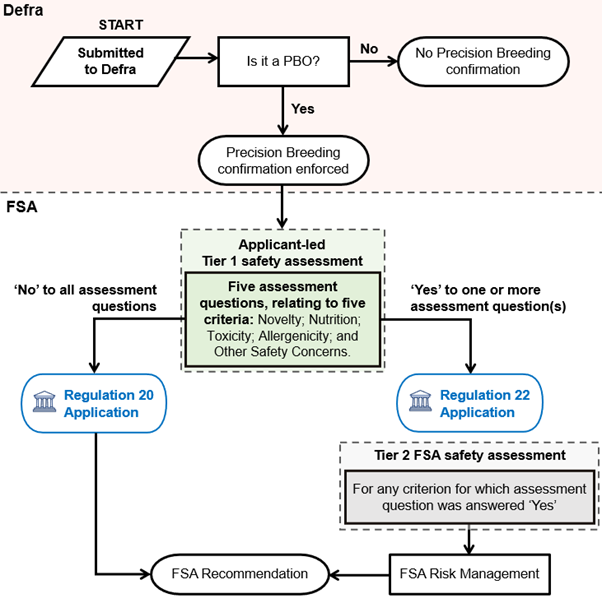
A flowchart providing an overview of the pathways to seek PB food or feed marketing authorisation, starting with the confirmation that an organism is a PBO by Defra Secretary of States. Section 3 of the guidance describes the assessment process. The Tier 1 safety assessment led by the applicant uses five assessment questions relating to Novelty, Nutrition, Toxicity, Allergenicity, and Other Safety Concerns. When all the assessment questions are answered ‘No’, no further safety assessment is required and the applicant submits an application under Regulation 20 for FSA recommendation. Where one or more of the assessment questions is answered ‘Yes’, a Tier 2 safety assessment is required for the corresponding criterion(s) and the applicant submits an application under Regulation 22 which may require additional data or information for assessment by FSA. Risk management will be considered before FSA recommendation of Tier 2 PBOs.
Questions on Tier 1 applicant-led safety assessment
What are substances of interest, how do I identify them, and what is their relevance to the safety assessment of PBOs?
Substances of interest are substances with levels or activity that are predicted to change as a result of the genetic change(s), which are known to have the potential to impact nutrition, toxicity or allergenicity.
Substances of interest are identified during the Tier 1 safety assessment of the PBO phenotype, as outlined in Part 2 and Section 7 of the technical guidance. Substances of interest that are identified to be present in the edible tissues of the PBO must be assessed for their impact on nutrition, toxicity and allergenicity to identify potential food/feed safety concerns.
Focusing the compositional assessment of PBOs on substances of interest enables a targeted, hypothesis-driven approach to safety assessment.
Do I need to identify all substances of interest in the plant, or just those in the edible parts of the plant?
As part of the Tier 1 safety assessment, applicants must identify all substances of interest in the plant, not just those in edible parts, following Section 7 of the technical guidance.
Identifying all substances of interest enables a clear picture of any possible risks to be built, allowing applicants to work out which changes resulting from precision breeding might affect safety or nutritional quality. Subsequent steps then narrow the scope, focusing only on substances of interest present in edible tissues. This ensures that all plausible pathways to harm are considered. It also provides a clear rationale for excluding substances, that whilst changed due to genetic changes made in plant, do not impact food or feed safety or quality.
Will identifying all substances of interest, potentially lead to identifying hundreds of substances of interest?
While a single genetic change can have widespread effects on gene expression or production of substances, altered substances are only of interest if they have potential to impact nutrition, toxicity or allergenicity (Sections 7, 7.5 of technical guidance). Where multiple substances of interest are identified, further consideration is required through the subsequent assessment steps outlined in Sections 7.5/8/12/13/14 of the technical guidance to determine their possible impact on nutrition, toxicity, or allergenicity.
What determines whether a substance of interest is ‘biologically relevant’?
Substances of interest are only biologically relevant if they are identified as being present at a concentration within the ranges that must be ingested for the substance to have a physiological effect on the consumer.
Do I need to conduct compositional analysis of my precision bred plant to identify all substances of interest, that may be biologically relevant?
As described above, each substance of interest in the edible tissues should be considered. However, this information can be inferred from any relevant existing knowledge of the plant (for example, expression data or compositional information) and does not require the applicant to conduct systematic wide ranging compositional tests. In some cases, it will be possible to infer from scientific literature that a substance of interest is not present at biologically relevant levels and does not require further assessment.
Instructions on when compositional data is needed are included in Part 3 of the technical guidance. Part 3, Section 9 outlines sources of evidence that can be used to determine the significance of identified changes in substances of interest, including when proprietary quantitative data can be used.
What is meant by ‘nutritionally disadvantageous’ to the consumer and how does it differ from safety?
Food or feed derived from a PBO is disadvantageous to the consumer if the nutritional quality of the PBO is altered in a way that is detrimental to nutrition of the consumer, taking into account their whole diet. Applicants must assess for nutritional quality as well as allergenic and toxicological safety. For example, increasing vitamin A levels in a PBO may reduce concentrations of other nutrients like vitamin C, iron or zinc; this would be nutritionally disadvantageous if the plant was normally an important source for any of these other substances in the diet. A change like this would not be a safety concern but could be nutritionally disadvantageous.
What is a suitable benchmark reference and what do I do if there isn’t one?
A suitable benchmark reference is a variety or dataset that represents the normal compositional range for the species or trait being assessed. The selected benchmark reference must have a similar role in the diet as the PBO, meaning it is consumed by the same population and provides a similar nutritional benefit. When a suitable benchmark reference from the same species is not available, varieties from the same plant family, or varieties with a same trait from comparable genetic change may be acceptable. Instructions on benchmark references are included in Sections 9.1, 17.2 and 17.3 of the technical guidance. Where further guidance is needed to identify a suitable benchmark reference, applicants may use the Business Support Service to seek advice.
Whilst benchmark references are available for the majority of edible plant species in the UK, there may on occasion be no suitable benchmark references available (for example, when a PBO is a niche crop). In these instances, applicants will need to generate their own compositional data on identified substances of interest in a suitable reference variety to use as benchmarking.
Questions on data requirement for applications
Do I need to provide quantitative data in my Regulation 20 (Tier 1) application as part of a Tier 1 safety assessment?
A summary of the quantitative data used to determine whether the criteria in Regulation 20 have been met, should only be submitted in your Regulation 20 (Tier 1) application, if it is necessary to support your conclusions. This is determined by the nature of the PBO and the genetic change introduced.
For example, an intentional change to a nutrient in a PBO must be quantified to determine significance: If this value is within the ranges found in a suitable benchmark reference, average quantity and standard deviation must be provided in the application to support the statement that the genetic change does not “significantly alter the nutritional quality of the organism as it is being consumed as food or feed at the date of the application in a way that is likely to be disadvantageous to the consumer” (Regulation 20 (1) (c) (i)) (Technical guidance Figure 5, Sections 9.2 and 17.2).
For example: if the purpose of the PBO was to alter vitamin A concentration and the applicant had established it was not nutritionally disadvantageous they would submit something along the lines of ‘the average vitamin A concentration (20mg/g) is within the ranges found within TBO in data set X’.
Applicants could also reference a publicly available benchmark reference, where there are data sets available for a range of crops.
Where changes in composition have no relevance to food or feed (if the substances of interest identified play no role in nutrition, toxicity or allergenicity, or if they are not in edible parts of the plant, or if they are present at concentration that are not physiologically relevant for consumers), compositional evidence is not required.
If there’s no suggestion that an identified substance of interest may impact safety or nutritional quality, is it sufficient to state just that in my application? If not, what evidence do I need to provide?
After completing the safety assessment steps in Section 7 of the technical guidance if no substances of interest are identified in the PBO, or where the body of scientific evidence does not provide a hypothesis for a credible impact of a substance of interest on nutrition, toxicity or allergenicity, no further information is required on the substance.
The Tier 1 safety assessment in Sections 12, 13 or 14 can be completed by providing a statement outlining the rationale and conclusion for each criterion of Regulation 20 in the corresponding section of the application form.
Evidence to support these conclusions can be published data, datasets, scientific knowledge from the literature.
General questions on regulatory process
I’m new to this regulatory process or am unsure how to conduct a safety assessment on my precision bred plant; am I able to seek assistance from the FSA with my application?
Information for applicants including guidance documents for submitting applications can be found here. If after consulting this information questions remain, you can submit these to our new, dedicated business support service for PBO applicants.
Will my Tier 1 safety assessment be checked as part of an application under Regulation 20?
Yes. As required by the regulations, all Regulation 20 (Tier 1) applications will be verified to ensure they contain the information specified in paragraph 1 of Schedule 4. These applications must be sufficiently detailed as required by Regulation 20 (4).
How do I know if a Tier 1 safety assessment is sufficient or an additional Tier 2 safety assessment of my PBO is required?
The technical guidance provides a step-by-step guide for assessing the safety of a PBO prior to seeking a food and feed marketing authorisation. It guides applicants through the Tier 1 safety assessment process to determine whether the criteria in Regulation 20 have been met or not, by identifying traits which could potentially impact safety and nutritional quality. If such traits are present, the tiered approach ensures the PBO(s) is identified as needing a Tier 2 FSA safety assessment. This provides additional assurance, in the form of a bespoke safety assessment and provision of risk management advice by the FSA.
What happens if I apply under Regulation 20 following a Tier 1 safety assessment, but a Tier 2 assessment is actually needed?
If an application is submitted under Regulation 20 (Tier 1), and during verification it is identified that a Regulation 22 (Tier 2) assessment is required, the application will be deemed invalid. The applicant will be advised to resubmit the application under Regulation 22 (Tier 2).
Is one Tier safer than the other?
Authorised PBOs are equally safe irrespective of application route. PBOs are only authorised where scientific evidence demonstrates safety.
In some instances, a Tier 2 assessment may be required to give additional clarity on the safety of a PBO or where risk management considerations are required, however this does not impact the overall safety of an authorised PBO.
How long will it take for decisions to be made on applications for a Regulation 20 (Tier 1) PBO and a Regulation 22 (Tier 2) PBO respectively?
We expect to make recommendations to the Secretary of State on Regulation 20 (Tier 1) applications around two months after receiving a valid application. Regulation 22 (Tier 2) applications will take up to 12-24 months, subject to complexity, once the process is fully established, because they require a bespoke safety assessment based on the information provided in the application. Each application will be assessed on its own merits, meaning some may be completed faster than these indicative timelines, others may take longer.
What should I do if new information relevant to the safety of my PBO comes to light after food and feed marketing authorisation is granted?
If new information comes to light after your PBO has been authorised for use in food and feed, you have a legal obligation under The Regulations to notify the FSA immediately, provide details of the new information, and comply with follow-up actions.
Can I make a parallel application to EFSA?
Currently, an organism that is considered a PBO in England is considered a genetically modified organism (GMO) in the EU, where all organisms produced by genetic technology are captured by assimilated Regulation (EC) No 1829/2003 (framework for genetically modified foods and feeds) in the EU. They will require a different supporting data package for an application to the European Food Safety Authority (EFSA).
How do I obtain advice/ Pre-applicant support?
Organisations intending to apply to the FSA for food and feed marketing authorisation of a PBO can request support through our Precision Breeding Business Support Service (BSS) before submitting their application. Please review the guidance provided on the BSS webpage and complete the accompanying enquiry form.
Hanes diwygio
Published: 25 Chwefror 2025
Diweddarwyd ddiwethaf: 12 Rhagfyr 2025
Hanes diwygio
Published: 25 Chwefror 2025
Diweddarwyd ddiwethaf: 12 Rhagfyr 2025